The Möbius strip is a surface with only one side and one boundary, created by taking a rectangular strip of paper, giving it a half-twist, and joining the ends. It is a classic object in topology, the branch of mathematics that studies properties preserved under continuous deformation. The strip's defining feature is its non-orientability: an ant crawling along the surface will return to its starting point having traversed both 'sides' without ever crossing an edge.
History
The Möbius strip was independently discovered by German mathematicians August Ferdinand Möbius and Johann Benedict Listing in 1858, though it had been known to the ancient Romans as a decorative motif.
How it works
The half-twist connects the two original sides into a single continuous surface. Mathematically, the Möbius strip is a two-dimensionalmanifold that cannot be embedded in three-dimensional space without self-intersection if made of a physical material, but the abstract surface is well-defined. Its boundary is a single closed curve that is twice as long as the original strip.
In practice
Möbius strips are used in conveyor belts to distribute wear evenly, in continuous-loop recording tapes to double playback time, and as models for molecular structures in chemistry.
Fun fact
If you cut a Möbius strip along its center line, you get a single longer loop with two full twists, not two separate strips.
Every winter, hospitals fill up, and by summer they seem to empty. Epidemics breathe like the tide. But why do waves of disease keep rolling in, even without new mutations? Mathematicians found an answer in a tug-of-war between two strains.
Within a single epidemic, two virus variants often coexist.
A vortex in a magnetic material is like a whirlpool, but instead of water, the directions of magnetization twist. An electron flying through such a vortex feels not just a magnetic field, but a curvature of space: its path bends as if it were rolling down a funnel with a narrow neck.
The boundary of a black hole is like the edge of a waterfall: cross it, and there's no way back. But unlike a waterfall, this boundary can be very fragile: a light nudge is enough to make it vanish.
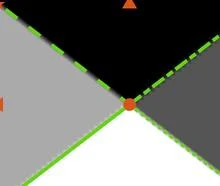
Physicists have found that the horizon's stability is set by an imaginary 'light flow' coming from the past. Invisible streams pierce spacetime.
A quantum particle traveling around a closed ring leaves two distinct 'records' along its path. The first is like a fingerprint on a doorknob: it remains unchanged no matter how many times you turn the knob, and it only tells you about the shape and material.
You can feel an unfamiliar object along its length, across its width, or diagonally: each time gaining new information. But what if one way of feeling tells you absolutely nothing about what another would reveal? That's exactly how mutually unbiased bases work in quantum mechanics: measuring in one of them leaves you completely in the dark about the outcome in another.
A zebra grazes in the African savanna, surrounded by a cloud of flies — horseflies, tsetse flies, and mosquitoes. But instead of landing calmly, the insects jerk, miss their target, and crash into the hide. The reason is not camouflage but the structure of the fly's eye.
The horsefly's eye is a mosaic of thousands of tiny tubes, ommatidia, each pointing in a different direction.
A mathematical doughnut, a torus, sits on the boundary of a three-dimensional world where gravity acts. You can crumple and stretch it, and physicists decided to see how it behaves. Inside this world, space can be flat like a table, expanding like a soap bubble, or curved like a saddle. The doughnut boundary refused to stay smooth.
An invisible film, a quantum field, is stretched over a rubber bagel. While the bagel is small, the film stays taut and doesn't sag anywhere: the vacuum remains empty. But once you stretch the bagel to a certain size, a dent spontaneously appears in the film — the field starts to be felt at every point.
This dent is not random.
A plastic heart rests on the water and doesn't tip over, no matter how you turn it. It freezes in any position, as if the water were holding it by invisible strings. This trick is possible thanks to the Zindler curve — a shape in which all lines that divide the area in half have the same length. The Zindler curve is a closed curve where any chord that bisects the area has the same length.
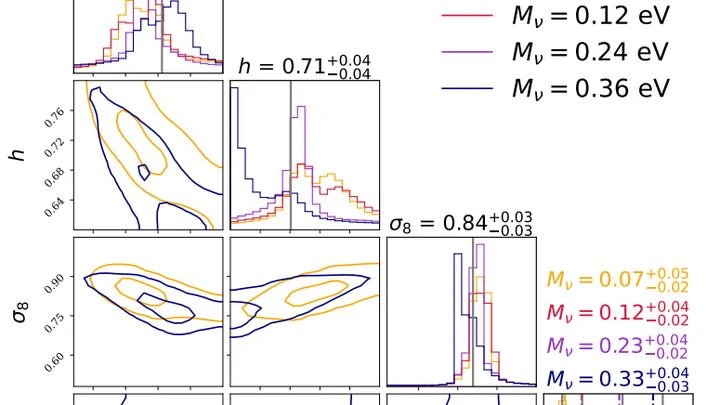
The Universe is a colossal web of invisible dark matter and galaxies, stretched by the expansion of space. Neutrinos, nearly intangible ghost particles, barely cling to the threads, but their collective mass subtly shifts the tension of the entire network.
An octopus tentacle bends, grabs, and stretches — all without a single bone. The secret is that inside it, sections that contract alternate with sections that remain passive. Scientists have long tried to replicate this trick in artificial materials, but until now they couldn't precisely dictate how a material would change shape.
Now researchers have proposed 3D-printing elastic threads from two materials at once.
A microbe with flagella rows through water the way a person rows with their arms. But if a person swims breaststroke, they go forward, while a microbe goes in a spiral. The reason is that a microbe has no single direction: each part of its surface pushes water in its own direction, and the body twists like a corkscrew.
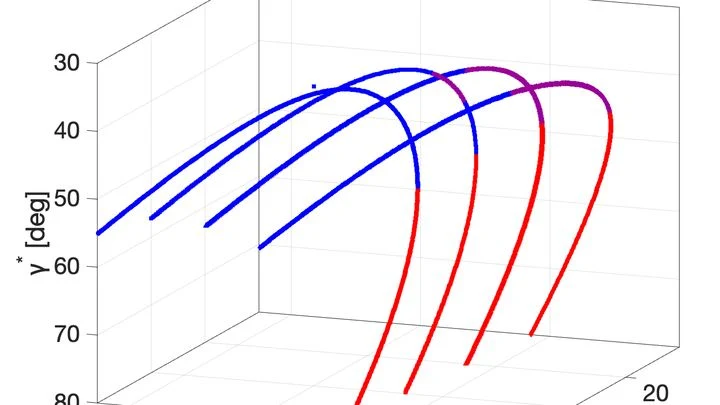
A lizard falling from a branch doesn't just tumble: it catches the air with its body and turns the fall into a glide. Engineers have long borrowed tricks from such feats, but until now there was no common language to compare the gliding of a snake, a lizard, and a man-made wing. The new study introduces such a language: a three-dimensional map of velocities that shows where any motion inevitably ends up.
A wormhole is a tunnel through space, connecting distant regions of the Universe. Its shadow against a bright gas background was long thought to be as round as that of a black hole. But for a rotating wormhole (one you could actually traverse), the shape of the shadow might be surprising: the edge becomes jagged, like a gear.
A neural network originally trained to distinguish real gravitational waves from noise in a gravitational wave detector recognizes bearing wear from vibrations without retraining.
An ordinary insulator conducts no current, neither in its interior nor along its edges. A topological insulator is a different story: it remains insulating inside but conducts electricity without loss along its edges.