The geometric phase, also known as Berry's phase, is a subtle but profound effect in quantum mechanics that appears when a quantum system undergoes a slow, cyclic evolution in its parameter space. Unlike the familiar dynamical phase that depends on the energy and time of evolution, the geometric phase depends only on the path taken in parameter space, not on how fast or slow the journey is. When a magnetic field is involved, it can directly influence this phase, creating observable consequences in interference experiments and the behavior of electrons in solids.
History
The concept was formalized by Michael Berry in 1984, although earlier related ideas appeared in the work of Pancharatnam (1956) in optics and in the Aharonov-Bohm effect (1959). Berry's paper unified these phenomena and showed their deep geometric origin.
How it works
Imagine a quantum state that is slowly carried around a closed loop in some parameter space, such as the direction of a magnetic field or the shape of a potential well. Even if the system returns to its original configuration, the wavefunction acquires an extra phase factor. This phase is 'geometric' because it equals the solid angle subtended by the loop in parameter space, a purely geometrical quantity. In magnetic systems, this phase can be interpreted as a kind of 'magnetic flux' threading the loop, and it modifies interference patterns in ways that reveal the underlying topology of the system.
In practice
Geometric phases are exploited in quantum computing for fault-tolerant qubit manipulations, and in condensed matter physics to explain phenomena like the quantum Hall effect and topological insulators.
Fun fact
The geometric phase is not just a quantum curiosity; it also appears in classical systems, such as the swinging of a pendulum on a slowly rotating platform, where it causes the plane of oscillation to shift by an angle equal to the solid angle traced by the platform's motion.
A vortex in a magnetic material is like a whirlpool, but instead of water, the directions of magnetization twist. An electron flying through such a vortex feels not just a magnetic field, but a curvature of space: its path bends as if it were rolling down a funnel with a narrow neck.
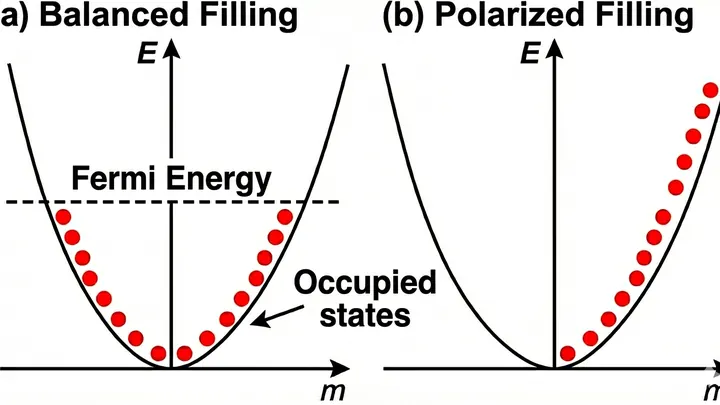
Take two thin sheets of a semiconductor. One is saturated with free electrons, like a packed café where every table is taken. The other, by contrast, is full of empty spots—'holes' eager to be filled. When these sheets are brought close together, a spark of attraction jumps between them: electrons and holes begin to feel each other across the thin gap.
Cut a spin chain, and particles without an energy gap appear at the edges. They are called zero modes, and they live only at the boundary. Previously, they were counted using complex topological invariants, but now there is a simpler way.
For a long time, the event horizon behaved like a cosmic dictator: everything that crossed its boundary vanished irretrievably from our Universe. But quantum mechanics, like a dissident's voice, whispered: information cannot simply disappear.
Toss a handful of phosphorus into silicon, and at a certain impurity concentration the material suddenly starts conducting electricity. This is a metal-insulator phase transition, and it happens abruptly. But what exactly changes in the electron wave functions when an insulator becomes a metal?
An ordinary magnet is like a compass: its needle points north. But a quantum compass can look in both directions at once. If a magnet floating in a vacuum is gently spun, its electron 'tops' synchronize so the whole piece of metal starts living by the rules of the microworld — freezes in a superposition, like a split pointer.
A person hunting for keys mentally runs through places where they might be. A bird that tucked hundreds of seeds into crevices in autumn retrieves them flawlessly in winter. How can a brain hold so many addresses when all birds have roughly the same number of neurons? The answer lies in geometry.
If you carry a cup of coffee slowly and steadily around a room and then return to the same spot, nothing happens to the drink. But in the quantum world, things are different: a particle that makes such a loop comes back not quite the same. It picks up an elusive 'extra'—the geometric phase, which physicists call the Berry phase.
Sunlight hits a silicon wafer, and a current flows in the circuit. That's the familiar work of a solar cell: light knocks out electrons, and a p–n junction (the boundary between two layers with different conductivities) forces them to move in one direction. But in some crystals, current arises differently — without any junctions, purely from the material's internal structure.
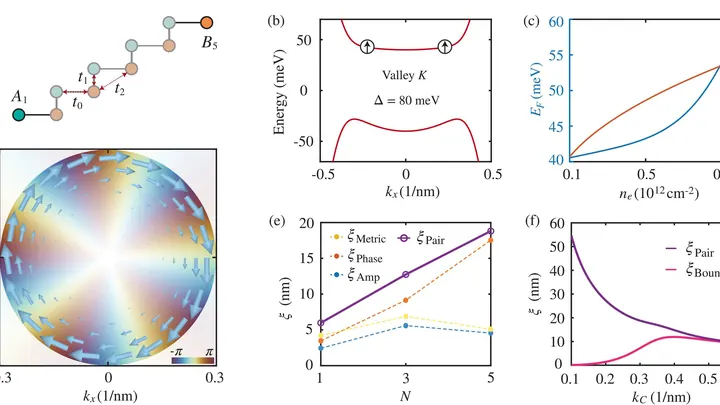
In a superconductor, electrons pair up like dancers holding hands. Usually, the distance between them, the pair size, depends on how fast they move and how strongly they are bound. But sometimes the dance floor almost disappears, and there's nowhere to move. This happens in materials with flat electronic bands: electrons nearly freeze, and the usual rules stop working.
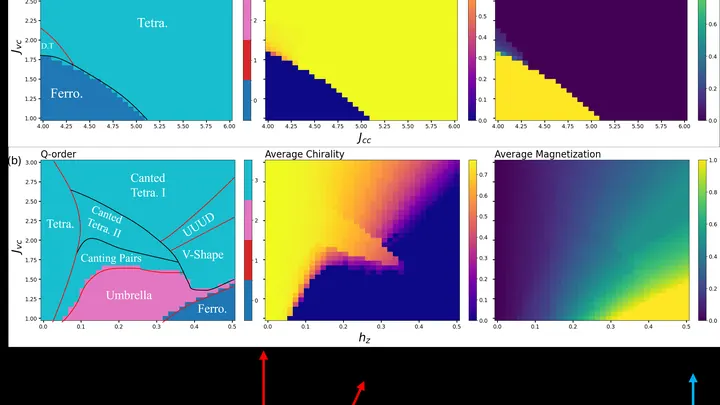
Imagine a triangular grid with tiny magnetic arrows at each node. Electrons, the charge carriers, run across this grid. Usually, the arrows align simply: all pointing the same way (ferromagnet) or alternating in the plane.
A laser beam hits an atom, and an electron is knocked loose. It accelerates, returns, and, crashing into the atom, emits a flash of light — a harmonic. If there are two light beams and they are crossed like an intersection, the electron can choose different routes. In the new experiment, the two beams had comparable strength and were directed at right angles.
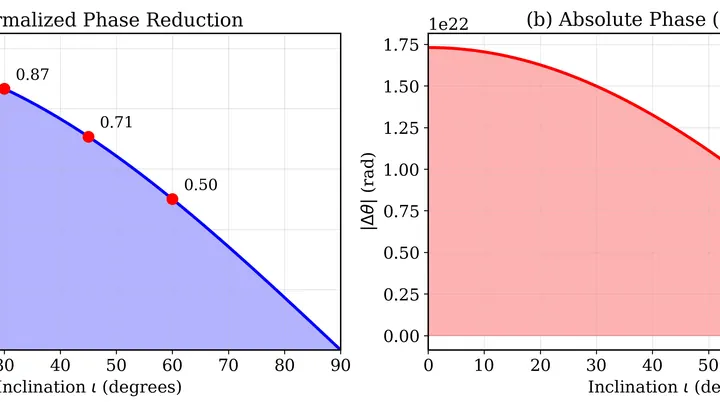
A spinning black hole drags spacetime with it, like a spoon swirling thick honey. This vortex is a manifestation of curved spacetime. But the key point: it can change the quantum rhythm of matter, even where there are no forces.
An electron inside a crystal is like a traveler walking through a city with winding streets. Its direction of motion constantly changes depending on where it is. Physicists call this feature the geometric Berry phase, and it determines how a material conducts electricity or responds to a magnetic field.
Electrons in a conductor behave like a crowd on an escalator: each one moves on its own, but together they create a flow. If you make them circle around a ring, their angular momentum (a measure of rotation) can couple to a magnetic field, like gears in a clock.
A lizard falling from a branch doesn't just tumble: it catches the air with its body and turns the fall into a glide. Engineers have long borrowed tricks from such feats, but until now there was no common language to compare the gliding of a snake, a lizard, and a man-made wing. The new study introduces such a language: a three-dimensional map of velocities that shows where any motion inevitably ends up.
A vortex in a superfluid gas is like a whirlpool in a sink: the fluid swirls around an empty core. If you spin such a vortex three times harder than usual, it won't hold: it breaks into three separate whirlpools, much like a thick stream of water splits into droplets.
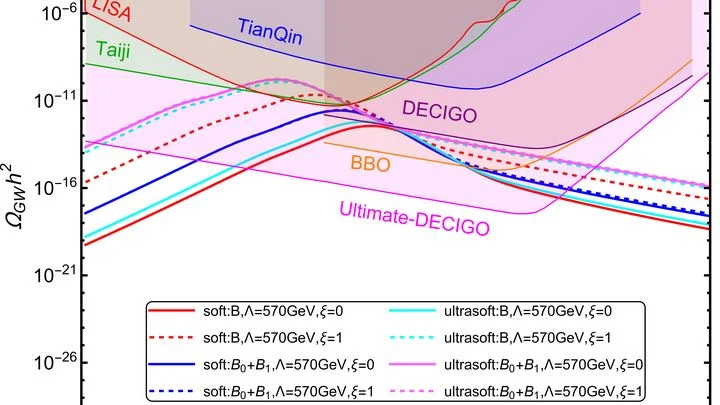
In the infant universe, right after the Big Bang, space was expanding rapidly, and the vacuum resembled a superheated liquid. When 'boiling' began, bubbles of true vacuum emerged. Expanding at the speed of light, they triggered gravitational waves — tremors of space itself that have reached us.