How Two-Headed Comets Are Born express
The icy body Arrokoth looks like a snowman: two spheres pressed together. Many such two-headed objects exist beyond Neptune's orbit, in the Kuiper Belt. For a long time, it was thought they formed from the slow collision of two separate bodies.
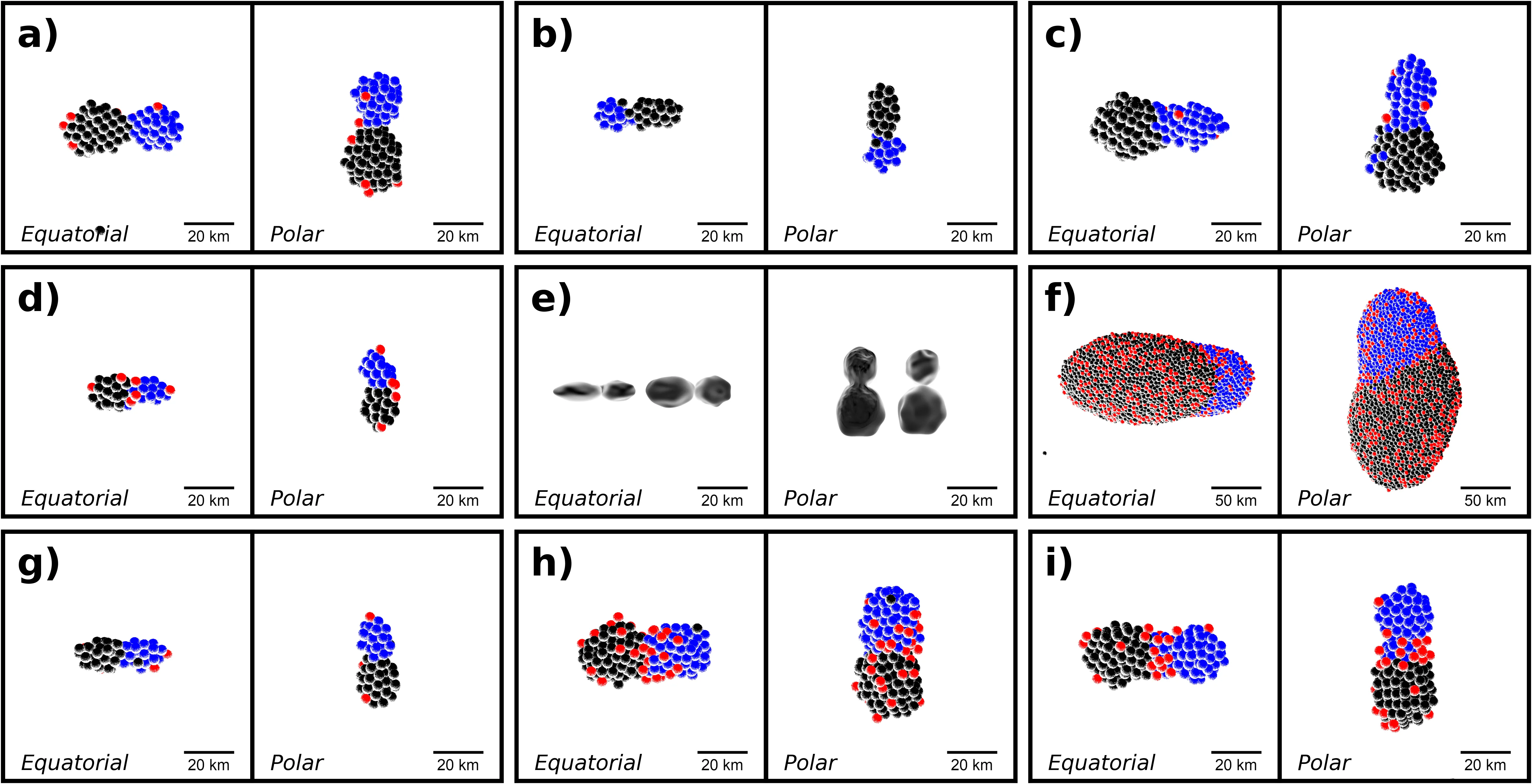
New simulations show a different path. A cloud of small pebbles around the young Sun collapses under its own gravity. The pebbles do not clump into a single sphere but into two adjacent clumps that later merge gently. Thus a snowman is born without any impact.
The calculations reproduce the shape of Arrokoth and other two-headed Kuiper Belt objects. So their appearance is not a coincidence but a record of how the first planetary embryos assembled.
Original abstract
as written by the authors arXiv:2602.16056
Bilobate contact binaries comprise a significant fraction of the relict Kuiper Belt, which includes the exemplary contact binary (486958) Arrokoth. The surfaces of its lobes contain similar amounts of highly volatile chemical species and few craters, indicating formation in a homogeneous and gentle environment. Arrokoth's bilobate shape was initially hypothesized to have formed via the direct gravitational collapse of a pebble cloud in the solar system's protoplanetary disk. However, alternative hypotheses have proposed that Arrokoth may be the result of binary planetesimal formation and the subsequent dynamical evolution of the binary components into contact through external perturbations over long timescales. Here, we show that contact binary planetesimals like Arrokoth can form directly from the gravitational collapse of pebble clouds. We used a soft-sphere discrete element method (SSDEM) to discover that planetesimals form a wide variety of shapes, including bilobate contact binaries. This method creates planetesimals as particle-aggregates with particles resting upon each other's surfaces via mutual surface penetration. The formation of contact binaries in our simulations strengthens the hypothesis that Arrokoth, and perhaps many other contact binaries in the Kuiper Belt, formed directly as bilobate objects from gravitational collapse, and so their shapes and surfaces record the era of planet formation.
The two halves of Arrokoth have nearly identical ice compositions, as if they were made from the same dough.
In Arthur C. Clarke's novel Rendezvous with Rama, the alien spacecraft also has the shape of two joined cylinders.