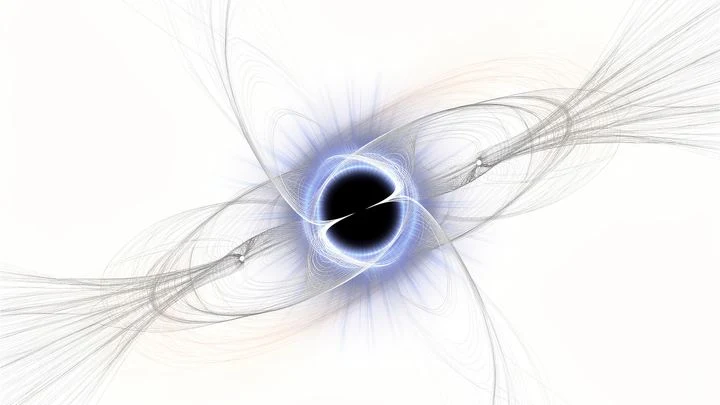
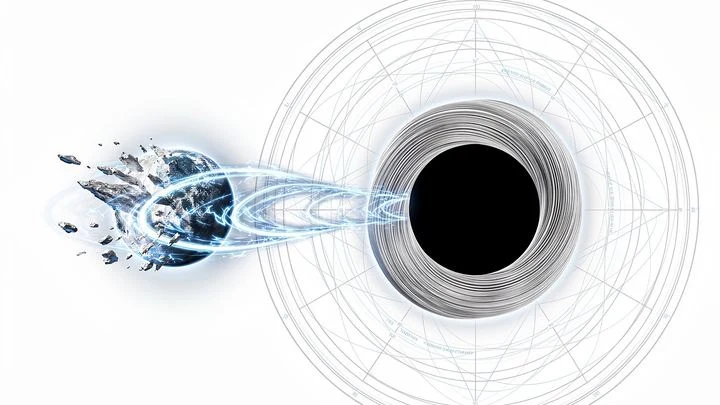
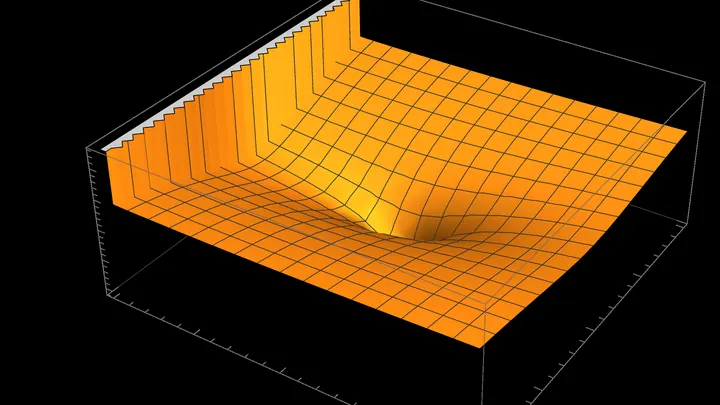
A debris disk is a rotating ring or torus of gas, dust, and rocky fragments that forms when a star or black hole tears apart a planet, asteroid, or other solid body through tidal forces. The material from the destroyed object spreads into an accretion disk, heating up and glowing brightly across many wavelengths, from infrared to X-rays. These disks are key observational signatures of tidal disruption events, providing astronomers with a way to study the composition of exoplanets and the physics of extreme gravity.
History
The concept of tidal disruption and debris disk formation was first theorized in the 1980s by astronomers such as Martin Rees and Jean-Pierre Luminet, who predicted the observable flares from such events. The first confirmed tidal disruption events were observed in the 1990s with X-ray and ultraviolet telescopes.
How it works
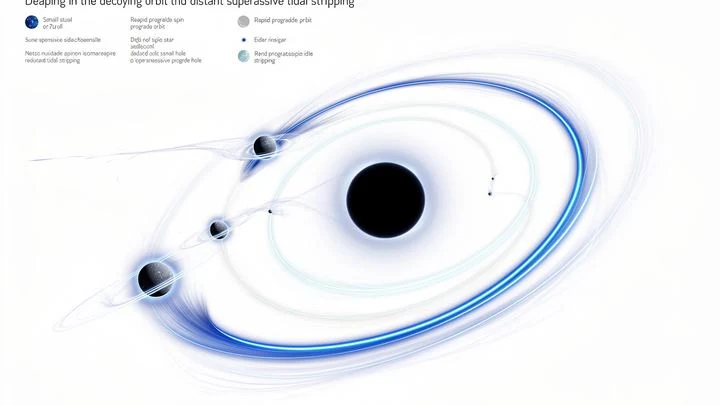
When a body passes within the Roche limit of a compact object, the tidal forces exceed the body's self-gravity, pulling it apart. The resulting debris does not fall straight in; instead, it retains some angular momentum and forms a disk around the central object. Friction and viscous forces within the disk cause the material to spiral inward, releasing gravitational potential energy as heat and light. The disk's emission can persist for months to years, gradually fading as the material is consumed.
In practice
Debris disks are used to infer the existence and composition of exoplanets that have been destroyed, and to study the demographics of planetary systems around other stars. They also serve as natural laboratories for testing models of accretion disk physics and relativistic gravity.
Fun fact
The debris disk from a tidally disrupted planet can sometimes form a temporary ring that resembles Saturn's rings, but on a vastly larger scale, spanning millions of kilometers.
On the surface of the Moon and asteroids, you can find pits smaller than a pinhead but with shiny, melted rims. Such marks are left by tiny meteorites, but the exact impact speed at which melting occurs remained unclear.
A star circles a rotating black hole like a figure skater at the center of a rink. While it is far away and can be treated as a point, the dance remains predictable: the orbit follows clear laws, like music that is easy to glide to. But as it approaches, gravity begins to act unevenly.
A gas disk with a mass of four hundred thousand suns encircles the black hole at the center of the Milky Way. Its gravity works like a gravitational rudder: slowly but inexorably turning the orbits of binary stars, driving them into the region where tidal forces tear the pair apart.
Two neutron stars whirl in a close dance, each feeling the tidal field of its partner. It's like the Moon raising oceans on Earth, but here it's spacetime itself and the star's matter that deform. Astrophysicists call this tidal deformation — a measure of how much an object 'bends' under the gravitational pull of its companion.
In 2008, the Spitzer telescope aimed at the star HD 15407A and detected a strong infrared excess. Fifteen years later, in 2023, JWST repeated the measurements. The light from the dust had dimmed by 14%. But the mineral composition of the dust remained the same, like a fingerprint taken in different years.
A black hole is a place from which nothing can escape. But some theories allow that deep inside, at the quantum level, it might bounce and turn into its opposite — a white hole, which only spews out matter and light.
A group of physicists built a computer model of such a transformation.
Three milliseconds before the merger. A gargantuan black hole spinning at breakneck speed drags in a neutron star — a ball the size of a city but with 1.5 times the Sun's mass. Tidal forces stretch the star into a thread as thin as a needle and fling its matter outward.
A branch falls into a whirlpool. It gets spun and broken, but sometimes a powerful fountain of water bursts from the center. Similarly, a black hole tears apart a passing star, and occasionally a blinding plasma jet, a jet, shoots into space.
When a star ventures too close to a supermassive black hole, a cosmic requiem plays out — a tidal disruption event. Thanks to photometry and spectroscopy, astronomers discern every instrument in this orchestra.
The cosmos is full of screams we can't hear. Every time a black hole tears a star apart, a blinding flash is born, and often — a narrow relativistic jet, shooting out thousands of light-years. But if that searchlight is aimed away from Earth, we see only a faint afterglow — a radio echo arriving with a delay.
Around some young stars where star formation has recently ended, there swirl not just dust rings but actual planetary battlefields — extreme debris disks.
Deep space, galactic center. A supermassive black hole is surrounded by a scorching disk of gas and dust. And then, through this fiery veil, a star shoots by every few hours — like an arrow loosed from the bow of gravity. Each passage triggers a dazzling X-ray flare that for a moment outshines the entire galactic nucleus.
In the centers of distant galaxies, X-ray 'beacons' sometimes light up. They don't flash randomly but on a strict schedule: every few hours or days. These bursts are called quasi-periodic eruptions (repeating at nearly regular intervals).
When a piano falls into an abyss, we think about the abyss. We don't think about the piano's cover. In much the same way, astrophysicists have for decades studied extreme close encounters between small bodies and massive black holes. They focused on the black hole itself and what orbits it. But what the 'bullet'—the small object heading toward doom — is wearing, almost no one asked.
A blob of cold helium swoops dangerously close to a black hole. But this isn't just a blob: it's a dead star the size of Earth, yet with a mass comparable to the Sun's.
In the accretion disks that gird the nuclei of active galaxies (quasars, discovered by Maarten Schmidt way back in the 1960s) a river of incandescent gas and dust churns. In its backwaters, where turbulent flows subside, against all odds, planets are born.
When a telescope catches the light of a distant white dwarf, the spectrograph sometimes fishes out heavy elements — calcium, iron, magnesium. These metals could not have stayed in the thin atmosphere of the stellar remnant; they are the traces of recently fallen planetary debris.
In the centers of galaxies, where supermassive black holes lie dormant surrounded by stellar swarms, lights of monstrous power sometimes flare up — tidal disruption events. But some of these events behave oddly: they repeat again and again, and each new ignition is dimmer than the last.
Among the icy chunks hurtling through the void, there are special travelers — interstellar comets. They were born around distant stars and happened to wander into our neighborhood. One of them, 3I/ATLAS, came under the gaze of telescopes as it approached the Sun. Its material, frozen gases and refractory dust, began to evaporate, leaving a glowing tail behind.
A bonfire that no one sees, but everyone feels the warmth: that's how astronomers found a flare in a distant galaxy. Not by its light, but by the infrared radiation of heated dust. The galaxy SDSS J010320.39+140152.5 caught attention when its center suddenly blazed in the infrared, as if someone had thrown logs onto an invisible fire.
A black hole rips apart a star, and we see a dazzling flare. Then, a couple of years later, when everyone has forgotten about it, radio telescopes suddenly pick up a new signal, like an echo from the past.
A giant black hole tore apart a star, leaving behind a lopsided disk of scorching gas — like a vinyl record warped by the heat. Now a tiny black hole (or a star) zips around and repeatedly pierces that disk. Each puncture is a bright X-ray flare.
A black hole is not just a dark sphere in space. If there is gas and dust nearby, they swirl into a flat, glowing disk that gradually falls inward. This disk acts like a lamp, illuminating the hole itself, and against the bright background you can see its shadow — a dark silhouette with sharp edges.
But what if the disk is not flat but torn into pieces?
Two stars orbit a common center, accreting gas from a surrounding cloud. Rotating disks of gas form around each star and around the pair as a whole. From these disks, jets shoot out like hoses. Inside the disks, gas is constantly churned — that's the magnetorotational instability at work.
At night, a distant streetlamp seems motionless, but if you walk closer and look carefully, you might notice it swaying slightly in the wind. That's roughly how astronomers hunt for planets around other stars: they measure how a star shifts ever so slightly under the gravitational tug of its invisible companions.
The young star HL Tau is surrounded by a disk of gas and dust — the cradle of future planets. Inside this disk, the gas is not static: it orbits the star, but it also trembles and churns, like water in a raging river. Astronomers have now directly measured the strength of this churning for the first time.
A black hole can torment a star for years, rather than rip it apart immediately. Tidal forces are when the hole's gravity stretches the star: the near side is pulled harder than the far side. Usually, getting too close rips the star apart instantly — that's a tidal disruption event.
Not all water in a whirlpool goes down the drain: some splashes back up in narrow sprays. Gas near a black hole behaves similarly. It falls, heats up, collides with itself, and part of it is ejected back into space in two narrow jets that fly in opposite directions.
On a deserted road at night, a streetlight flickers rarely but at full power. That's how WZ Sge-type stars behave: they smolder barely noticeably for years, then suddenly flare hundreds of times brighter. Astronomers decided to check what happens in their gas disks during quiescence, and found almost emptiness.
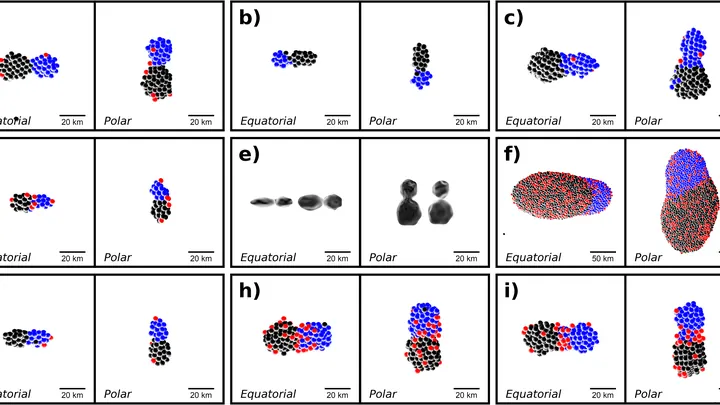
The icy body Arrokoth looks like a snowman: two spheres pressed together. Many such two-headed objects exist beyond Neptune's orbit, in the Kuiper Belt. For a long time, it was thought they formed from the slow collision of two separate bodies.
New simulations show a different path. A cloud of small pebbles around the young Sun collapses under its own gravity.
The center of a galaxy is a bustling metropolis where a giant black hole often snatches inattentive stars. But telescopes caught a flare in a quiet suburb, tens of thousands of light-years from the core. This gave away a wandering black hole — an invisible predator, flung out of the center after an ancient galaxy collision.
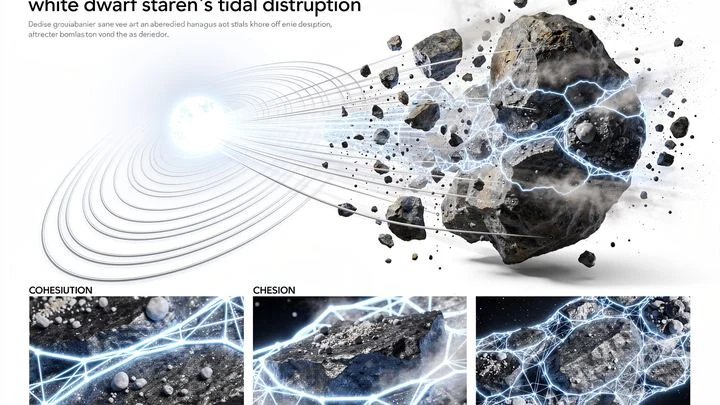
When a planet approaches its star to a critical distance, tidal forces, the result of a sharp gradient in gravity between the near and far sides of the celestial body, tear it apart. This process ignites a cosmic funeral pyre: the planet's debris forms a glowing accretion disk around the star.
An ordinary lump of coal left under the blazing sun just heats up. But if you take it into space and bring it twenty times closer to the Sun than Earth is, it won't survive for more than a few minutes. That's roughly how dark, carbon-rich asteroids behave. They are rarely found on orbits that dive deep inside Mercury's orbit.
Cosmic neutrinos are ghost particles, passing freely through the Earth. The IceCube telescope in the ice of Antarctica once caught such a neutrino, and it matched an infrared flare. That flare turned out to be the moment a black hole tore a star apart in a distant galaxy.
The young binary star IRS 44 in the constellation Ophiuchus resembles a bustling kitchen: streams of gas, like jets of dough, fall onto a rotating disk, and where they strike, heat is born.
When a star wanders too close to a black hole, an object with gravity so intense that not even light can escape, tidal forces shred it like dough caught in a mixer's beaters. This event, known as a tidal disruption event (TDE), unleashes a powerful flare of radiation.
Vortons are invisible cosmic hoops, closed loops of curved spacetime. Thinner than an atom but heavier than stars, these Big Bang relics spin like giant carousels, churning everything around them. Einstein's equations describe how particles dance near such a hoop: paths twist into spirals or dart chaotically.
The Universe is filled with invisible mass, dark matter, which reveals itself only through gravity. One hypothesis suggests that dark matter consists of primordial black holes — objects formed in the extreme conditions just after the Big Bang.
Four hours and fifty-eight minutes. With a rhythm like a metronome, something passes in front of the white dwarf ZTF J1944+4557, dimming its light by a third, sometimes almost by half.
A radio telescope catches a signal lasting a few milliseconds, and in that instant, energy comparable to what the Sun emits over days is released. This is a fast radio burst, a millisecond radio pulse from a distant galaxy. Since their discovery in 2007, astrophysicists have debated what causes them.