Free-floating planets are not gravitationally bound to any star. Their discovery was made possible by two methods: direct observation in the infrared if the planet is young and hot, and gravitational microlensing — when the planet focuses the light of a background star into a characteristic symmetric brightness spike. The light curve conveys information about mass and distance, and the absence of repeated events indicates its isolation.
History
The first candidates were substellar-mass objects in the Orion cluster, recorded in deep infrared surveys in the late 1990s – early 2000s. A key breakthrough came from gravitational microlensing experiments (OGLE, MOA) starting in the 2000s, revealing many short, star-unassociated lensing events. In 2011, a statistically significant population of invisible planetary masses in the Galaxy was announced.
How it works
The main detection method is gravitational microlensing. When a planet passes near the line of sight to a background star, its gravitational field, according to general relativity, curves spacetime and focuses light, creating two images that are individually unresolved but produce a spike in total brightness. The characteristic angular scale is the Einstein radius: θ_E = √((4GM)/(c²) · (D_ls)/(D_l D_s)), where M is the lens mass, D_l, D_s, D_ls are distances (observer–lens, observer–source, lens–source). The event duration t_E = θ_E/μ_rel, where μ_rel is the relative proper motion, is limited to a few hours for Earth-mass planets. Free-floating planets produce simple, symmetric curves without additional caustics, distinguishing them from lensing campaigns for exoplanets in bound systems.
In practice
Revising theories of planetary system formation and estimating the population of potentially habitable worlds hidden in interstellar space.
Fun fact
According to one estimate, there could be up to 20 billion free-floating planets in the Milky Way — more than stars — and some of them can hold onto moons.
2,41 hours. That's exactly how long a day lasts on SIMP 0136 — a lonely planet-like object 6,1 parsecs away. That's twice as far as Proxima Centauri. Its mass ranges from 12,7 to 17,8 Jupiter masses, placing it on the boundary between planet and star.
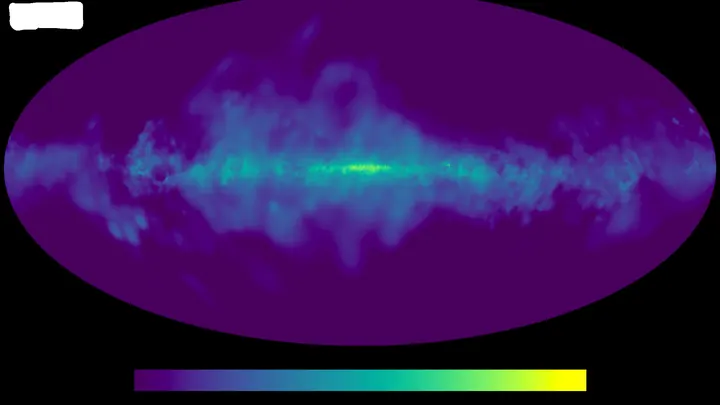
Two hundred million stars. In the heart of the Galaxy, where the future survey by the Nancy Grace Roman telescope will aim, about 250 times during its mission the light of one of them will flicker at an invisible touch.
Every 165 days, the giant planet dives toward its star, nearly grazing its fiery corona, then flies off into the icy void. This is TIC 241249530 b — an exoplanet with a record eccentricity of 0,94.
A quarter-century ago, Michel Mayor and Didier Queloz discovered the first hot Jupiter, and shattered all the rules of planet formation. A gas giant on a days-long orbit couldn't have formed next to the star: it's far too hot and lacks building material. So, it must have been born far away and then migrated.
In the Galactic bulge, where the light of billions of stars merges into a continuous glow, four cold giants passed unnoticed. You can't see them through a telescope — too far, too dim.
Like an exquisite clockwork mechanism, a multi-planet system responds sensitively to the slightest nudge. And when the star at the heart of this mechanism dies, shedding its envelope and turning into a white dwarf, even a modest kick at a speed of 0.75 km/s can trigger a cascade of events, flinging entire worlds into interstellar emptiness.
The light of a distant star is no perfect beacon. Passing through the gravitational field of another star, it bends, splits, and magnifies, creating a fleeting Einstein ring in the sky. This is how gravitational microlensing manifests, predicted by Fritz Zwicky back in the 1930s.
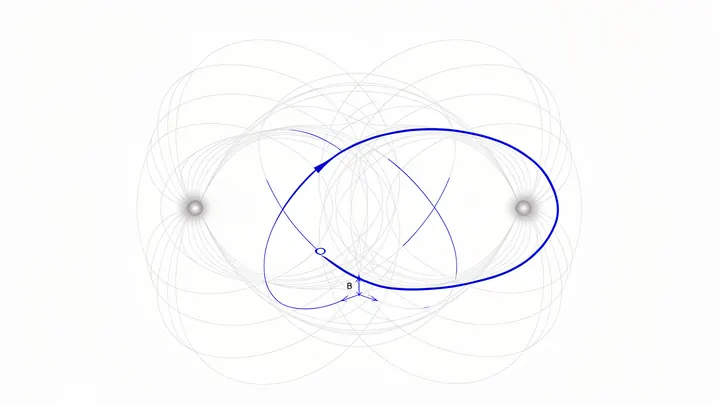
The three-body problem is the eternal stumbling block of celestial mechanics. Even Poincaré realized in the late 19th century that its chaos defies general analytical solutions. In this gravitational madness, islands of regularity appear only rarely — periodic orbits.
A pebble drops into a night lake, and ripples spread across the water. You can't see the pebble itself, but the ripples give it away. Astronomers use a similar trick when hunting for dark bodies in space: these objects betray themselves by the way they warp the light of distant stars.
The cosmic accounting has hit a snag. The bookkeeper is balancing the books: in one column, all the planets astronomers have counted in the galaxy; in the other, the stockpile of building material in the dusty cocoons of newborn stars. The numbers don't line up. Even if you gathered every last grain of dust and molded it into planets, there wouldn't be enough material.
A streetlamp flickers as someone walks past. That's roughly how our nearest star, Proxima Centauri, behaves: it flares in response to the motion of its planets.
Astronomers observed the star with a highly sensitive instrument, the ESPRESSO spectrograph. It captures light and splits it into colors, much like a prism.
In 2015, the LIGO detectors caught the first burst of gravitational waves — astronomers heard two black holes colliding far out in space. That ripple in spacetime reached us with its signal shape intact: like the sound of a bell traveling billions of years without distortion.
At night, a distant streetlamp seems motionless, but if you walk closer and look carefully, you might notice it swaying slightly in the wind. That's roughly how astronomers hunt for planets around other stars: they measure how a star shifts ever so slightly under the gravitational tug of its invisible companions.
The galaxy Holmberg IX is like a city where construction of new houses suddenly stopped, even though building materials are everywhere. Astronomers peered into it with various telescopes and saw a strange picture: plenty of gas and heavy elements, but almost no dust. Usually, where there's gas, new stars are born, but here it's different.
The Kepler telescope spent years watching thousands of stars, spotting planets by the tiny dips in starlight when a planet passes in front of its star. Such a passage, or transit, lets us measure the planet's size but not the shape of its path.
In the constellation Cetus, 65 million light-years from Earth, three dwarf galaxies nestle: DF2, DF4, and DF9. All have been declared “galaxies without dark matter” — the mysterious invisible substance that usually holds stars together.
The icy body Arrokoth looks like a snowman: two spheres pressed together. Many such two-headed objects exist beyond Neptune's orbit, in the Kuiper Belt. For a long time, it was thought they formed from the slow collision of two separate bodies.
New simulations show a different path. A cloud of small pebbles around the young Sun collapses under its own gravity.
The Kepler telescope William Borucki's caught the faint twinkling of distant stars and discovered thousands of planets around other suns. Among them gapes a gap: almost no worlds sized between rocky balls and puffy water giants.
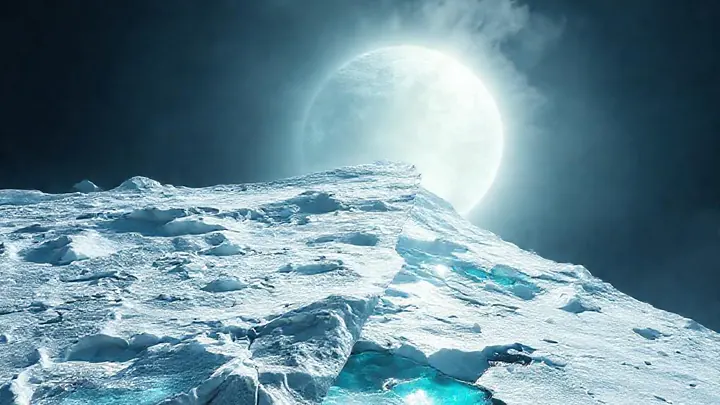
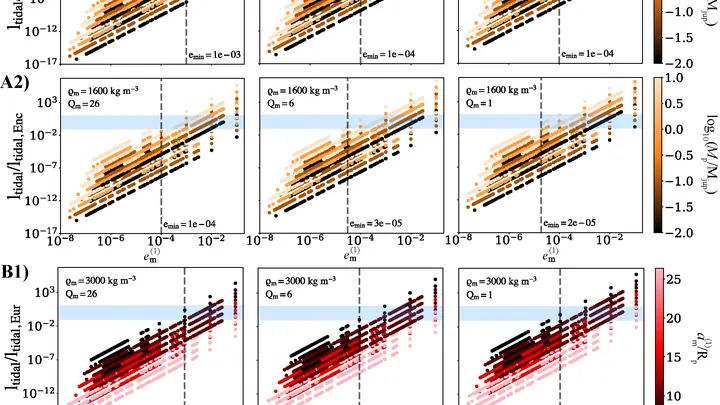
Rogue planets, ejected from star systems, may harbor life on their moons. A moon of such a planet can preserve heat and liquid water for billions of years. The whole secret lies in a reliable "blanket" and an internal "stove."
The stove is tidal forces: they squeeze and stretch the moon's interior, heating it up like kneading clay.
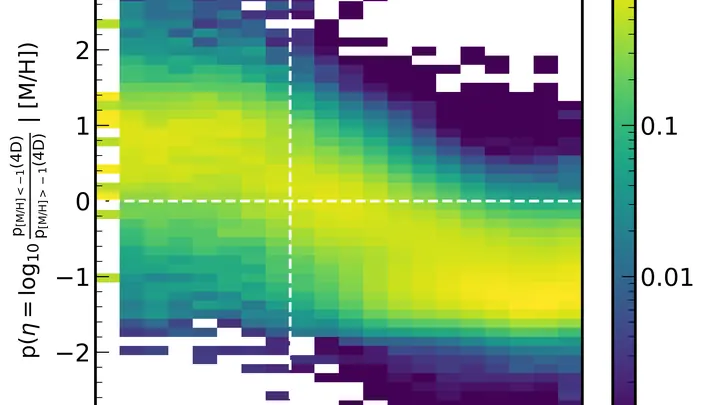
The galaxy's kitchen has a recipe for stellar soup. The main ingredient is hydrogen, but the flavor depends on a pinch of metals. Astronomers have now peered into the pots where that pinch is almost absent, and found that the smallest stars are missing.
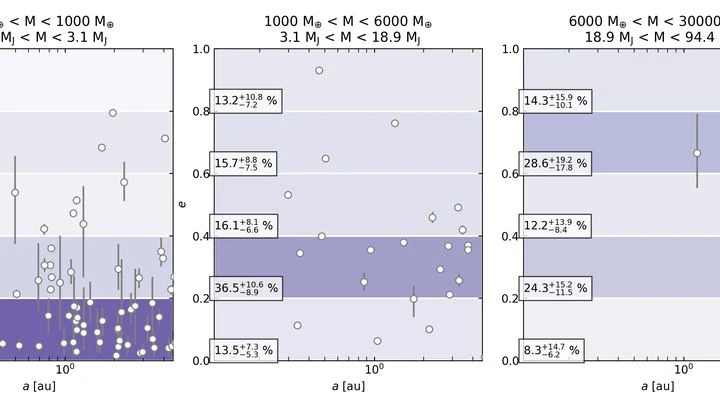
A planet's orbit is its path around its star. If the path is perfectly circular, the planet always stays at the same distance from the star. But many planets have slightly stretched paths, like a running track in a stadium. Astronomers studied hundreds of giant planets around other stars and found a curious pattern.
Jupiter is a colossal ball of gas that sits five times farther from the Sun than Earth. Now imagine a similar ball, but around another star, at a distance tens of times greater. These are called cold Jupiters, and they remain a puzzle: how did they get there?
Astronomers studied four such planets around distant stars.
Three distant giant planets circle their stars so closely that a year on them lasts just a few Earth days. These worlds are called hot Jupiters, and their orbits are a real puzzle: how did they end up right next to the star if they were born far away, in the cold outskirts of the system? One key clue is the angle at which a planet orbits relative to the star's rotation.
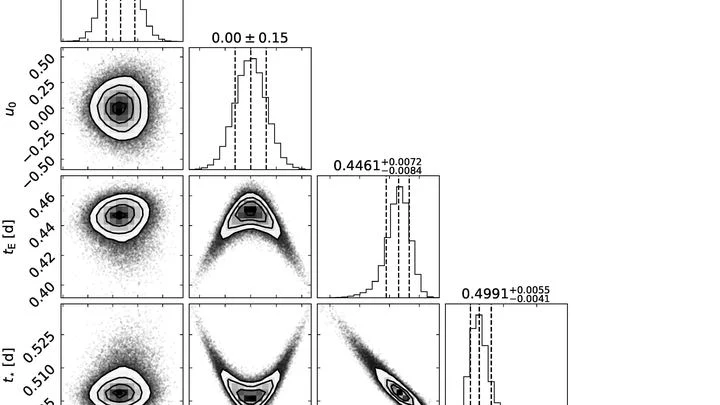
One night, a star at the edge of the sky suddenly flickered and brightened for a few days. It wasn't a supernova, and no cloud passed by — an invisible planet drifted between the star and Earth. Its gravity bent the light of the distant star like a pair of glasses focusing a sunbeam.
Space works like a billiard table. Massive outer planets, like heavy balls, transfer their energy to light inner worlds. Such a gravitational kick can fling a small planet out of the stellar system. It turns into a free-floating wanderer — a rogue exoplanet without a star.
Detecting these invisible bodies is hard: they neither emit nor reflect light.
Space works like a billiard table. Massive outer planets, like heavy balls, transfer their energy to light inner worlds. Such a gravitational kick can fling a small planet out of the stellar system. It turns into a free-floating wanderer — a rogue exoplanet without a star.
Detecting these invisible bodies is hard: they neither emit nor reflect light.
The lone planet KMT-2024-BLG-0816, one of many free-floating planets, was discovered when its gravity acted like a magnifying glass for a few hours. Passing in front of a distant star, the invisible body warped space like a glass marble, and boosted the background light.
The lone planet KMT-2024-BLG-0816, one of many free-floating planets, was discovered when its gravity acted like a magnifying glass for a few hours. Passing in front of a distant star, the invisible body warped space like a glass marble, and boosted the background light.
In the darkness of interstellar space drift millions of rogue planets — worlds not bound to any star. They are almost impossible to see, but when such a wanderer passes in front of a distant star, its gravity bends the light and momentarily creates a cosmic magnifying glass.
The planet's gravity rhythmically squeezes and kneads the moon like dough: from this constant 'kneading', the interior heats up, and oceans of water can persist under the icy crust for ages.
In the Galaxy, there are plenty of rogue planets, thrown out by supernova explosions.
At the center of the Milky Way, a giant stellar cauldron boils. Massive stars are born and die there: each death is a supernova explosion, hurling clouds of charged particles into space.