The Burst That Wouldn't Fade express
On the night of August 18, 2025, the SVOM space telescope detected a short gamma-ray burst — a powerful flash of energy lasting less than two seconds. Such bursts are usually linked to mergers of neutron stars, the ultra-dense remnants of dead stars. The ground-based GOTO telescope in Australia found optical emission in the same patch of sky just minutes later.
Further observations at different wavelengths revealed an unusual picture. The afterglow, the light that lingers after the initial blast, was brighter than that of most short gamma-ray bursts. What's more, it didn't fade following the standard scenario. Modeling showed that the shock wave keeps receiving extra energy, as if someone were adding fuel to an already blazing fire.
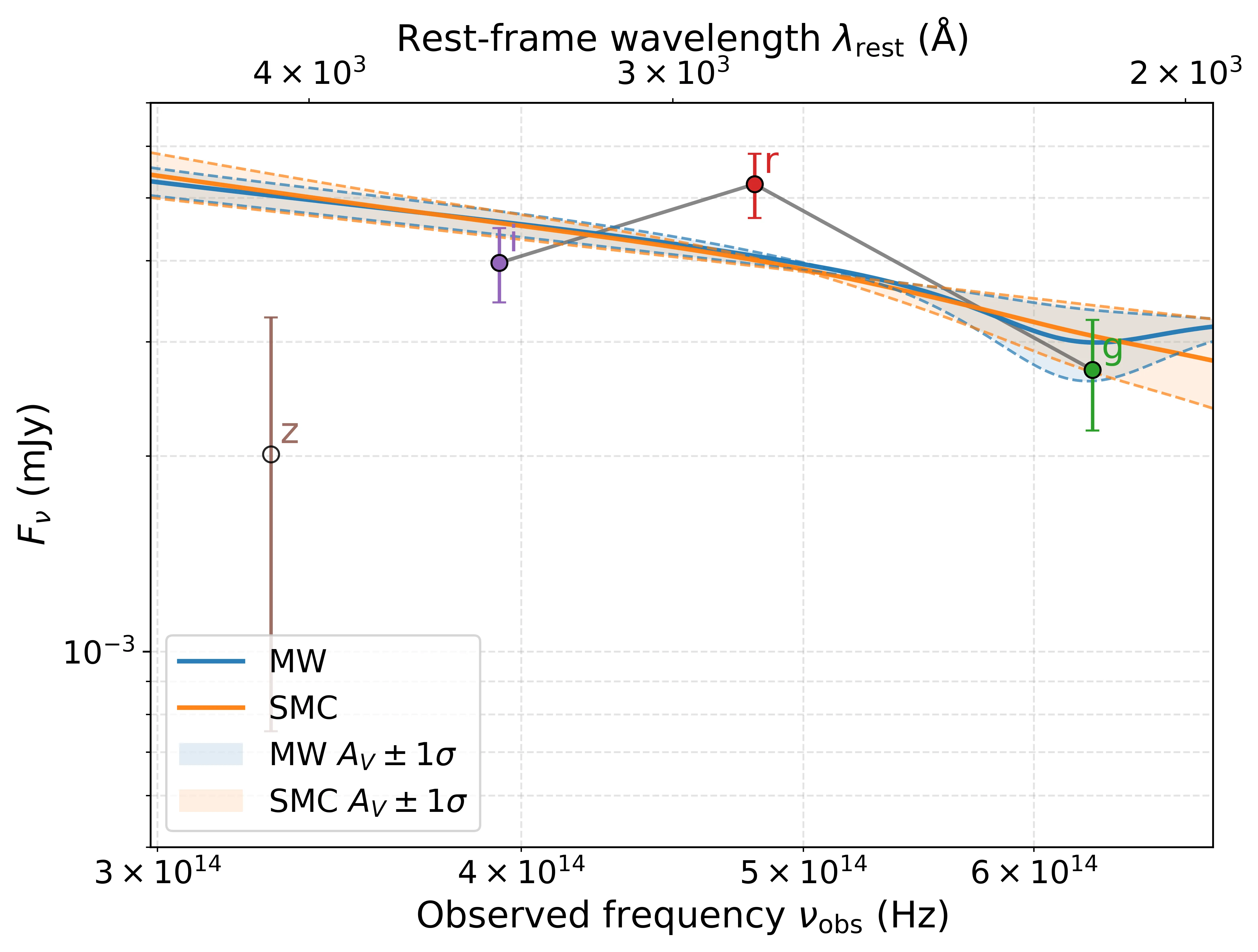
Spectroscopy with the Keck telescope revealed absorption lines of iron and magnesium, allowing a precise redshift of z=1.216. However, the burst's host galaxy remains elusive: the nearest candidate sits about 34 kiloparsecs from the explosion site, too far for a confident association. Perhaps the galaxy is simply too faint to be seen.
This finding highlights the importance of rapidly pointing telescopes at short gamma-ray bursts. Each such event is a chance to understand what happens when neutron stars merge and how the most powerful explosions in the universe are born.
Original abstract
as written by the authors arXiv:2602.16559
Rapid localisation and follow-up of gamma-ray bursts (GRBs) increasingly rely on low-latency triggers from new missions coupled to wide-field robotic optical facilities. We present the discovery and multi-wavelength follow-up of GRB 250818B, detected by the Space Variable Objects Monitor (SVOM) and localised optically by the Gravitational-wave Optical Transient Observer (GOTO). We compile and homogenise X-ray, optical/NIR, and radio data to build broadband light curves and spectral energy distributions. The afterglow is unusually luminous for a nominal short GRB, lying on the bright end of the short-GRB population in X-rays and optical and among the most luminous high-redshift short-GRB afterglows in the radio. MeerKAT detects the source at 3.1 GHz, while ALMA provides deep higher-frequency limits. Keck/LRIS spectroscopy shows continuum and metal absorption (Fe II, Mg II, Mg I), giving $$z=1.216$$. Synchrotron forward-shock modelling favours a constant-density medium and strongly prefers refreshed (energy-injection) emission, well described by a two-component jet with $$E_{K,iso} \sim 4\times10^{52}$$ erg, $$n_0 \sim 3.6$$ cm$$^{-3}$$, $$\theta_j \simeq 0.10$$ rad ($$\sim 5.7$$ deg), and $$p \simeq 1.64$$. The host association is ambiguous: the nearest LS DR10 galaxy candidate ($$r_{AB} \sim 24.7$$) is offset by $$\sim 4$$ arcsec ($$\sim 34$$ kpc) with chance-alignment probability $$P_{cc} \sim 0.2$$, and current imaging does not exclude a fainter, near-coincident host. SED fitting of the candidate host suggests a low-mass galaxy. GRB 250818B highlights the power of rapid wide-field counterpart identification in the SVOM era, while host-association uncertainty can still limit offset-based interpretation.
Gamma-ray burst GRB 250818B is so distant that its light began its journey when the universe was just 4.5 billion years old — before the Sun even existed.