The Burst That Wouldn't Fade express
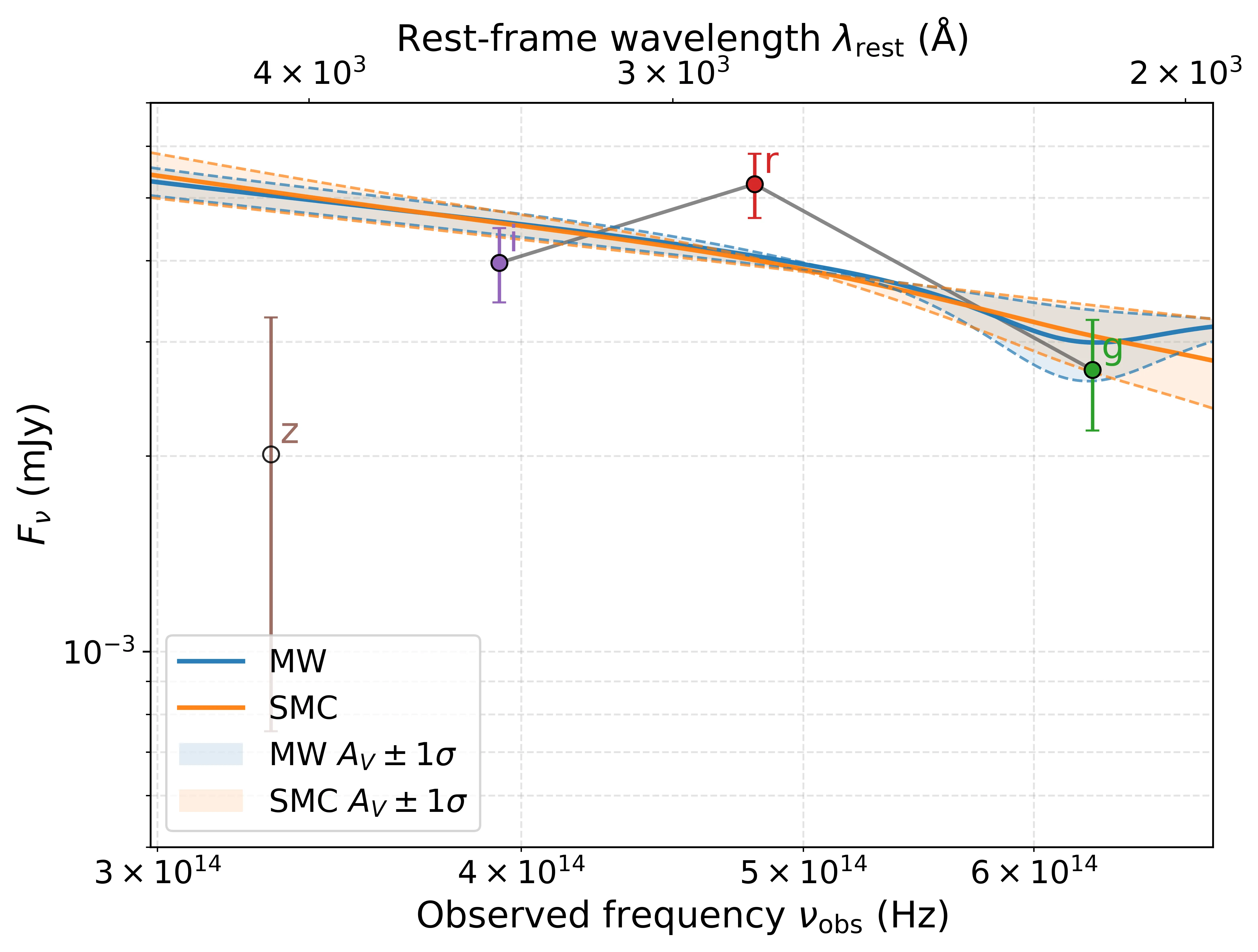
On the night of August 18, 2025, the SVOM space telescope detected a short gamma-ray burst — a powerful flash of energy lasting less than two seconds. Such bursts are usually linked to mergers of neutron stars, the ultra-dense remnants of dead stars. The ground-based GOTO telescope in Australia found optical emission in the same patch of sky just minutes later.
Further observations at different wavelengths revealed an unusual picture. The afterglow, the light that lingers after the initial blast, was brighter than that of most short gamma-ray bursts. What's more, it didn't fade following the standard scenario. Modeling showed that the shock wave keeps receiving extra energy, as if someone were adding fuel to an already blazing fire.
Spectroscopy with the Keck telescope revealed absorption lines of iron and magnesium, allowing a precise redshift of z=1.216. However, the burst's host galaxy remains elusive: the nearest candidate sits about 34 kiloparsecs from the explosion site, too far for a confident association. Perhaps the galaxy is simply too faint to be seen.
This finding highlights the importance of rapidly pointing telescopes at short gamma-ray bursts. Each such event is a chance to understand what happens when neutron stars merge and how the most powerful explosions in the universe are born.
Gamma-ray burst GRB 250818B is so distant that its light began its journey when the universe was just 4.5 billion years old — before the Sun even existed.