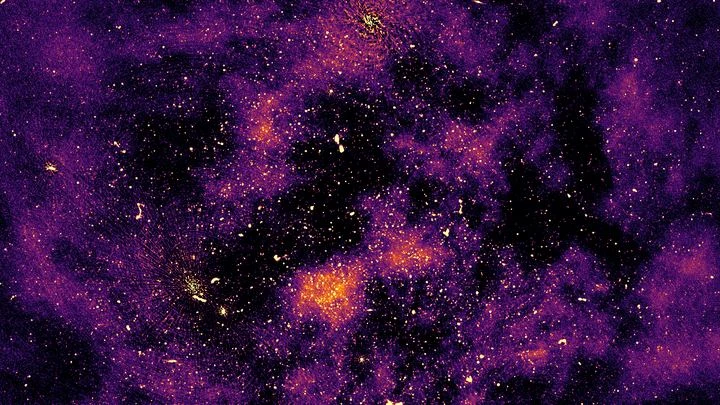
The Green Bank Telescope (GBT) is a fully steerable radio telescope located in the National Radio Quiet Zone in West Virginia, USA. With a 100-meter diameter dish, it is the largest fully steerable radio telescope in the world, allowing it to observe a wide portion of the sky with high sensitivity. It operates at frequencies from 0.1 to 116 GHz, covering a broad range of radio wavelengths.
History
The GBT was completed in 2000, replacing the previous 300-foot telescope that collapsed in 1988. It was built by the National Radio AstronomyObservatory (NRAO) and has since become a key facility for radio astronomy.
How it works
The GBT uses a parabolic reflector to collect radio waves from celestial sources and focus them onto receivers. Its steerable design allows astronomers to track objects across the sky, while its active surface adjusts the mirror panels to maintain accuracy at different elevations. The telescope's location in a radio quiet zone minimizes interference from human-made signals, enabling detection of faint cosmic emissions.
In practice
The GBT is used for studying pulsars, molecular clouds, galaxies, and transient phenomena, and it also participates in searches for technosignatures from extraterrestrial civilizations.
Fun fact
The GBT's dish is so large that it could cover a football field, and its surface accuracy is maintained to within a fraction of a millimeter.
A radio telescope, like a sensitive ear, picks up the whispers of distant galaxies. Hidden among that noise are giants — giant radio sources. These are clouds of charged particles ejected from the vicinity of supermassive black holes.
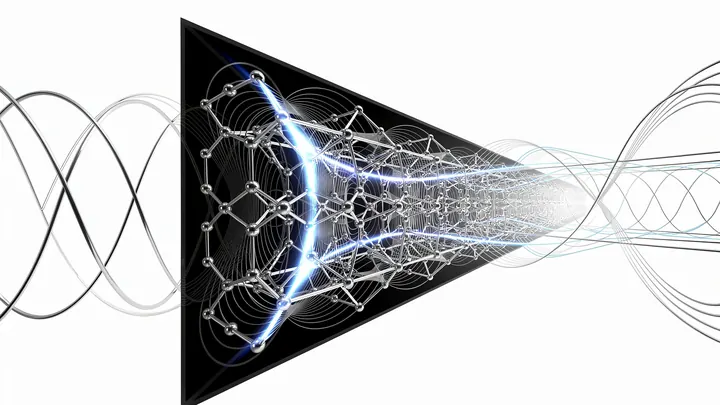
In a dark room, a whisper is barely audible. To make out the words, you need to get close, or set up many sensitive microphones. That's roughly the reasoning behind the new work: the authors place quantum "ears" right inside a resonator, where a high-frequency gravitational wave turns into an electromagnetic echo.
Betelgeuse, the red supergiant familiar from Orion's shoulder, keeps surprising us. After the mysterious Great Dimming of 2019–2020, when the star suddenly dimmed, it didn't just recover; it changed its ways.
Radio astronomy began with the mysterious noise caught by the antenna of Karl Jansky and the rhythmic pulses that Jocelyn Bell Burnell playfully called 'little green men'.
The Universe is humming, but our ears catch only the bass. LIGO hears the rumble of black hole mergers — the infrasound of space. Higher up, in the gigahertz range, the flutes and violins of primordial gravity ring out.
The black hole in GRS 1915+105 behaves like a lighthouse with a shaky foundation: its jet, normally aimed in one direction, suddenly veered off by 34 degrees in just a month. Astronomers spotted this during a radio burst in 2025. It turns out that since 2023, the "beam" had been wandering within a 70-degree range, but the abrupt jump in 37 days set a record.
Gravitational waves are ripples in the very fabric of spacetime, akin to vibrations of a giant cosmic string. Conventional detectors like LIGO and Virgo pick up low-frequency "notes"—disturbances from mergers of massive black holes of stellar masses.
Imagine an orchestra where each musician plays their own part, and the conductor tries to catch a faint rhythm common to all. That's roughly how astronomers search for gravitational waves from pairs of supermassive black holes (weighing billions of suns) circling each other in distant galaxies.
For decades, the search for extraterrestrial intelligence has waited for quiet, coherent signals from space — a kind of 'whistle' in the radio silence. However, our own technosphere has created a continuous radio background — the hum of a vast metropolis, emitted by all communications, radars, and broadcasting stations.
Searching for extraterrestrial signals is like trying to hear a whisper at a roaring stadium. The Green Bank Telescope listened to 70,000 stars, but 100 million bursts turned out to be earthly noise — from phones, satellites, microwave ovens.
Radio waves from a gamma-ray burst — the cataclysmic death of a massive star whose flash briefly outshines an entire galaxy — reach Earth polarized. This means their electric field oscillates predominantly in a single plane, like a compass needle frozen in a magnetic field.
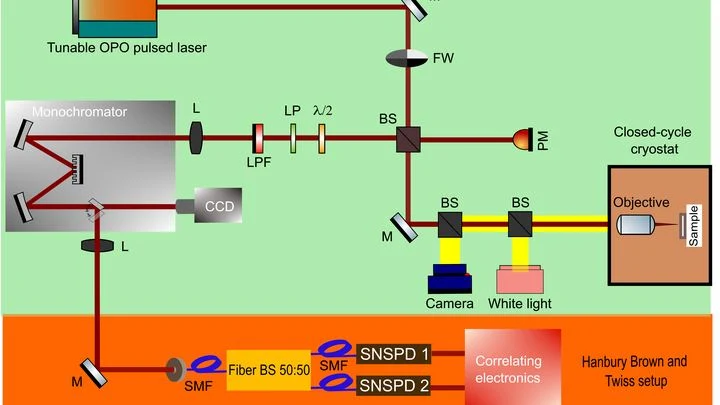
Tiny semiconductor islands grown right on silicon fire off single photons, like a machine gun that shoots exactly one bullet at a time. These islands are called quantum dots. They can emit light in discrete packets, which is needed for secure information in quantum networks.
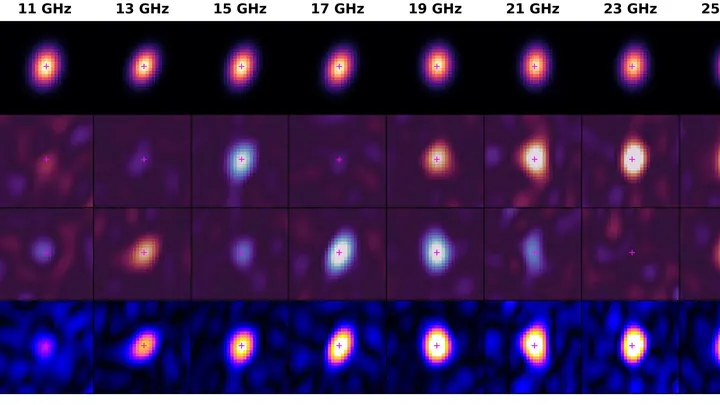
The plasma jet from the center of a distant galaxy is like a river that flows from its source and gradually becomes clear. Near the black hole, the flow is dense and opaque to radio waves, like muddy water.
The night sky looks calm, but if you listen in on the radio band, it's full of short clicks and rustles. Astronomers are combing the sky for solitary radio pulses — bursts lasting milliseconds that come from various corners of the Galaxy and beyond.
One such search is underway at the 100-meter radio telescope in Effelsberg, Germany.
The night sky looks still, but many stars tremble like a drum after a strike. For seven straight years, the TESS satellite stared at the same patches of sky and caught this trembling in 19,151 red giants — old, bloated stars. Previously, far fewer of these 'singing' giants were known, and now the list has grown by 80%.
A gamma-ray burst is like a shot from a cosmic cannon: a brief but dazzling flash that outshines an entire galaxy for a few seconds. But when observed in the hardest gamma-ray band (photons with energies above a gigaelectronvolt), the signal often gets lost in the noise, like a whisper in a noisy hall.
In October 2022, the cosmos put on a fireworks show that every detector on Earth noticed. The explosion, named GRB 221009A, was so bright that it was called the brightest ever observed. It's a gamma-ray burst — a short but incredibly powerful flash that releases as much energy in seconds as the Sun will produce in its entire lifetime.
A tiny needle glides over the surface like a finger over a page written in Braille. That's how a scanning tunneling microscope works: it feels the atomic landscape and turns bumps into a picture. But when you need to add a magnetic field, the design hits a wall.
On the night of August 18, 2025, the SVOM space telescope detected a short gamma-ray burst — a powerful flash of energy lasting less than two seconds. Such bursts are usually linked to mergers of neutron stars, the ultra-dense remnants of dead stars.
A gamma-ray burst is a short but incredibly powerful explosion in a distant galaxy. In a few seconds, it releases as much energy as the Sun will emit over billions of years. The Neil Gehrels Swift satellite catches such flashes with a special telescope called BAT, which detects gamma rays.
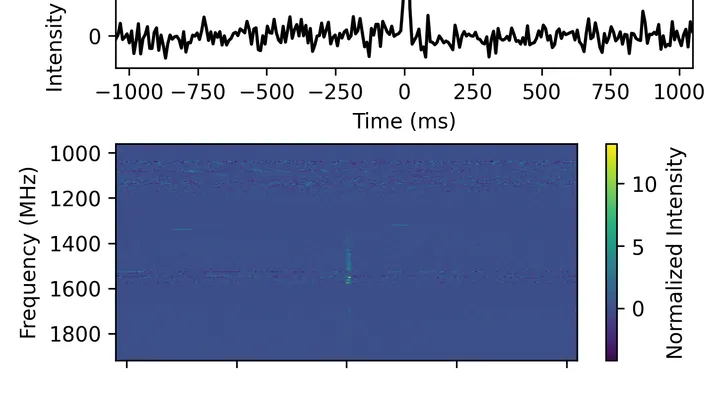
At night, while most people sleep, the giant dish of the Green Bank radio telescope in West Virginia keeps listening to the sky. Over 24,186 hours, that's nearly three years of continuous observation, it caught 50 pulsars and three fast radio bursts.
There is a region of light that has long remained a blind spot: from 5 to 15 terahertz. It is not radio waves, nor infrared heat, but something in between, where molecules vibrate in particularly characteristic ways. Scientists from Germany have built a setup that finally peers into this 'new terahertz gap' and even beyond — past 25 terahertz.
The secret lies in a crystal with the long name BNA.
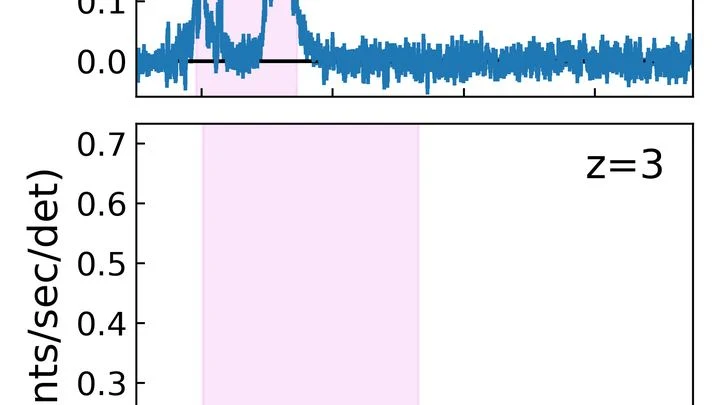
In October 2022, the space-based detector GECAM-C caught the most powerful gamma-ray burst ever seen, GRB 221009A — an explosion that briefly became the brightest source of gamma rays in the sky. But the most interesting part came after: the instrument detected a series of additional flares, and one of them was record-breaking.
Seven billion years ago, a black hole at the center of a galaxy unleashed a gamma-ray flare — the most energetic form of light — with staggering power. Its light, after crossing cosmic distances, reached the MAGIC telescopes in December 2017.
The black hole in the binary system V4641 Sagittarii behaves like a giant blender. It sucks in matter from its companion star and flings it back into space in two narrow jets. These jets slam into the surrounding gas like a water jet hitting sand, gradually carving out a huge cavity around the hole.
The RATAN-600 radio telescope is a ring of hundreds of aluminum panels on a mountainside in Karachay-Cherkessia. In the spring of 2018, its mirror caught radio waves from sixteen red dwarfs — small, dim, but very long-lived stars.