Orphan Stars: How to Find Their Home express
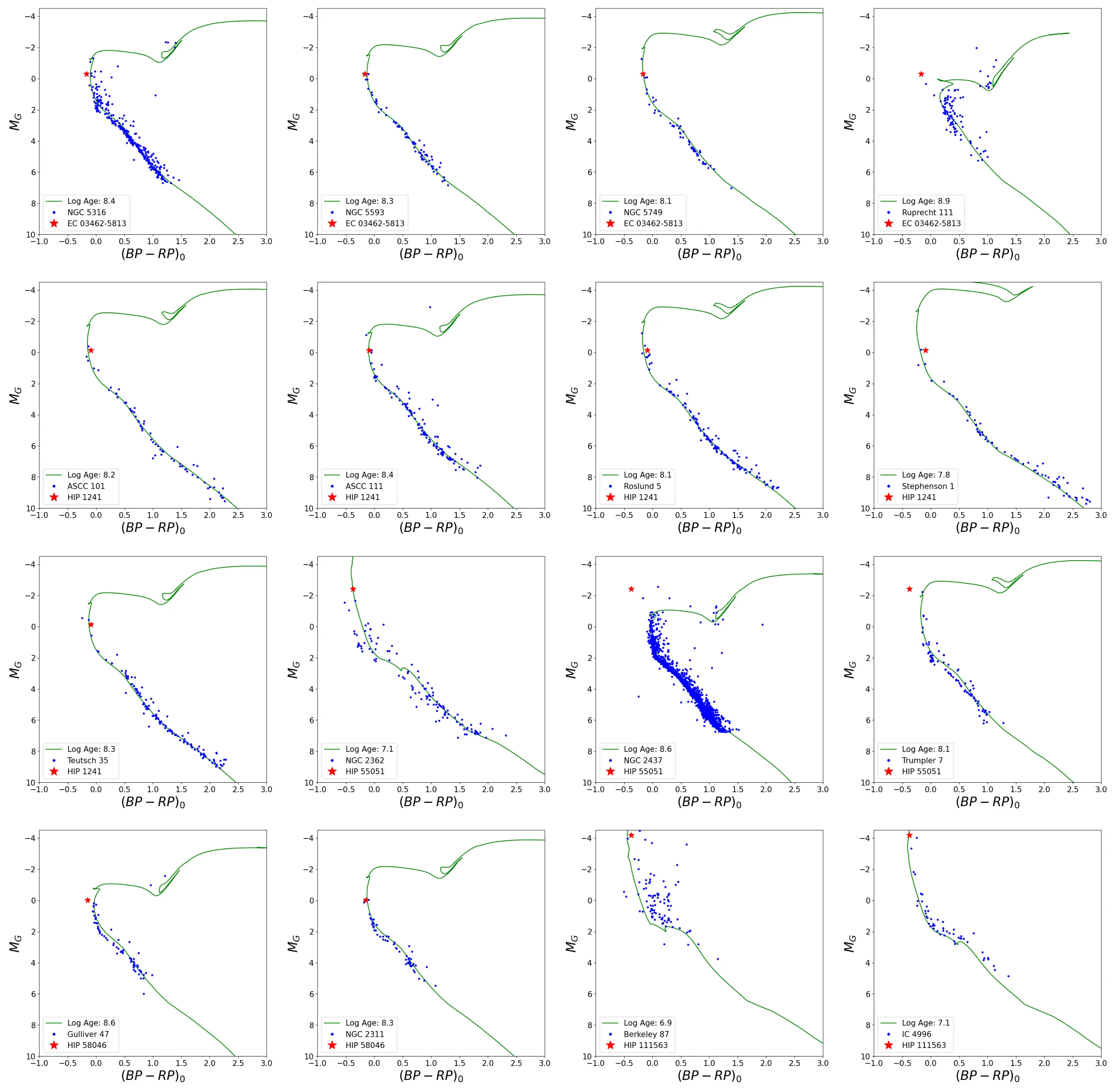
Blue giant stars are usually born in tight stellar nurseries — open clusters within the thin disk of our Galaxy. But sometimes such stars are found high above the disk, as if thrown out of their home. How did they get there? Astronomers decided to run a "paternity test": take 39 such orphan stars and 447 clusters, and trace their paths backward in time using Gaia telescope data.
Gaia measures star positions and velocities with incredible precision. The scientists rewound the cosmic film tens of millions of years and checked whether the trajectories of stars and clusters crossed. If they did, the star could have been ejected from that cluster. To verify, they compared the ages of the star and cluster using color-magnitude diagrams — a kind of stellar passport. Five pairs matched.
For each of the five stars, they estimated the ejection speed and travel time. The mechanisms turned out to be different: some were flung out by a neighboring supernova explosion, others by a gravitational slingshot during close encounters in the cluster core.
So "stellar orphans" find their families. And that one star that doesn't fit the pattern reminds us that the Galaxy still holds many surprises.
Original abstract
as written by the authors arXiv:2602.16925
OB stars generally form in open clusters within the Milky Way's thin disk, so when they are found at high Galactic latitudes, it is thought that they were ejected from their birth clusters during the past few tens of millions of years. Using Gaia Data Release 3 (hereafter DR3) data, we traced the kinematic trajectories of 39 high-latitude B-type stars and 447 Galactic open clusters with high-quality astrometry to search for moments of past intersection. In cases where we found matching trajectories, we also considered the clusters' HR diagrams to confirm parent-orphan pairs have matching ages. Further analysis of the clusters' core environments allowed us to determine a probable ejection mechanism. Through these paternity tests, we have identified possible origins for five of these orphaned B-type stars. Here we present the likely travel times, ejection velocities, and a discussion of the runaway mechanism for each case. We also identify one star whose trajectory did not bring it near the disk during the time period of our analysis, and we discuss its possible origins as well.
The Gaia telescope is so precise that it can measure the angle subtended by a coin on the Moon as seen from Earth.
In the series "Star Trek," there's an episode where a runaway star carries a planet with it — a scenario that could actually happen during an ejection from a cluster.