The Hidden Fragility of Ecosystems express
An ecosystem is like a swing that someone is subtly pushing. Previously, it was thought that the main concern was that the swing wouldn't swing too wildly. But the authors of this work showed that the greater danger is when the equilibrium point itself slides toward a place where the swing can no longer return.
In nature, interactions between species are not fixed in stone. The strength with which one species affects another is constantly changing slightly — due to weather, disease, random encounters. These small nudges don't just cause abundances to fluctuate around a stable point. They shift the equilibrium point itself. And here's the surprise: even very weak, 'light' randomness leads to species abundances that can become very large or very small according to a law called a power law. It's as if a gentle breeze sometimes lifts not dust particles but entire houses into the air.
The scientists derived a formula for the critical noise level — the strength of random nudges at which a community almost certainly loses viability. It turns out that this critical level decreases inversely with the number of species. In other words, a large and diverse forest is more fragile to such random shifts than a small pond with five species. This is a troubling conclusion for biodiversity conservation.
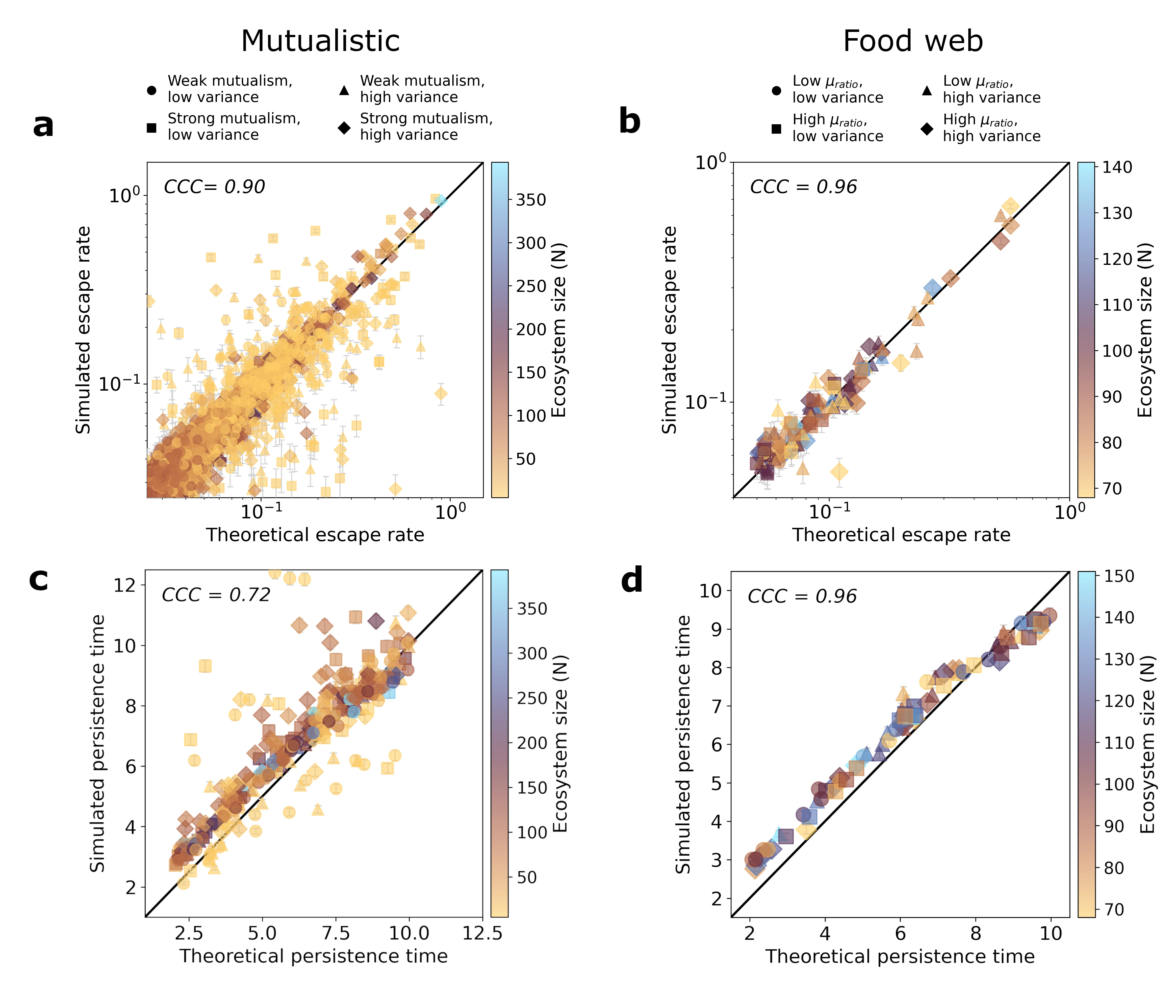
The authors didn't stop at theory. They took data on 34 species and found a power law for most of them. Then they tested their predictions on 98 real networks — from mutualism (mutually beneficial relationships, like bees and flowers) to food chains. Their fragility metrics successfully predicted which networks would fall apart faster.
Original abstract
as written by the authors arXiv:2602.18942
Theoretical ecology has traditionally equated persistence with the stability of a fixed equilibrium point. Here we argue that the primary threat to ecosystem persistence need not be the loss of stability, but instead the escape of the stable equilibrium to a negative orthant. In a realistic setting, fluctuations in interactions do not merely disturb abundances about an equilibrium but can displace the equilibrium point itself. We theoretically and empirically analyze such displacements of the equilibrium point in a complex community. Theoretically, we find that light-tailed fluctuations in species interactions, no matter how small, lead to a heavy-tailed power law $$P(y)=1/y^\alpha$$ for the equilibrium abundance $$y$$ of a species. Remarkably, the exponent $$\alpha=2$$ is a universal value independent of interaction structure, community size, and species. Empirically, our analysis of 34 species reveals a power law signal for most, with a median exponent $$\alpha \sim2.56$$. Next, we derive a formula for the critical noise, $$\sigma_c$$, beyond which the community experiences feasibility loss ``with near certainty''. We find that $$\sigma_c(N)\sim N^{-1}$$, implying that larger communities are significantly more fragile to noise induced feasibility loss. Lastly, we define and calculate biologically measurable analytical metrics for both global and species-specific feasibility escape rates, and implement these metrics in dynamic simulations of 98 real world mutualistic and food web networks, to successfully predict their fragility.
The power law with exponent 2 found in this work is surprisingly universal: it does not depend on how the interactions between species are structured, nor on the size of the community, nor on the specific species.