New Sensors Open Low Frequencies for Gravitational Waves express
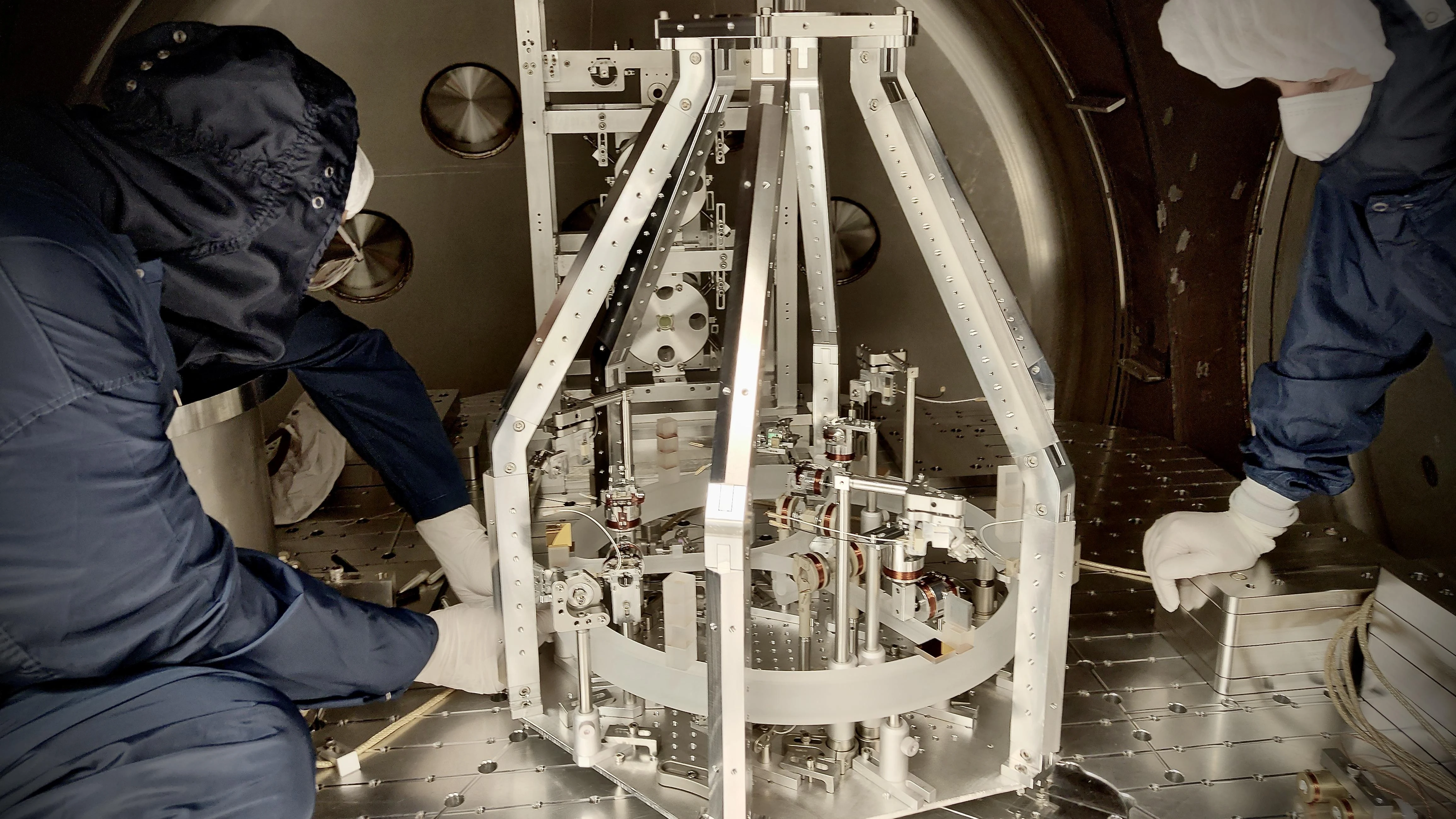
Even Einstein predicted gravitational waves — a trembling of the very fabric of spacetime. Today they are captured by gigantic installations like LIGO, created thanks to Rainer Weiss and Kip Thorne. But all of them are a bit deaf to low notes: at frequencies below 20 oscillations per second, earthly shaking (from surf, trains, even walking people) drowns out the signal, like the noise of an orchestra muffling a quiet whisper.
The solution is a system that dampens the tremor, like active noise-canceling headphones, suppressing interference down to one-hundredth of an oscillation per second (10 millihertz). With motion sensors five times more accurate than usual, this gives a tenfold gain at a frequency of 10 hertz. Now we can hear the bass chords of the Universe — mergers of black holes of intermediate mass, thousands of times heavier than the Sun.
This dramatic leap will not only triple the search radius (volume — almost 30 times), but also possibly show whether supermassive black holes at the centers of galaxies grow from such "seeds".
Original abstract
as written by the authors arXiv:2602.23531
Extending the sensitivity of terrestrial gravitational-wave detectors below 20 Hz is a long-standing challenge, limited by ground motion and inertial sensing noise. In this letter, we demonstrate ultra-high-vacuum compatible inertial isolation and position sensing technologies that achieve active platform stabilization down to 10 mHz. Our laser position sensors reach a sub-pm/$$\sqrt{\rm Hz}$$ sensitivity above 10 mHz, independent of the input light polarization, representing a 100-fold improvement over the current LIGO position sensors. In addition, our inertial sensors provide at least a factor of 5 improvement in low-frequency sensitivity compared to state-of-the-art commercial seismometers. We integrate these technologies into a LIGO-like interferometer model and predict a low-frequency sensitivity improvement of up to an order of magnitude at 10 Hz, with enhanced linearity and calibration stability. This extension increases the detection horizon for intermediate-mass black hole binaries of mass $$10^3 M_\odot$$ by a factor of 3. Our results provide the first experimental demonstration of a practical pathway to sub-10 Hz operation of terrestrial gravitational-wave detectors and establish key technologies for next-generation observatories such as Cosmic Explorer and Einstein Telescope.
Low-frequency gravitational waves are the only messenger from black holes with masses from hundreds to hundreds of thousands of suns; these "golden means" have hidden from all telescopes.
Like in 'Interstellar': the instruments sensed how space trembled from distant black holes. Now we hear that tremor with unimaginable clarity.