Self-interaction is the phenomenon where a physicalfield or entity influences itself, rather than only being acted upon by external sources. In general relativity, this is most famously embodied by the fact that spacetime curvature itself carries energy and momentum, which in turn generates further curvature. This nonlinearity means that gravitational fields do not simply add up like independent waves; they interact with each other and with their own source, leading to effects that are absent in linear theories.
History
The concept of self-interaction in gravity is inherent in Einstein's general relativity, published in 1915. The nonlinear nature of the field equations was immediately recognized, though its full implications for gravitational waves and strong-field regimes were explored over subsequent decades.
How it works
In a linear theory, the field at a point is simply the sum of contributions from all sources, and the field does not affect its own propagation. In a self-interacting theory, the field's energy density acts as a new source for the field itself. For gravity, the energy of the gravitational field creates additional curvature, which then alters the path of the field itself. This feedback loop is what makes Einstein's equations nonlinear and leads to phenomena like the bending of light by its own energy, and the fact that a strong gravitational wave can act as a gravitational lens for itself.
In practice
Self-interaction is crucial in modeling the inspiral and merger of black holes and neutron stars, where the strong gravitational fields significantly alter the motion of the objects themselves, and in understanding the behavior of gravitational waves in the early universe.
Fun fact
In quantum field theory, self-interactionleads to the phenomenon of 'vacuum polarization,' where a particle's own field can create virtual particle-antiparticle pairs that screen or modify its charge.
A superconductor pushes out a magnetic field like a sponge squeezing out water. This Meissner effect has been known for nearly a century, but it's usually calculated in a flat world — without gravity. In the strong field of a black hole or at enormous speeds, the picture changes.
A stone drops into a pond, and ripples spread across the water. In the same way, massive bodies generate gravitational waves, except it's space itself that ripples. So far, these waves have been caught by giant detectors that barely flinch as a wave passes through. But what happens on the microscopic scale, inside a tiny piece of matter?
Quantum field theory is the language physicists use to describe elementary particles and their interactions. The authors of the work decided to slightly "tweak" this language: they introduced deformations, that is, small changes to the rules of the game.
In 2017, detectors picked up a gravitational wave from the collision of two neutron stars. Just 1.7 seconds later, telescopes saw a flash of gamma-ray burst from the same spot. That tiny delay became a treasure for physicists.
Two houses with identical facades. Windows, doors, wall color — everything matches. But inside, one is empty, while the other buzzes with life. How can you tell without stepping inside? In space, there's a similar puzzle: a black hole and a gravastar look the same from the outside, but they are built differently.
$$10^{-35}$$ seconds. A tiny instant during which the Universe manages to expand by a factor of $$10^{26}$$. Immediately after, it goes through thousands of rapid transformations — like a ball bouncing along a chain of tunnels. This cascade is the essence of chain inflation, first proposed by Alan Guth.
A cloud of waves collapses under its own gravity. While it's loose, everything goes by the book: the field oscillates gently in nearly flat space, and approximate formulas work perfectly. But add just a bit more energy, and the picture changes.
Physicists used a numerical model to catch the moment when simple calculations stop describing reality.
An eardrum at the very edge of a waterfall. Sound behaves strangely here: echoes don't multiply: they fade. That's exactly what gravitational waves look like at the horizon of a black hole — the boundary beyond which even light disappears.
A desert where every step reshapes the terrain. Dunes settle, new slopes emerge, and the next step is dictated by what you've just trampled. That's roughly how "sandscapes" work — a mathematical model inspired by living systems.
According to Einstein's general theory of relativity Albert Einstein, a massive rotating body drags the fabric of spacetime along with it, much like a spoon twirled in a jar sets thick honey flowing.
At the very beginning of the universe, when all of space was compressed into a point, the laws of physics break down. This point is called a singularity — an edge where our equations lose meaning. But what if it's not an end, but a special type of boundary?
The authors of this work propose viewing the singularity as a free boundary.
Two floats on the waves. Throw a stone into water, and the ripples will spread, rocking both floats one after another — not simultaneously. In the quantum world, such rocking is called entanglement: particles, like floats, begin moving in sync.
A single particle can be in two places at once — that's superposition. But any interaction, like a shout, instantly 'collapses' this uncertainty. It was long thought that even gravity could interfere.
At the heart of an active galaxy, where interstellar gas spirals into a dazzling accretion disk around a supermassive black hole, a boundary is born through which even sound cannot break. This acoustic horizon was long considered frozen ripples on water.
A tuning fork, once struck, makes neighboring strings vibrate. Much the same happens with a cloud of ultralight particles (also called axions) around a rapidly spinning black hole. The hole, like a motor, spins up the particles, and they begin to emit gravitational waves — a trembling of space itself.
A thrown stone arcs along a clean trajectory, but an electron's position in an atom is smeared out like fog. The transition from one to the other is a puzzle. New work shows that the fuzziness disappears not because of an observer, but because of the particle's own gravity.
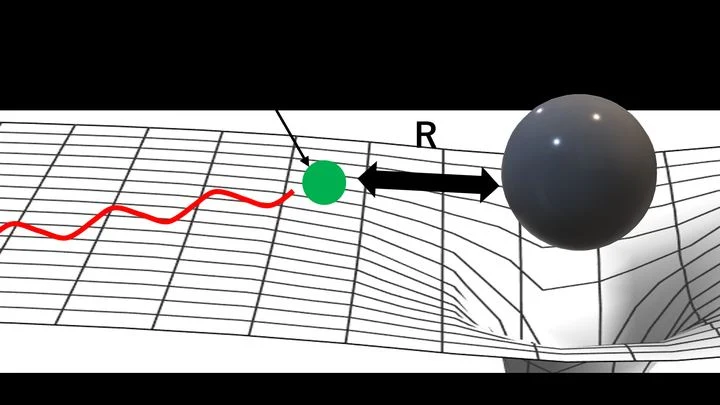
Einstein's general relativity describes gravity as the curvature of spacetime — much like a heavy weight pressing down on a stretched elastic sheet. Black holes are regions where this curvature reaches extreme values, the deepest "funnels" in the fabric of the universe.
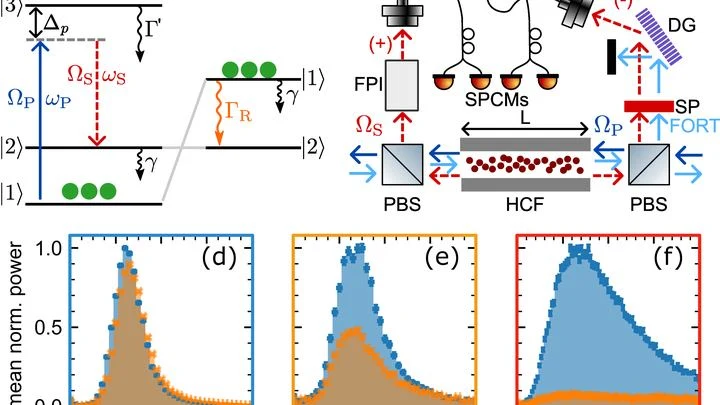
A swarm of fireflies in a night forest flashes randomly: each beetle blinks on its own, and the light scatters equally in all directions. Now imagine the fireflies agreeing to blink so that their combined light goes only north — even though they stay put and none of them turns. That's roughly what physicists did with atoms inside a thin glass tube.
Picture heavy balls resting on a stretchy trampoline: each one sinks into the fabric, and their dents overlap, causing the balls to roll toward each other. This analogy helps explain how gravity — the curvature of spacetime — links massive particles. But what if you bring gravity and quantum mechanics together?
An atom excited by light gives its energy back in an instant — it emits a photon. This process is like a tired runner dropping a heavy load. But if the runner is on a mountain slope, it's harder to pick up speed. Gravity acts on the atom similarly: near a massive body, time flows slower, and the atom emits differently.
The expansion of the universe is like a dance floor stretching wider. For decades, physicists assumed that more stretching would spawn more particles, like the floor spontaneously generating new dancers. But those models ignored an obvious fact: dancers sometimes link arms. When particles interact, new simulations reveal, they actually suppress creation.
In the quantum world, an object can be in several places at once. Yet in everyday life we see things strictly in their places. The reason is gravity. A massive star under its own weight inevitably collapses into a black hole or a neutron star, but it can't be both at the same time.
Two particles can become linked so that a nudge on one instantly reverberates in the other, even if they are separated by galaxies. Einstein called it "spooky action at a distance." Physicists wondered: can gravity itself, a simple mutual attraction, create such a connection?
A century ago, Einstein's equations predicted black holes, but inside them physics broke down: particle trajectories ended at the singularity, a point of infinite curvature. It was a dead end, the end of spacetime. Now physicist Itzhak Bars proposes a radical twist: the singularity is not a wall but a door.
In 2022, physicists observed gravity shifting the phase of a single atom's wave, the gravitational analog of the Aharonov–Bohm effect. This experiment became part of a long-standing debate: whether gravity must be quantized or remains a classical background in the quantum world.
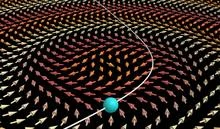
An electron gliding over invisible hills and valleys created by a spin texture: that is the picture behind a new chapter in condensed matter physics. In quantum materials where the direction of localized spins varies smoothly (a spin texture), an electron is no longer just a particle flying through the lattice.