Quantum Computer Weaves an Invisible Thread of Order express
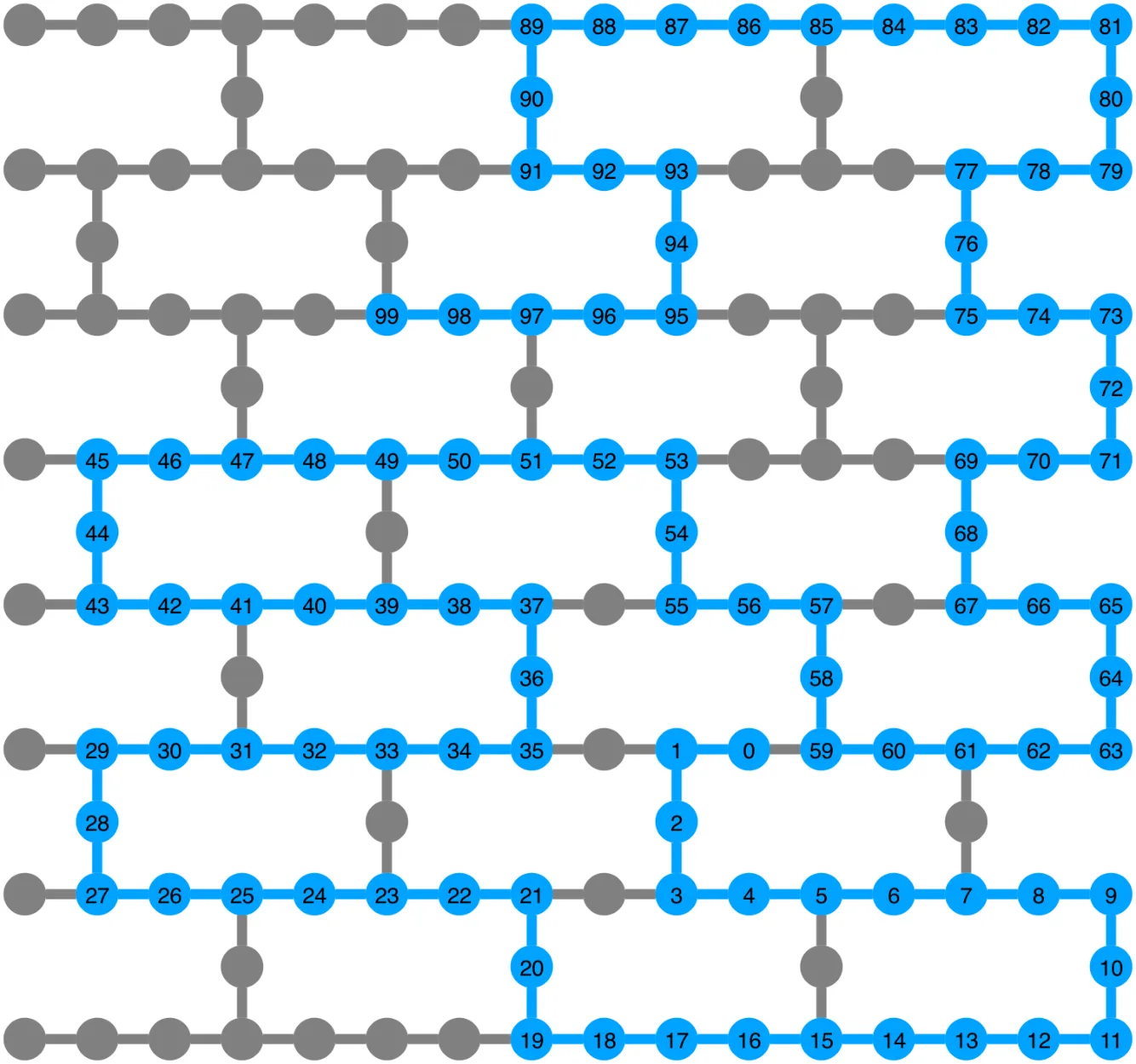
A rope braided from a hundred short strands can be twisted to the right or to the left. Each strand individually doesn't know which way the whole rope is twisted, but try to unravel it, and the difference immediately shows. That's roughly how the states physicists call symmetry-protected are arranged: locally they are indistinguishable, but globally they are different.
A group of researchers took a chain of a hundred spins — tiny magnetic arrows that can point up or down. The spins alternated: strong coupling, weak coupling, strong again. Such a chain can exist in two different hidden phases, and both were prepared on an IBM quantum processor with an accuracy of 97.9–99.0%.
Three independent signatures helped verify that the phase was indeed the right one. The first is nonlocal string order: if you measure every other spin over a length of up to twenty sites, a strict pattern emerges, even though neighboring spins don't show it. The second is the entanglement spectrum: it has characteristic repeated levels, like a symmetric ornament. The third is edge modes: at the ends of the chain, "free" spins appear that are protected by symmetry from disturbances.
Previously, such states were only obtained in computer simulations or in very small systems. Now they can be prepared on real quantum hardware and, possibly, we can study what happens when the system changes abruptly in time, a task that is impossible for ordinary computers.
A chain of a hundred spins has $2^{100}$ possible configurations — more than the number of atoms in the visible Universe, yet the desired state was set with just a few dozen operations.