Double Arc Around Vampire Stars express
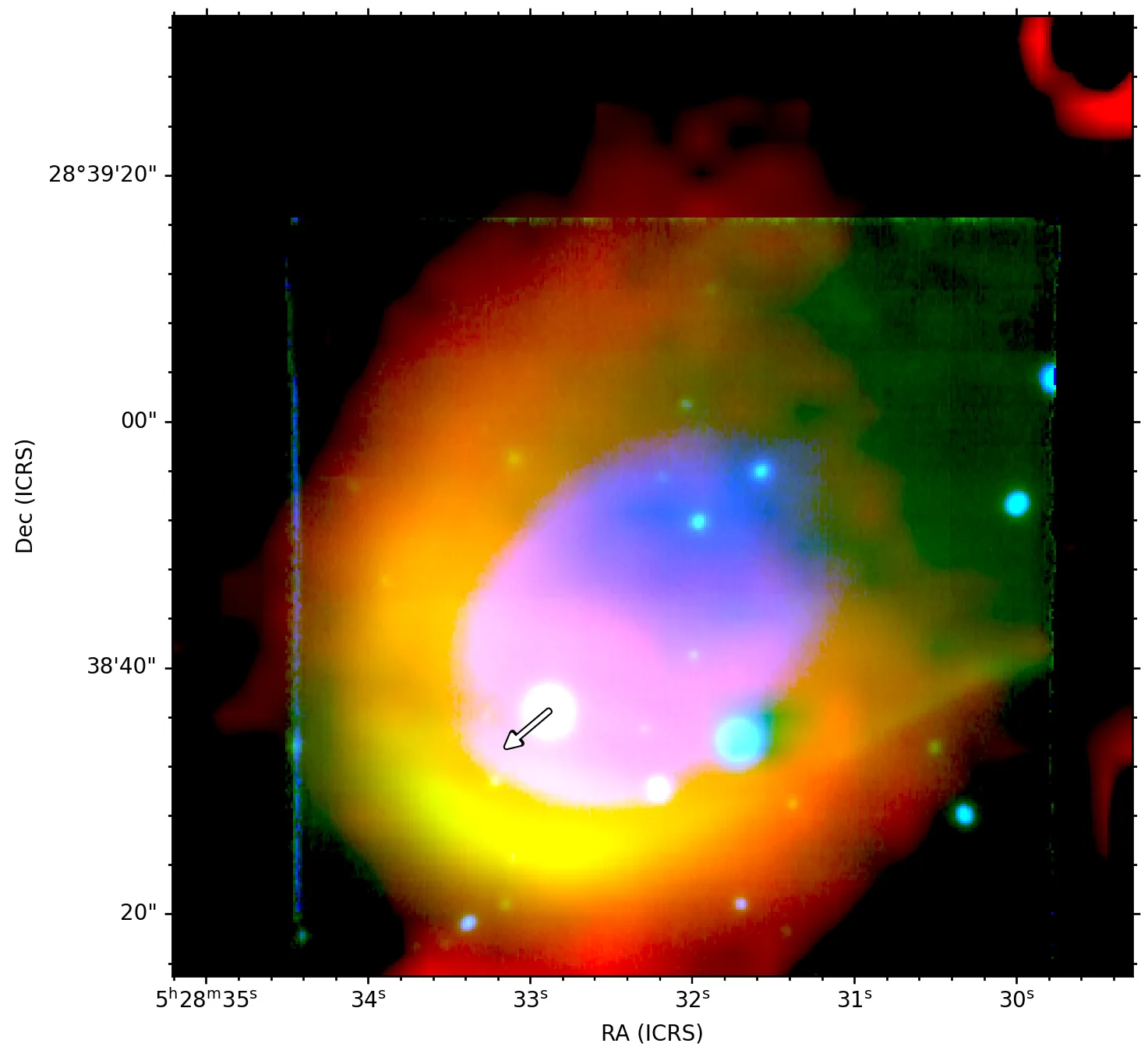
Around certain close binary stars, where a white dwarf siphons matter from its companion, astronomers have seen a glowing arc. They took it for a shock wave — the place where a fast stellar wind slams into interstellar gas. But new observations show: there's more than one arc.
Spectroscopy of archival images in ultraviolet, visible, and infrared light revealed a layered structure in three systems — BZ Cam, V341 Ara, and 1RXS J052832.5+283824. The bright optical arc, once mistaken for the outer boundary, is actually just the inner jump: here the stellar wind abruptly decelerates. Farther out, in infrared rays, a second, wider arc appears: that's the true outer edge, where interstellar matter gets swept up.
So the shock wave in cataclysmic variables is like a layered cake: fast wind, inner jump, hot cavity, outer jump. The true size of the whole structure is only visible when you look beyond the optical.
Original abstract
as written by the authors arXiv:2603.11742
Bow shocks around cataclysmic variables (CVs) have traditionally been identified with a single bright optical arc. This feature has been interpreted as the bow shock formed by the interaction between a sustained outflow and the interstellar medium (ISM). We show that this interpretation is incomplete. Generic wind-ISM interaction theory predicts a two-shock configuration consisting of an inner terminal wind (reverse) shock and an outer forward shock, separated by a hot, low-density shocked wind cavity. Using archival ultraviolet, optical, and infrared imaging of the nova-like systems BZ Cam and V341 Ara, and the polar 1RXS J052832.5+283824, we find that the nebulae around all three systems exhibit this layered structure. In each case, the previously identified bow shock bright in Halpha and [OIII] corresponds to a compact inner arc, while additional emission components reveal a more extended morphology. Specifically, each system shows an outer arc detected in mid-infrared images, and the region between the optical and infrared arcs is filled with faint Halpha emission and, where available, far ultraviolet emission. We identify this infrared arc, reported here for the first time in these systems, as the sweep-up boundary of the forward shock, while the bright inner optical arc corresponds to the terminal wind shock rather than the forward shock as previously assumed. These results reveal that the true extent and layered structure of bow shocks around CVs only become apparent when observations extend beyond the optical band.
The infrared outer arc in these three systems was spotted for the first time — earlier, such observations simply weren't done in the right wavelength range.