A solar storm, also known as a coronal mass ejection (CME), is a massive burst of magnetizedplasma and radiation released from the Sun's corona into space. These clouds of charged particles can travel at speeds of hundreds to thousands of kilometers per second, and when they reach Earth, they interact with the planet's magnetic field, potentially causing geomagnetic storms. Such storms can disrupt satellite operations, power grids, and communication systems, and they are also responsible for the spectacular auroras seen at high latitudes.
History
The connection between solar activity and geomagnetic disturbances was first established in the mid-19th century, notably by Richard Carrington who observed a solar flare in 1859 that was followed by a major geomagnetic storm. The term 'coronal mass ejection' was coined in the 1970s after observations from the Skylab space station.
How it works
Solar storms originate from regions of intense magnetic activity on the Sun's surface, such as sunspots. When magnetic field lines become twisted and stressed, they can suddenly reconnect and release enormous amounts of stored energy, propelling a cloud of plasma outward. As this cloud travels through space, it carries with it the Sun's magnetic field. Upon arrival at Earth, the interaction between the solar magnetic field and Earth's magnetosphere can compress the magnetosphere on the day side and stretch it on the night side, leading to the injection of energetic particles into the upper atmosphere and the generation of strong electrical currents in the ionosphere.
In practice
Monitoring solar storms is crucial for protecting satellites, power grids, and aviation communications. Space weather forecasting agencies track CMEs to issue warnings, allowing operators to take preventive measures like shutting down sensitive electronics or adjusting satellite orbits.
Fun fact
The 1859 Carrington Event produced auroras so bright that people could read newspapers at night as far south as the Caribbean, and telegraph systems failed or sparked even when disconnected from their power sources.
A massive star doesn’t simply fade away — it blows up as a supernova, leaving behind an expanding remnant and a wildly spinning neutron star — a pulsar. In this cosmic storm, astonishing patterns emerge, and the 'Nimbus'–'Thunder' system is a dazzling illustration.
Eight hundred million years ago, in the main asteroid belt, a giant inkwell shattered. The parent body, over a hundred kilometers in diameter, made of primitive carbonaceous chondrites, suddenly broke apart near the J3:1 resonance with Jupiter.
A black hole is a cosmic pocket into which everything, even light, falls. But the pioneering work of John Wheeler, Stephen Hawking, and Roger Penrose showed: sometimes, due to the colossal spacetime curvature, the pocket turns inside out.
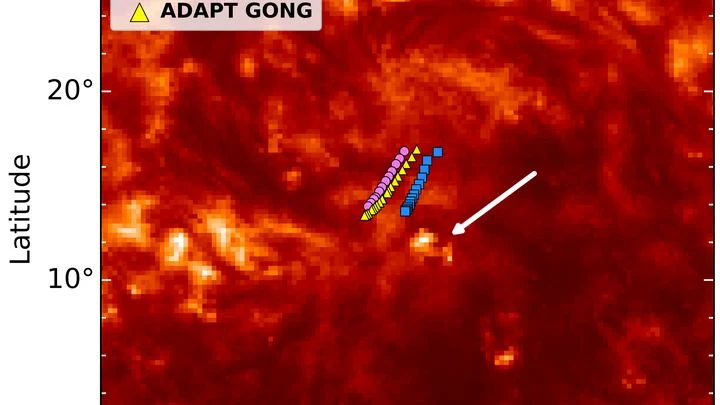
In December 2011, Comet Lovejoy boldly raced through the searing corona of the Sun. Right after — a flare. Scientists checked whether the comet could have caused it. The atmosphere of the Sun is threaded with taut magnetic loops, like a drawn bowstring.
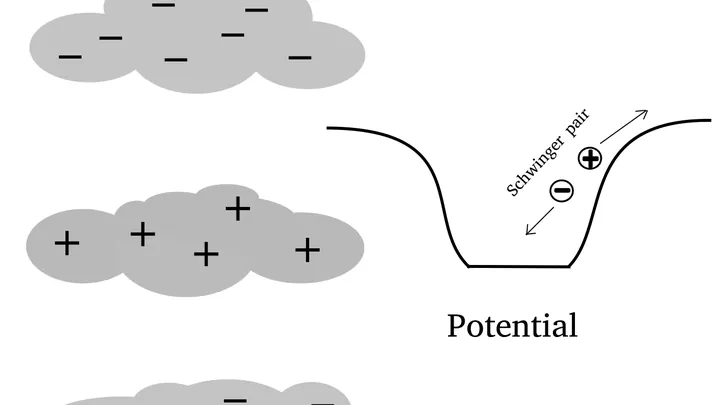
During a thunderstorm, the sky acts like a giant battery: charge builds up in the cloud, and a lightning bolt discharges it. That charge is invisible, but cosmic particles (muons, which constantly rain down on Earth from space) can sense it. As a muon flies through a charged cloud, it speeds up or slows down slightly, and these changes reveal the voltage inside the cloud.
Above the Sun's surface hang long ribbons of glowing gas — streamers. They look like giant harps stretched across the corona. When a wave runs along such a ribbon, it trembles and bends like a string after being plucked.
For a long time, it was thought that only a very fast ejection of material, one traveling at more than 500 kilometers per second, could launch such a wave.
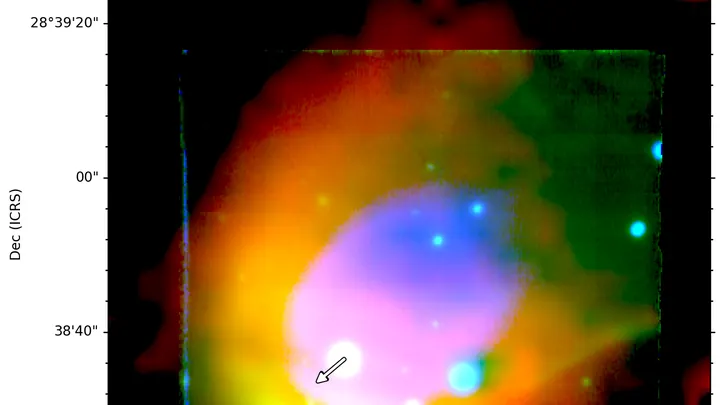
Around certain close binary stars, where a white dwarf siphons matter from its companion, astronomers have seen a glowing arc. They took it for a shock wave — the place where a fast stellar wind slams into interstellar gas. But new observations show: there's more than one arc.
Above Jupiter's poles, auroras blaze as electrons are accelerated by electric fields and slam into the upper atmosphere, making the gas glow. But not all electrons head downward. Some, it turns out, get a kick in the opposite direction — away from the planet, into deep space.
A thundercloud stores electricity like a battery before a flash. It can discharge in two ways: by lightning or by producing particles with a tiny charge: these are called millicharged particles. Such particles are nearly invisible to detectors, but their trace can be caught by how often lightning strikes.
The authors compared thunderstorms on different planets in the Solar System.
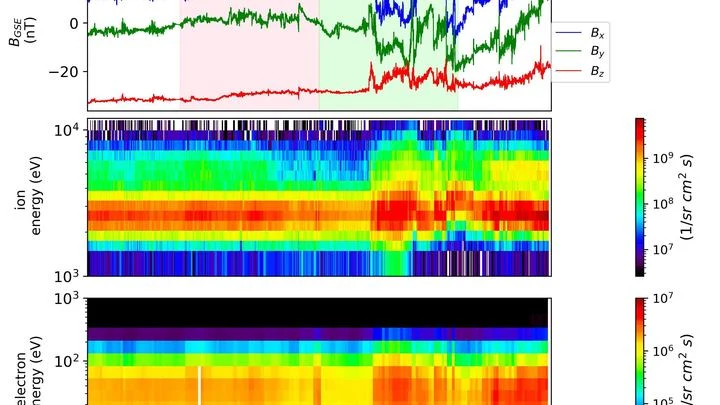
October 10, 2024. The Sun hurled a cloud of magnetized plasma toward Earth, and four spacecraft, stationed at a single point between the Sun and Earth, simultaneously recorded how that cloud churned. The distance between the outermost probes was just 80 Earth radii, about half a million kilometers.
The solar flare of June 3, 2012 behaved like an orchestra where, after the main performance, a second soloist unexpectedly steps in. First, instruments recorded a sharp burst of gamma-ray emission with energies above 100 megaelectronvolts — as if billions of tiny bullets struck the detectors at once. Then, after a brief pause, the emission intensified again and persisted for more than eight minutes.
A solar flare is like an explosion in a star's atmosphere: in minutes, it releases energy comparable to billions of nuclear bombs. On May 4, 2022, the RT-7.5 radio telescope in Moscow was watching an M5.7-class flare. The instrument was catching millimeter radio waves: those shorter than a centimeter and invisible to the eye.
In the Antennae Galaxies, which are crashing into each other, giant gas clouds collided at a speed of 50 kilometers per second. It's like two trains hurtling toward each other — the impact compressed the gas, and it ignited with new stars.
An ordinary lump of coal left under the blazing sun just heats up. But if you take it into space and bring it twenty times closer to the Sun than Earth is, it won't survive for more than a few minutes. That's roughly how dark, carbon-rich asteroids behave. They are rarely found on orbits that dive deep inside Mercury's orbit.
When countless asteroids pummeled the young Earth, they tore chunks from its mantle. These fragments spiraled in a cosmic disk around the planet and, like a snowball in a blizzard, fused into the Moon.
The Moon harbors a secret that has puzzled planetary scientists for decades: its isotopic composition is almost indistinguishable from Earth's. According to the canonical giant impact model, the Moon should have inherited most of its material from the impactor Theia, a Mars-sized planet that slammed into the young Earth.