Double Arc Around Vampire Stars express
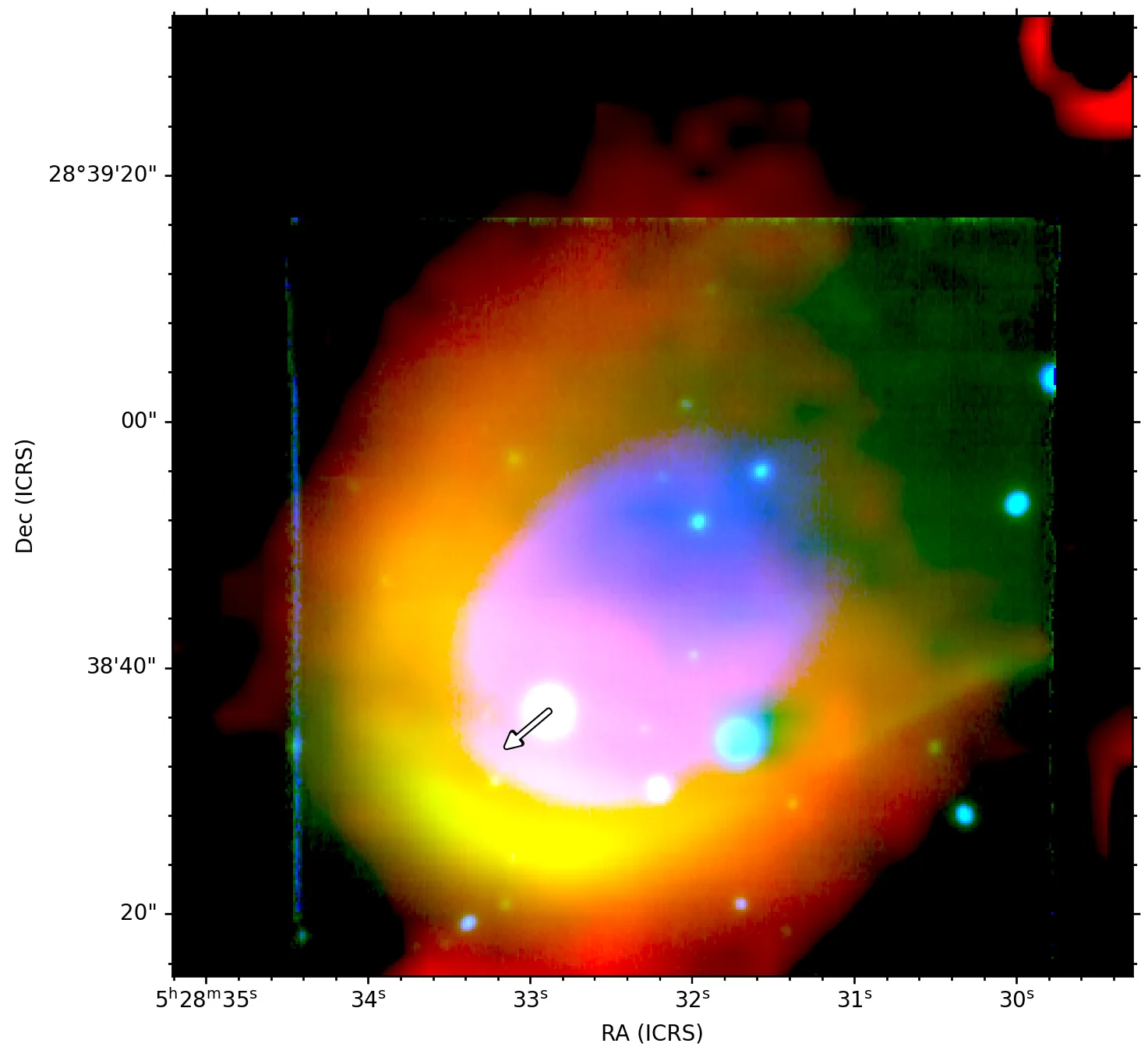
Around certain close binary stars, where a white dwarf siphons matter from its companion, astronomers have seen a glowing arc. They took it for a shock wave — the place where a fast stellar wind slams into interstellar gas. But new observations show: there's more than one arc.
Spectroscopy of archival images in ultraviolet, visible, and infrared light revealed a layered structure in three systems — BZ Cam, V341 Ara, and 1RXS J052832.5+283824. The bright optical arc, once mistaken for the outer boundary, is actually just the inner jump: here the stellar wind abruptly decelerates. Farther out, in infrared rays, a second, wider arc appears: that's the true outer edge, where interstellar matter gets swept up.
So the shock wave in cataclysmic variables is like a layered cake: fast wind, inner jump, hot cavity, outer jump. The true size of the whole structure is only visible when you look beyond the optical.
The infrared outer arc in these three systems was spotted for the first time — earlier, such observations simply weren't done in the right wavelength range.