Invisible Quantum Dot Stops Current express
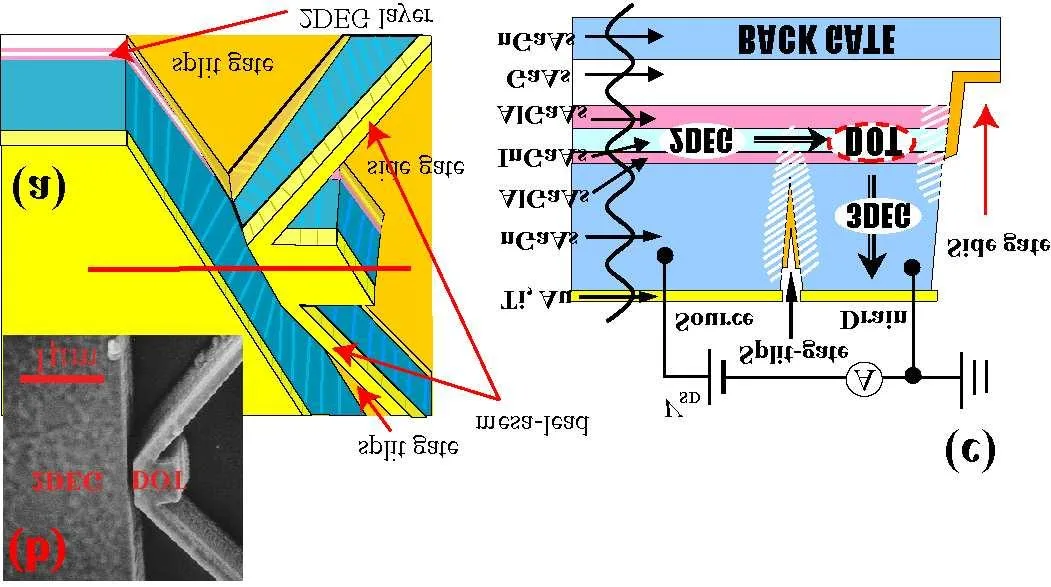
A quantum dot is like a tiny island where one or a few electrons can settle. In this new work, such an island was connected to two 'seas' of electrons: one flat like a pancake, the other bulky like an ocean. Electrons can hop from the island to the seas and back, and this hop depends on the shape of the electron's wave on the island.
It turns out that some electron states on the island are 'dark': electrons get stuck in them for a long time because their wave barely overlaps with the waves in the seas. Such a dark state is like a trion, three electrons with entangled spins, that can't easily fall apart. As a result, the current through the dot drops sharply, and on the current-voltage plot (the so-called Coulomb diamond), one side bulges asymmetrically.
This discovery helps explain how the shape of electron waves controls current in nanodevices. In the future, such dark states could be used as memory cells or qubits that are protected from accidental readout.
The electron's dark state in the dot is like a traffic light stuck on red: the electron 'sees' the exit but can't use it because of its internal symmetry.