How an Electron Loses Itself in a One-Dimensional World express
An electron in an ordinary wire is like a courier carrying both a package and the recipient's signature at once: its charge and spin are always together. But if the wire is made just one atom thick, the courier gets cramped. In such a one-dimensional tube, electrons cannot overtake each other, and their collective behavior changes beyond recognition.
Quantum mechanics allows particles to break apart into components that lead their own lives. In the one-dimensional model studied by the authors, an electron splits into a spinon (carrier of spin) and a holon (carrier of charge). The spinon is like a magnetic needle without electric charge, and the holon is like charge without magnetism. They move at different speeds and independently of each other.
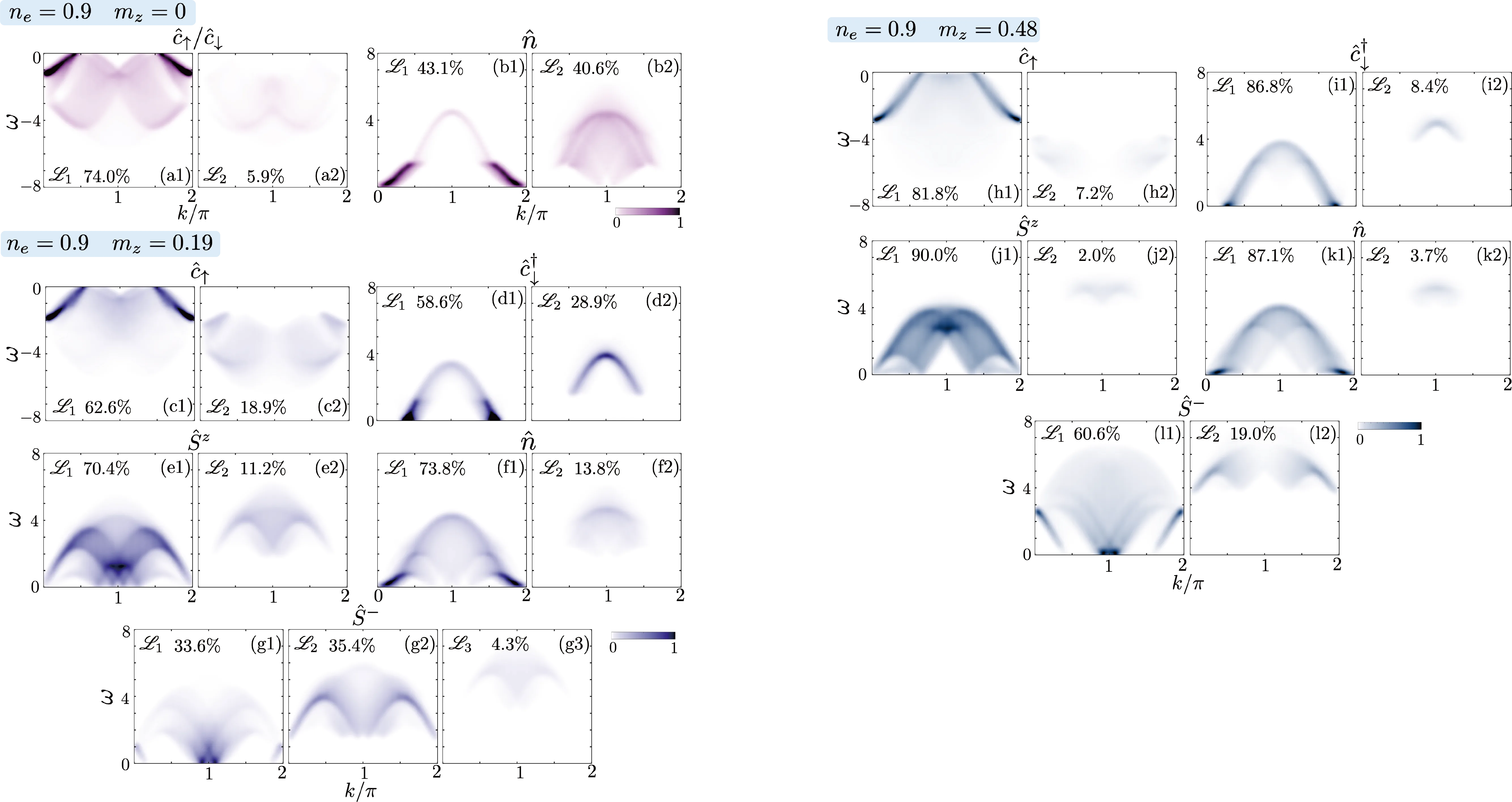
The authors applied a method that accurately accounts for all interactions between electrons and found the spectra — the characteristic energies at which the system absorbs or emits particles. In these spectra, boundaries are visible that correspond to the motion of individual spinons and holons. Moreover, they discovered bound states—'strings' of several particles that also contribute to the observed signals.
Such splitting of the electron is not just a mathematical curiosity. It shows up in experiments with one-dimensional conductors, such as carbon nanotubes or organic chains. Understanding these processes is essential for creating quantum wires and components of future electronics, where charge and spin could be used separately.
Original abstract
as written by the authors arXiv:2603.24453
Following the Bethe ansatz we determine the dynamical spectra of the one-dimensional supersymmetric t-J model. A series of fractionalized excitations are identified through two sets of Bethe numbers. Typical patterns in each set are found to yield wavefunctions containing elementary spin and charge carriers, manifested as distinct boundaries of the collective excitations in the spectra of single electron Green functions. In spin channels, gapless excitations fractionalized into two spin and a pair of postive and negative charge carriers, extending to finite energy as multiple continua. These patterns connect to the half-filling limit where only fractionalized spinons survive. In particle density channel, apart from spin-charge fractionalization, excitations involving only charge fluctuations are observed. Furthermore, nontrivial Bethe strings encoding bound state structure appear in channels of reducing or conserving magnetization, where spin and charge constituents can also be identified. These string states contribute significantly even to the low-energy sector in the limit of vanishing magnetization.
In one-dimensional systems, an electron can 'undress' into parts that never appear alone in our three-dimensional world. It's as if a courier handed you a package, and the signature was delivered by another person coming from the other side of the street.