Liquid Xenon Instead of Crystals: A Tomograph That Sees Three Times Sharper express
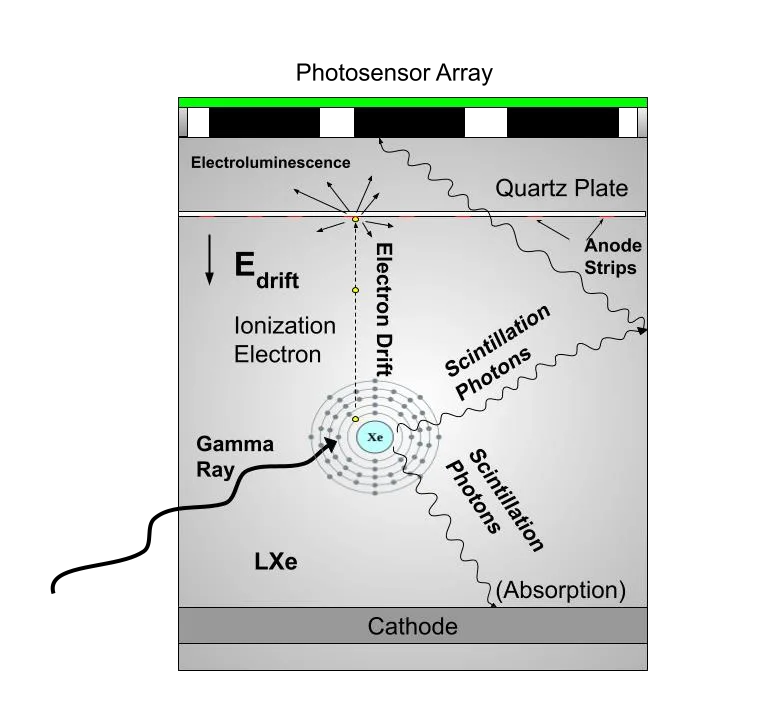
The camera that hunts for tumors works like a highly sensitive camera: it catches the faint glow from a substance that accumulates in diseased cells. In conventional machines, the light is born in a crystal — a solid piece that resembles glass. But a crystal doesn't always convey exactly where the light flashed, so the image comes out slightly blurry.
The new idea is to replace the crystal with liquid xenon. This is a transparent liquid that flashes on its own when struck by a particle of light. The flash is very clean: xenon barely mixes up shades, so the device easily distinguishes 'useful' light from random noise. What's more, the liquid reveals how deep inside itself the signal was born, like water in a glass shows where a drop fell.
Such precision matters when a tumor is small or sits near vital organs. The doctor sees its boundaries clearly and doesn't touch anything extra. The liquid is also easy to pour into containers of any shape — the machine can be made wider to examine more of the body in one go.
This is still a computer model, but it replicates the physics of real devices. If the calculations hold up, tomographs with liquid xenon could peer into the body with a precision that today is only a dream.
Original abstract
as written by the authors arXiv:2603.25974
Liquid xenon time projection chambers offer a homogeneous detection medium with excellent intrinsic energy resolution, fast scintillation, and true three-dimensional position sensitivity, making them an attractive alternative to crystal-based detectors for positron emission tomography (PET). In this work, we present a new single-phase liquid xenon time projection chamber (TPC) concept optimized for medical imaging, employing combined scintillation and electroluminescence-based ionization readout to enable low-noise signal amplification and intrinsic depth-of-interaction measurement. We evaluate the system-level performance of this detector concept using Monte Carlo simulations based on OpenGATE and Geant4, with direct comparison to conventional LYSO-based PET systems. The study focuses on detection sensitivity, energy-based event selection efficiency, and reconstructed spatial resolution. While LYSO detectors provide higher absolute stopping efficiency due to their higher density, liquid xenon detectors exhibit improved photopeak purity as a result of superior intrinsic energy resolution, leading to enhanced rejection of scattered events. Point-source reconstruction studies demonstrate that the intrinsic three-dimensional position sensitivity of the liquid xenon TPC translates into a reconstructed spatial resolution of approximately 1~mm full width at half maximum (FWHM) at the system level, compared to approximately 4~mm for LYSO-based systems under comparable conditions. These results indicate that liquid-xenon-based PET detectors can achieve competitive or superior imaging performance, particularly for applications requiring high spatial resolution, large axial acceptance, and scalable detector geometries.
Xenon is the same gas that fills lamps in car headlights. In liquid form, it is as clear as water and flashes when hit by invisible radiation.