Bubbles vs. Pressure: Making Hydrogen Cheaper express
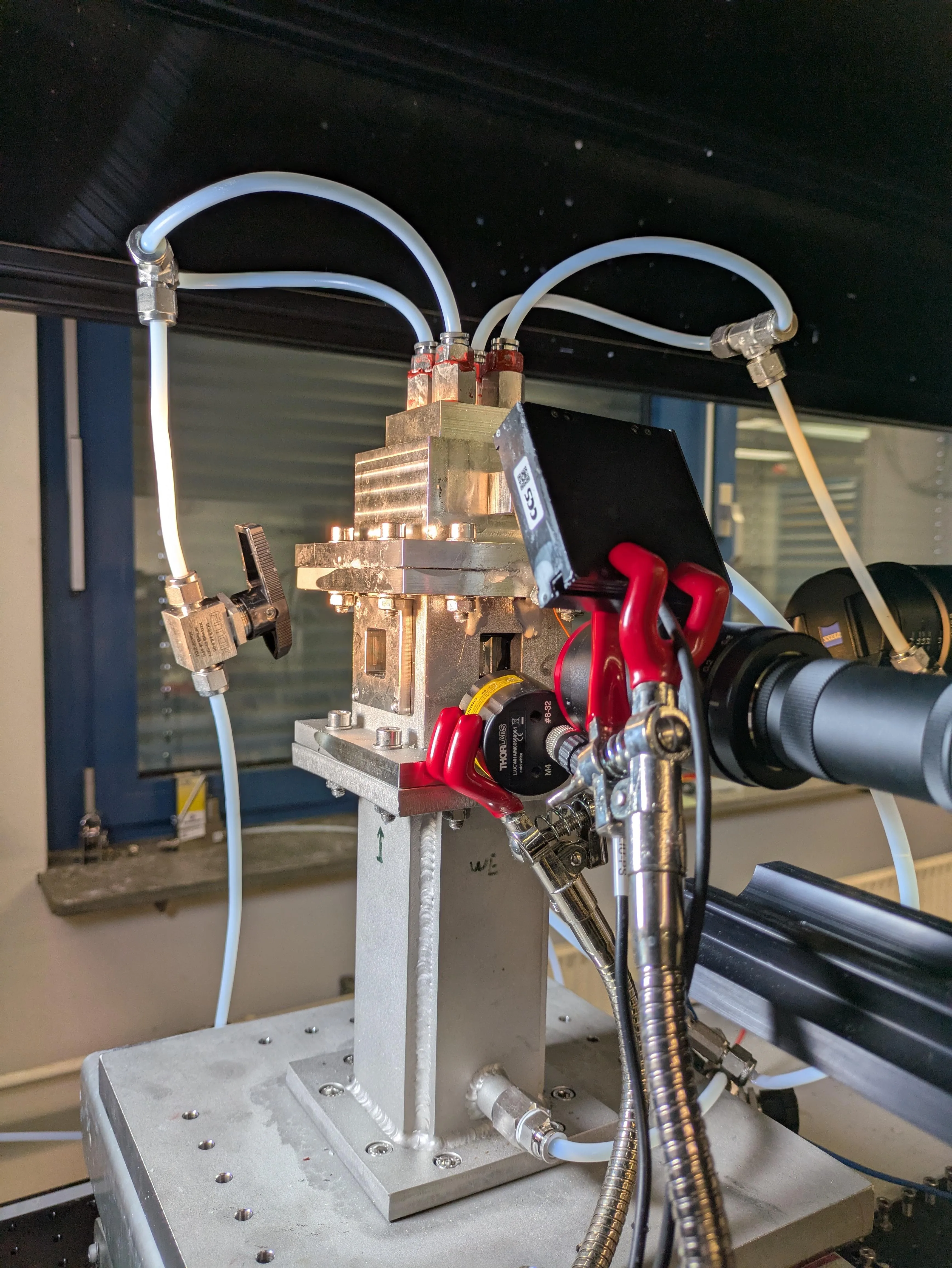
Splitting water into hydrogen and oxygen with electricity is an age-old dream of clean fuel. But tiny gas bubbles stand in the way: they cling to the electrodes like foam on the side of a soda glass, interfering with the current's work. Each bubble is a tiny plug, blocking part of the surface where the reaction should occur.
Scientists decided to see what would happen if they raised the pressure in the setup. It turned out that bubbles become smaller: they get compressed like balloons underwater. And by patterning the electrode with microscopic pillars, you can control bubble size: the larger the pillars, the larger the bubbles they release. In experiments, pressure ranged from 1 to 6 atmospheres, and at high pressure, small bubbles detached faster, freeing up space for the reaction.
The most surprising part: although thermodynamics predicts an increase in voltage losses with pressure (about 23 millivolts at 6 atmospheres), in practice, at high current, losses did not increase but decreased — by as much as 60 millivolts. The small bubbles more than compensated for the thermodynamic penalty. This paves the way for cheaper hydrogen, which could be produced right at wind and solar farms, storing wind and solar energy as gas.
So, battling bubbles is not just technical tinkering. It's a step toward hydrogen no longer being an expensive laboratory curiosity but becoming a common fuel that can be stored and transported.
Original abstract
as written by the authors arXiv:2603.26855
Understanding how bubbles influence the efficiency of water electrolysis is crucial to achieve economically competitive hydrogen, generated by renewable energy sources, such as wind and solar power. Water electrolysis is typically performed at high pressures to reduce the cost of energy-intensive mechanical compression of the produced H2. Thus, a better understanding of how the absolute pressure affects electrochemical performance and bubble size is necessary. In general, bubble sizes decrease as the pressure increases. Using different-sized pillar-patterned Ni electrodes generated by Direct Laser Writing, the detached bubble sizes can be modified even at elevated pressures. As the pillar size increases, the bubbles become larger at all pressures investigated from 1 to 6 bar. At a current density of -25 mA/cm2, the cathodic potential increases with pressure according to the thermodynamic voltage losses given by the Nernst equation (~ 23 mV at p = 6 bar). Surprisingly, increasing the current density to 100 mA/cm2 leads to a reduction of the overpotential by up to ~ 60 mV. Reduced bubble sizes at increased pressures minimize the losses caused by the bubbles, thereby compensating for the thermodynamic voltage penalty. Applying the Buckingham {\Pi}-theorem enables the derivation of dimensionless numbers to characterize the ratio of bubble-induced and thermodynamic voltage losses
Bubbles during water electrolysis act like tiny lenses: they refract light and can even create rainbow patterns on the electrode surface.