The Faraday constant, F, is the magnitude of electric charge carried by one mole of electrons, approximately 96,485.33212 C/mol. It bridges the macroscopic world of electrolysis and electrochemistry with the microscopic world of individual charges: one mole of electrons carries exactly F coulombs. It is named after Michael Faraday, whose laws of electrolysis established the quantitative link between charge and chemical change.
History
Faraday formulated his laws of electrolysis in 1834, but the constant itself was first determined numerically by later researchers, notably by John Strutt (Lord Rayleigh) and others in the late 19th century. The modern precise value comes from measurements of the elementary charge and Avogadro's number.
How it works
The constant is defined as F = N_A × e, where N_A is Avogadro's number and e is the elementary charge. In electrolysis, passing a current I for time t deposits a mass m of a substance with molar mass M and valence z, following m = (M × I × t) / (z × F). This relation allows chemists to calculate how much material is produced or consumed in electrochemical cells, from batteries to electroplating.
In practice
The Faraday constant is used in electroplating, battery design, fuel cells, and in analytical chemistry for coulometric titration—a technique that measures the amount of substance by the charge passed.
Fun fact
The Faraday constant is so large that one mole of electrons—about 6 × 10²³ particles—would take over 11 days to flow through a standard 100-watt light bulb.
A microwave oven heats food, but in the lab, microwaves have done something different: they turned a superconductor into a permanent magnet. A 300-nanometer-thick film of yttrium barium copper oxide, cooled to 80 kelvin, responded to 5-gigahertz radiation.
Water in a glass looks continuous, but it's actually a dance of trillions of molecules constantly breaking and forming bonds. Seeing this dance in full detail was previously impossible: accurate calculations that account for the quantum properties of electrons could only handle tiny droplets of a few hundred atoms. The new model UBio-MolFM changes the game.
A molecule works like a marketplace: electron shoppers enter through two gates (contacts) and head for stalls with the most attractive goods — the chemically active spots. Previously, current was thought to spread evenly, but it turns out up to 90% of all flow rushes through these 'hot spots'. Reactive centers become superconducting highways inside the molecule.
The hunt for non-Abelian anyons is a quest for a quantum ghost that leaves only one clue: entropy. These particles live in two-dimensional systems at ultralow temperatures. Their exchange doesn't just flip the sign of the wavefunction — it entangles states, creating topological order.
A neat stack of atomic layers lies on a substrate. An invisible beam of terahertz light shines down on it, with a magnetic field applied from the side. After reflection, the beam's polarization rotates slightly.
An ordinary crystal is like an apartment building: electrons move through shared hallways and staircases, influencing each other through the walls. Now, imagine removing all the walls, leaving just a single line of apartments. How would the residents behave?
Hydrogen has nothing to do with it, but the collective behavior of electrons takes center stage.
In a thin semiconductor channel, electrons behave not like lone runners but like a crowd at rush hour. They constantly bump into each other, and these collisions determine how easily heat and electric current pass through the material.
Water boils at 100 degrees Celsius, but if you squeeze it hard enough, it behaves differently. Similarly, quarks and gluons, the building blocks of protons and neutrons, change their properties in a strong magnetic field.
Splitting water into hydrogen and oxygen with electricity is an age-old dream of clean fuel. But tiny gas bubbles stand in the way: they cling to the electrodes like foam on the side of a soda glass, interfering with the current's work. Each bubble is a tiny plug, blocking part of the surface where the reaction should occur.
Radio waves passing through magnetized gas have their polarization slightly rotated, like a compass needle deflecting near a magnet. This rotation, called the Faraday effect, revealed the invisible environment around the supermassive black hole in galaxy NGC 1275.
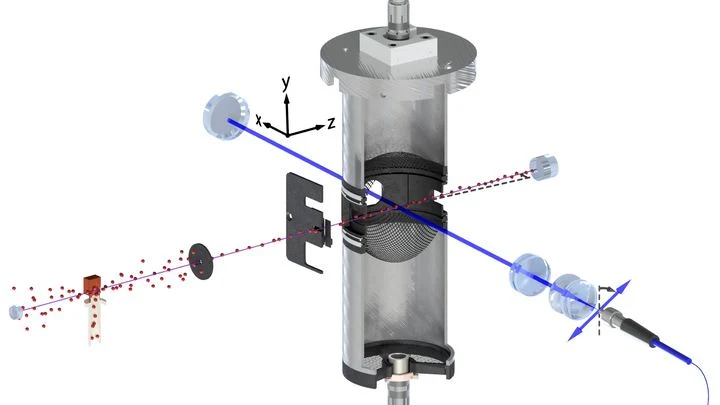
A tiny glass sphere floats in a laser beam like a speck of dust in sunlight. Inside it is radioactive lead, which decays from time to time. Each decay ejects charged particles, and the sphere loses or gains a tiny electric charge.
In an underground ring 27 kilometers in circumference, protons are accelerated to nearly the speed of light and smashed head-on. At the collision point, conditions briefly recreate those of the first trillionth of a second after the birth of the universe.
Fast radio bursts are instantaneous radio flashes from deep space. In a thousandth of a second they release as much energy as the Sun emits in a month. One such burst, repeating, allowed scientists to peer into the epicenter of a recent stellar explosion.
The hydrogen atom is like a tiny clock, ticking with a precision engineers can only dream of. When an electron jumps between orbits, it absorbs or emits light at a strictly defined frequency: that's the 'tick.' In the new work, physicists caught one such transition, between the 2S and 6P states, and measured its frequency with an…
In the crystal lattice of iron selenide, iron and selenium atoms alternate like bricks in a wall. But sometimes extra iron atoms sneak into the voids between them, like uninvited guests squeezing into the gaps between bricks.
A translator gets distracted by every rustle in the hall, and a one-hour meeting stretches into two. Single molecules squeezed between two metal contacts behave much the same way: they constantly change their shape and seating, and this affects how current and heat pass through them.
After an injection under the skin, a drug doesn't just spread out like ink in water. Antibody molecules carry an electric charge, and that charge makes them interact with surrounding tissues — much like a magnet attracts or repels iron filings.