The Reactor That Eats Its Own Fuel express
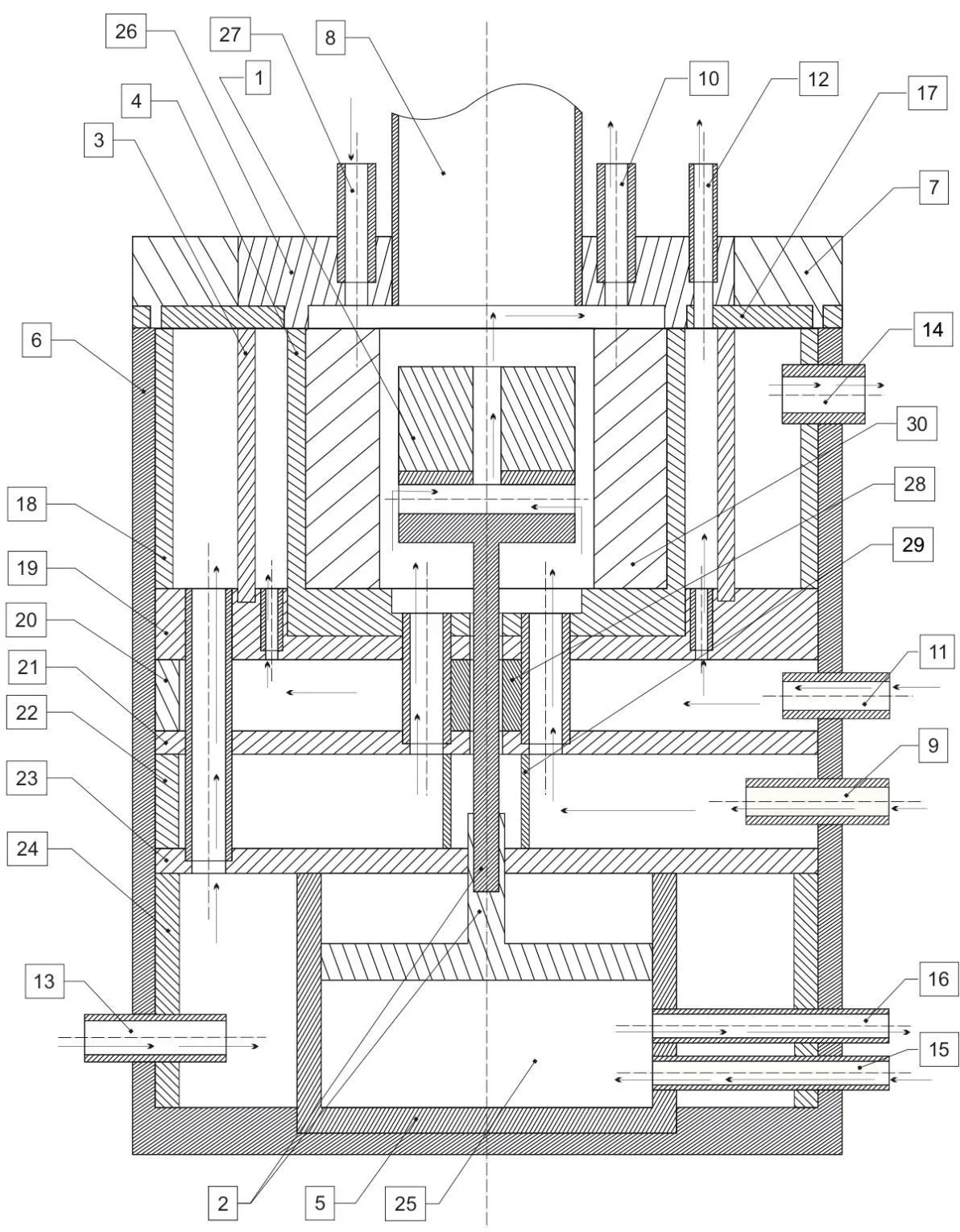
An ordinary nuclear reactor is like a boiler where fuel burns evenly throughout the volume. Here the picture is different: a fission wave, a narrow zone where atoms split and release heat, slowly creeps along a cylindrical rod of uranium carbide. Ahead of the wave, the fuel is untouched; behind, it is already spent. So fire runs along a candle wick, leaving wax behind.
The main trick lies in the neutron spectrum. In ordinary fast reactors, neutrons are very energetic and quickly damage walls and mechanisms. Here the spectrum is softened: the peak falls at 20–50 thousand electronvolts (for comparison, the energy of a neutron in this range is hundreds of times lower than in a typical fast reactor). This reduces radiation damage to materials by more than an order of magnitude. Additionally, the fuel slowly moves relative to the channel walls via a hydraulic system, so a given point on the wall is not irradiated all the time.
Such a reactor is a prototype of a single-channel device with cylindrical symmetry. It requires no complex refueling systems and allows much fuller use of uranium than ordinary thermal-neutron reactors. If a pilot model confirms the calculations, humanity will get an energy source that itself "finishes off" its fuel, leaving less waste.
Original abstract
as written by the authors arXiv:2603.28833
This paper presents the principle scheme of the prototype of the fast single channel reactor operating in the traveling wave fission mode on the soft fast neutron spectrum. The reactor design has cylindrical symmetry. The problem of the radiation resistance construction materials in this experimental reactor is solved by the base proposals published by the authors of this article. The traveling wave fission mode is realised by the neutrons with the softened fast spectrum. The neutron spectrum peaks is in range 20000 - 50000 eV. That reduces the neutron impact on construction materials more than an order of magnitude. To further reducing neutron impact on construction materials in the reactor using elements of the hydravlic fuel handling system for nuclear fuel movement relative to the fuel channel walls. The nuclear fuel in which the fission wave travels is the cylindrical uranium dicarbide.
The fission wave in such a reactor moves at a speed of a few centimeters per year — slower than fingernails grow.
The idea of a self-sustaining fission wave resembles the fictional "atomic fire" from Larry Niven's novel Ringworld, but here it is real and under control.