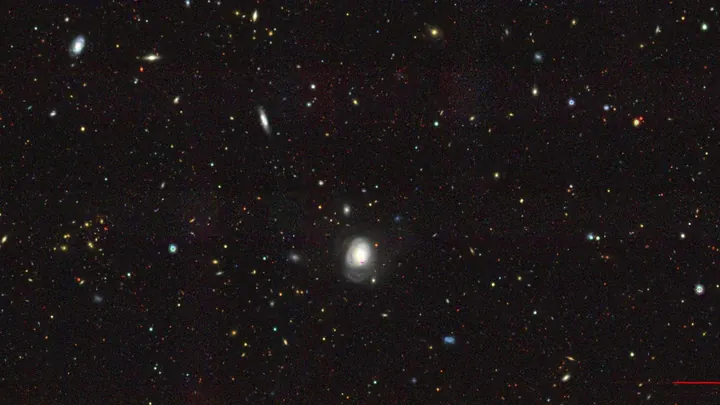
A satellite galaxy is a smaller galaxy that orbits a larger one, held in place by the larger galaxy's gravitational pull. The Milky Way, for example, has dozens of such companions, including the Large and Small Magellanic Clouds, which are visible to the naked eye from the Southern Hemisphere. Satellite galaxies can be dwarf spheroidals, irregulars, or even small spirals, and they play a crucial role in understanding how galaxies form and evolve.
History
The concept of satellite galaxies dates back to the early 20th century, when astronomers like Harlow Shapley recognized that the Magellanic Clouds are separate systems gravitationally bound to the Milky Way. Systematic surveys in the 1990s and 2000s, such as the Sloan Digital Sky Survey, dramatically increased the known count of Milky Way satellites.
How it works
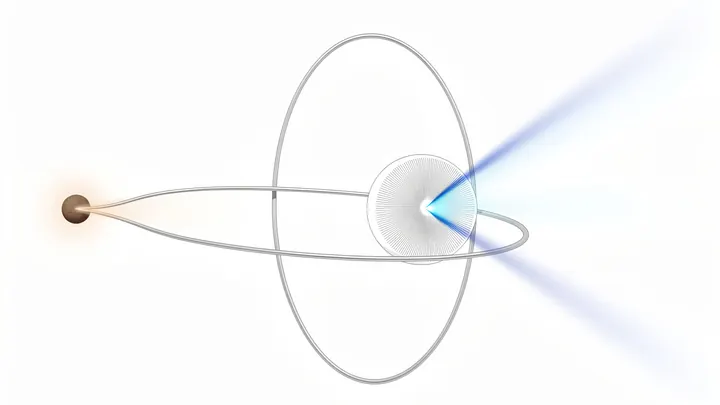
The satellite galaxy moves along an orbit determined by the gravitational field of the host galaxy. Over time, tidal forces — the difference in gravity across the satellite's extent — can stretch and distort it, sometimes pulling streams of stars into the host. The satellite's motion and internal dynamics reveal the mass distribution of the host galaxy, including its dark matter halo, which is otherwise invisible.
In practice
Satellite galaxies are used to test models of dark matter and galaxy formation, and they provide natural laboratories for studying stellar populations in low-mass environments.
Fun fact
Some satellite galaxies, like the Sagittarius Dwarf, are being torn apart by the Milky Way's gravity, leaving behind a stream of stars that wraps around our galaxy.
A million orbits: the same score. Nine dark matter halos: nine orchestras without a conductor. All musicians play from the same notes, but in each hall the music sounds different: sometimes in tune, sometimes out of sync. Likewise, satellite galaxies falling into a host halo follow orbits that depend not only on mass but also on the shape of the invisible stage.
Picture a lighthouse on the shore at night. Its lamp is off almost all the time, but once every few days, for a split second, it blazes so brightly that the light is visible beyond the horizon.
Picture a lighthouse on the shore at night. Its lamp is off almost all the time, but once every few days, for a split second, it blazes so brightly that the light is visible beyond the horizon.
Radio telescopes listen to the sky like sensitive ears: they catch the whispers of distant explosions, the hum of galaxies, the crackle of pulsars. But sometimes they pick up a sound that isn't in the catalogs. In 2003, such a sound emerged in the constellation Aquila — a spot in the sky that had been quiet until it suddenly began to speak.
A lighthouse flashes for a fraction of a second and goes dark again. The MeerKAT telescope in South Africa catches such flashes in the radio band. During its observations, it picked up 27 new sources that no one had seen before. Neutron stars are the remnants of exploded stars, compressed to the size of a city.
Pulsars are rapidly spinning neutron stars that emit radio pulses like a lighthouse. But some of them stay silent almost all the time, occasionally emitting a single pulse. Such objects are called rotating radio transients (RRATs). They were discovered nearly twenty years ago, but they remain a mystery.
A lighthouse that blinks not every second but once every few minutes or even hours. That is exactly how long-period radio transients behave — cosmic sources discovered only recently.
Somewhere in the depths of the Milky Way, radio pulses flare up from time to time — rare, steady, like the ticks of a distant metronome. These long-period radio transients were discovered only recently, and they immediately puzzled astronomers.
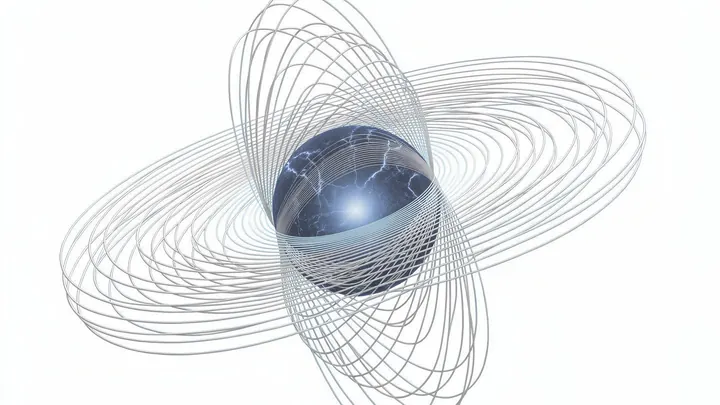
Right after the Big Bang, space cooled unevenly. In some places, folds could have formed — threads of energy as thin as a hair but incredibly dense. Physicists call them cosmic strings. They oscillate, collide, and emit gravitational waves — ripples in the fabric of space itself.
In 1967, astronomers caught the first radio signal from a distant cosmic lighthouse — a pulsar. Since then, thousands of these stellar remnants have been discovered, slicing through space with beams like a revolver's burst.
At the center of many galaxies lurks a supermassive black hole, ejecting relativistic plasma jets over hundreds of kiloparsecs. One such is the radio galaxy ESO 137-G007 in the Norma Cluster, known as the “Corkscrew Galaxy” for its twisted jets.
Long-period radio transients (LPTs) are a mysterious class discovered only recently. Their pulses last minutes or hours, and their nature was completely unknown. ASKAP J1745-5051, caught by the Australian telescope ASKAP, became the first to get a full explanation.
Einstein and Rosen imagined a bridge connecting two sheets of reality. Wheeler gave it a name — wormhole, and Thorne with Morris proved: the tunnel is traversable if you fill it with exotic matter.
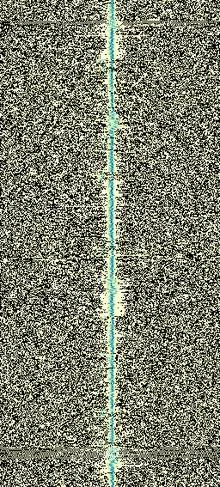
The night sky looks calm, but if you listen in on the radio band, it's full of short clicks and rustles. Astronomers are combing the sky for solitary radio pulses — bursts lasting milliseconds that come from various corners of the Galaxy and beyond.
One such search is underway at the 100-meter radio telescope in Effelsberg, Germany.
A guitar string only sounds at certain notes, when pressed at the frets. So it is with the gas-dust disk around a young star: it's shot through with standing waves, but only chosen oscillations survive. Where the wave crests, cosmic dust and hydrogen collect, and later exoplanets are born.
A radio telescope picks up a signal from the center of the Milky Way. The source MAXI J1744-294 flares in X-rays and radio waves, but where it actually resides is a mystery. It could be near the black hole, or it could just lie along the same line of sight, thousands of light-years away.
Stars on the outskirts of galaxies rotate unexpectedly fast. According to Newton, the farther from the center, the slower the motion should be, like in a round dance, where the outer dancers move more slowly. But in reality, stellar outskirts race along almost as fast as the core, resembling a giant carousel: on it, the outer horses fly faster so as not to fall behind the inner ones.
Around distant icy bodies the size of a city, circling beyond Neptune, rings of dust and ice have been found. Small moons often whirl nearby. Mathematical analysis shows that a moon's gravity rocks the ring like a swing, making it tilt.
The night sky is full of beacons that blink on schedule. Pulsars are fast-spinning neutron stars whose radio pulses arrive with clockwork precision. But there are other beacons too: they stay silent for minutes or hours, then suddenly emit a single pulse, and go quiet again.
An ordinary nuclear reactor is like a boiler where fuel burns evenly throughout the volume. Here the picture is different: a fission wave, a narrow zone where atoms split and release heat, slowly creeps along a cylindrical rod of uranium carbide. Ahead of the wave, the fuel is untouched; behind, it is already spent. So fire runs along a candle wick, leaving wax behind.
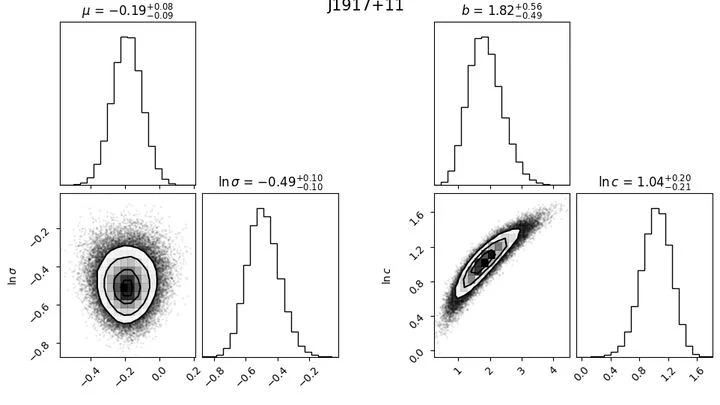
Radio pulsar J1574+4703 behaves like a finicky lighthouse. Instead of shining steadily, it turns its radio beam on in short flashes and then falls silent for long stretches. Objects like this are called 'rotating radio transients', or RRATs for short.
Astronomers caught a signal from a cosmic lighthouse — a radio pulsar with a period of 36 minutes. Unlike ordinary pulsars (neutron stars that spin hundreds of times per second), this one barely turned. It transmitted pulses for only eight days and vanished, visible only in the radio range.
For a long time, astrophysics was dominated by the belief that giant jets of radio emission, radio outbursts blasting from central regions, were the exclusive privilege of elliptical galaxies. It was thought that only their calm, featureless internal environment could allow such colossal fountains of energy, powered by supermassive black holes, to form.
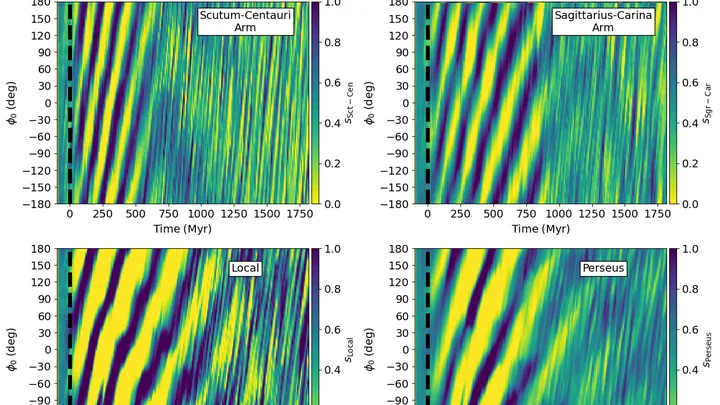
The Sagittarius galaxy plunged into the disk of the Milky Way and passed through again and again, like a stone thrown into a still pond. Each strike left ripples: waves and warps in the star field.
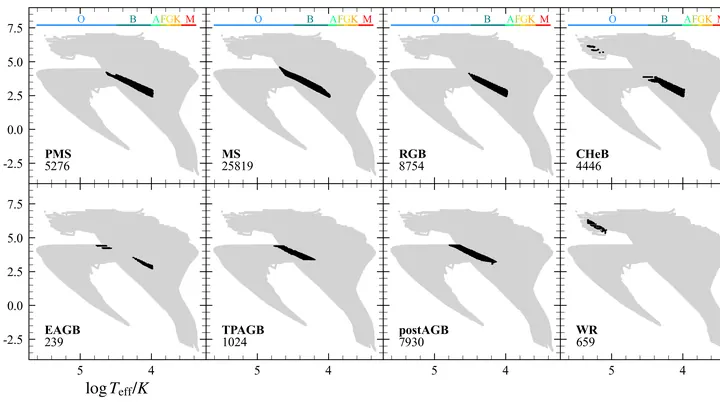
The night sky looks like a scattering of identical sparks. But hidden among them are true giants — red supergiants. These stars are hundreds of times wider than the Sun and shine so brightly that they can be seen from enormous distances. You'd think there'd be no better beacons for a map of the galaxy.