Light and Atoms: How Anisotropy Controls Heat express
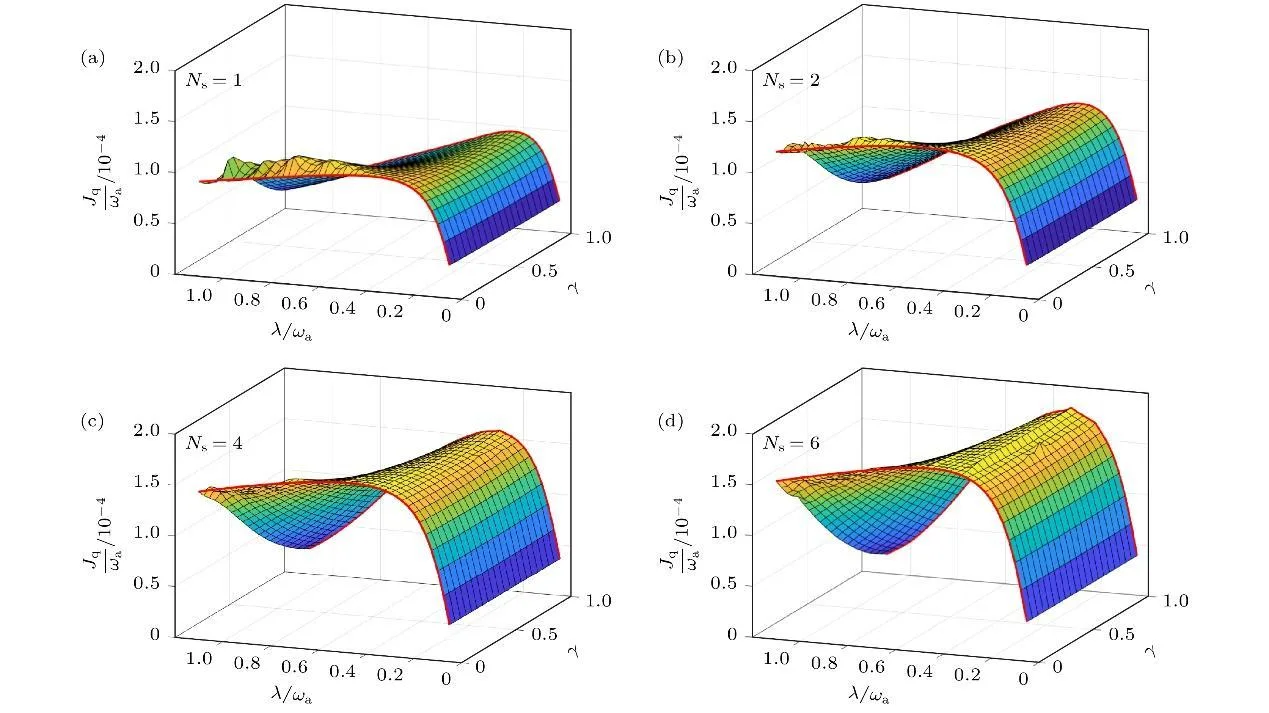
Light and atoms, like dancers, can move in sync or out of step. When their interaction is anisotropic (that is, direction-dependent) the dance gets trickier. In a new study, physicists considered a model where many atoms (qubits) collectively interact with an anisotropic light field, and each component is connected to a thermal reservoir. It turns out that anisotropy can drastically change the heat flow through the system.
The number of atoms acts as an amplifier: as it grows, the peaks in heat current become higher and the valleys deeper. In the limit of an infinite number of atoms (the thermodynamic limit), simple formulas were derived that set an upper bound on the heat current for finite systems. These formulas describe a process akin to cotunneling — where heat is transferred not in single quanta but in coordinated chunks.
A thermal diode, a device that conducts heat better in one direction than the other, also depends on anisotropy. Tuning the light–atom interaction opens a path to controlling heat at the quantum level, which could prove useful in future microelectronics.
In the Dicke model, interaction anisotropy can lead to exotic quantum phase transitions, where the system's properties change abruptly as parameters are varied smoothly.