Quantum light-matter interaction studies how quantum systems—atoms, molecules, or solid-state devices—exchange energy and information with light at the quantum level. This field underpins technologies like quantum networks, where photons carry quantum information between distant nodes, and quantum sensors that exploit light-matter entanglement. It also explains fundamental phenomena such as spontaneous emission and the Lamb shift.
History
The quantum theory of light-matter interaction was developed in the 1920s–1940s by Dirac, Fermi, and others, culminating in QED. The concept of strong coupling was realized experimentally in cavity QED in the 1990s.
How it works
At its core, this interaction is described by quantum electrodynamics (QED), where light is quantized into photons and matter into discrete energy levels. When a photon matches an energy transition in an atom, it can be absorbed or emitted, with the process governed by probabilities. In strong-coupling regimes, the system can enter a state where light and matter exchange energy coherently, forming hybrid quasiparticles called polaritons.
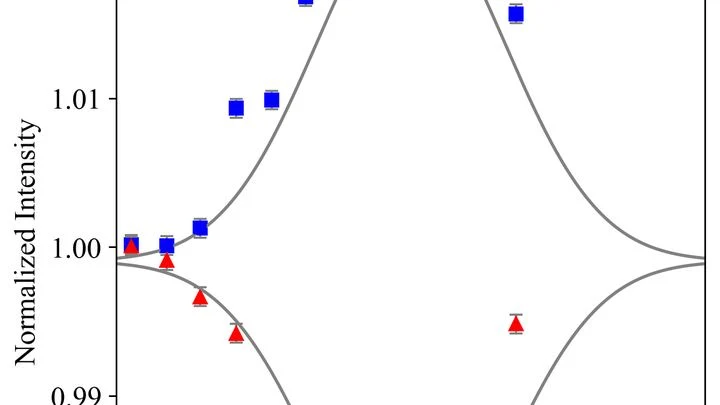
In a phenomenon called 'vacuum Rabi splitting,' even a single atom in a cavity can split a beam of light into two distinct frequencies, revealing the quantum nature of the interaction.
Quantum computers of the future will likely communicate via light. An atom stores information, and a photon carries it across the network. But an atom doesn't hang still: it jitters and oscillates, and this motion can corrupt the signal.
Previously, engineers could only calculate for a stationary atom.
In 1905, Einstein showed that the chaotic motion of pollen in water results from the jostling of invisible molecules. A century later, physicists have learned not only to observe but also to control motion at the quantum level.
Spacetime can be imagined as a tightly stretched fabric. A massive body dents it, guiding light. Rotation twists the fabric into a spiral. Such a gravitational funnel can entangle a passing photon with the very source of rotation — say, a tiny mirror. Quantum entanglement springs up: an invisible thread binding their fates.
In the quantum world, light and matter constantly exchange energy. Previously, they were described statically, like frozen poses. The new approach follows the dance itself: the transitions between states, like a continuous sequence of movements.
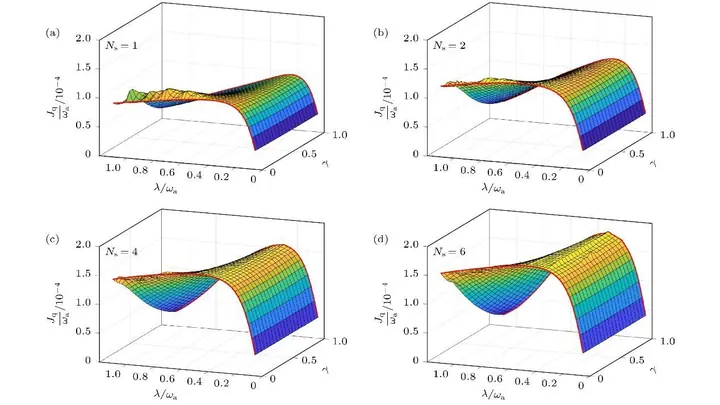
Light and atoms, like dancers, can move in sync or out of step. When their interaction is anisotropic (that is, direction-dependent) the dance gets trickier. In a new study, physicists considered a model where many atoms (qubits) collectively interact with an anisotropic light field, and each component is connected to a thermal reservoir.
In a dark room, two flashlights shine on a wall. Usually, their beams simply add up, and the spot becomes brighter. But if the flashlights emit light in special packets, photons, then under certain conditions they can behave differently. Instead of independently hitting different spots, two photons 'agree' and only come out together, as a pair, from a single output.