The concept explains how matter transitions from classical to quantum behavior. At room temperature, thermal fluctuations overwhelm quantum effects, but as temperature drops, the de Broglie wavelength of particles—the quantum spread of their position—becomes comparable to the distance between them. This leads to overlapping wavefunctions and macroscopic quantum phenomena. The study of ultra-low temperatures has also revealed unexpected states, such as supersolids and quantum spin liquids, reshaping our understanding of condensed matter.
History
The field began with the liquefaction of helium by Heike Kamerlingh Onnes in 1908, who later discovered superconductivity in mercury at 4.2 K. The concept of absolute zero was earlier formalized by William Thomson (Lord Kelvin) in the 19th century. The development of laser cooling in the 1980s, recognized with the Nobel Prize in 1997, opened the door to nanokelvin temperatures.
How it works
The mechanism relies on removing energy from a system. For gases, laser cooling uses photons to slow atoms, while evaporative cooling selectively removes the most energetic particles, leaving the rest colder. For solids, cryostats use liquid helium or dilution refrigerators to extract heat. At these temperatures, thermal conductivity and heat capacity change dramatically, and quantum effects like tunneling and coherence become observable. The key is isolating the system from external heat sources, often using vacuum chambers and magnetic or optical traps.
In practice
Ultra-low temperatures are used in quantum computing to maintain qubit coherence, in superconducting magnets for MRI machines and particle accelerators, and in precision sensors like SQUIDs (superconducting quantum interference devices).
Fun fact
At temperatures below 2.17 K, liquid helium becomes a superfluid that can climb up the walls of its container and leak through microscopic pores that are impermeable to normal liquids.
The Mpemba effect is a mystery where hot вода sometimes freezes faster than warm water. Usually this is attributed to how вода loses heat and энтропию (a measure of disorder). But in a glass of water, chaos prevents a precise model.
Physicists built a quantum model: a particle in a well with two depressions separated by a barrier.
Quantum tunneling — the ability of particles to pass through barriers forbidden by classical physics — powers stars with thermonuclear fusion, ignites primordial nucleosynthesis, and gives us flash memory.
Dark matter is the invisible scaffold that holds galaxies together. But how did it come to be? The standard answer: particles of dark matter once stopped colliding and "froze out" in the amount we see today. However, there's a trickier path — UFO, or ultra-fast freeze-out.
Here, everything is like coffee that cools down and then heats up again as you carry it through a cold corridor.
The Sun is a giant nuclear reactor that continuously sends us light and heat. But it also has another, almost silent postal service: every second, tens of billions of neutrinos, ghostly particles born in the thermonuclear furnace, fly through a square centimeter of your palm. Most of them leave no trace.
A hot liquid flows easily: molecules dart around, collide, and quickly find new spots. But cool it below its freezing point, and everything changes. Motion nearly freezes, and viscosity skyrockets. The key question isn't that particles are lazy, but where they can even go.
The authors combined two established ideas.
In an orchestra, one musician plays so quietly that their sound is almost inaudible in the overall chorus. In the quantum world, such 'quiet' states are called dark: their energy barely escapes, like light in a darkened room. But if there are many musicians, their mutual influence can unexpectedly awaken even the most silent one.
Hundreds of people on a dance floor stand at equal distances from each other — strict order, like in a crystal lattice. Slow music is thermal vibrations, making dancers sway slightly. If the music gets louder and faster, order collapses: everyone mixes. That's how thermal motion destroys ordered states of electrons in solids.
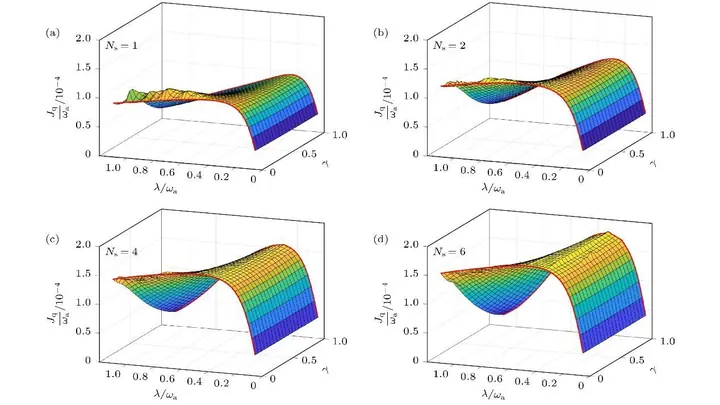
Light and atoms, like dancers, can move in sync or out of step. When their interaction is anisotropic (that is, direction-dependent) the dance gets trickier. In a new study, physicists considered a model where many atoms (qubits) collectively interact with an anisotropic light field, and each component is connected to a thermal reservoir.
A layer of electrons trapped between two semiconductor plates lines up into a neat lattice at low temperatures, like beads on a string stretched between your fingers. As the temperature rises, order collapses: the crystal melts. But exactly how it melts has long been a puzzle.
Light from tiny perovskite crystals is like a choir performance, where voices sound sometimes solo, sometimes in a tight duet. Previously, such a duet could only be heard under extreme cooling, nearly to the chill of outer space. Now the choir sings at room temperature.
Since Vera Rubin first convincingly showed that galaxies are surrounded by invisible matter, the quest to understand the nature of dark matter has remained one of physics' greatest challenges.
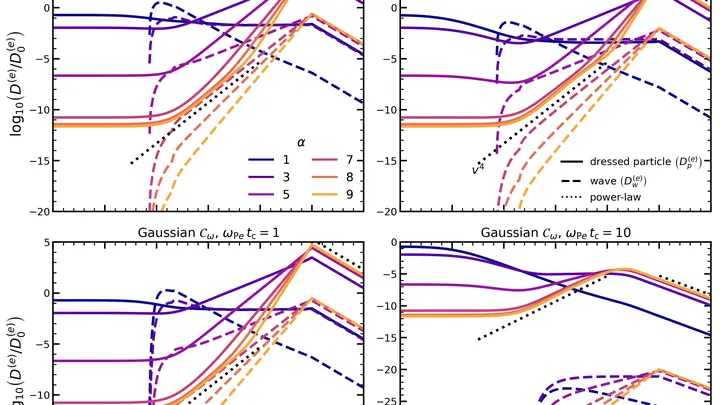
In a hot gas of charged particles — plasma — chaotic electric fields work like a sieve. A slow particle gets surrounded by a cloud of opposite charges, which cancels the external field. A fast one sheds this armor and gets accelerated.
Ice cubes in a glass melt, and the water mixes on its own. Many quantum systems behave this way: particles exchange energy, and after a while, order disappears. But if you add a spoonful of honey to the glass, mixing slows down, and in intense cold, the water freezes into glass — without a crystal lattice, but also without flow.
In a laboratory at Purdue University, a laser beam strikes a crystal of hexagonal boron nitride, and in response, a single point of light flashes. This is not just luminescence; it is a signal from a spin defect, a pair of electron spins, one of which is coupled to a carbon-13 nuclear spin.