The Dwarf Galaxy That Stopped Making Stars express
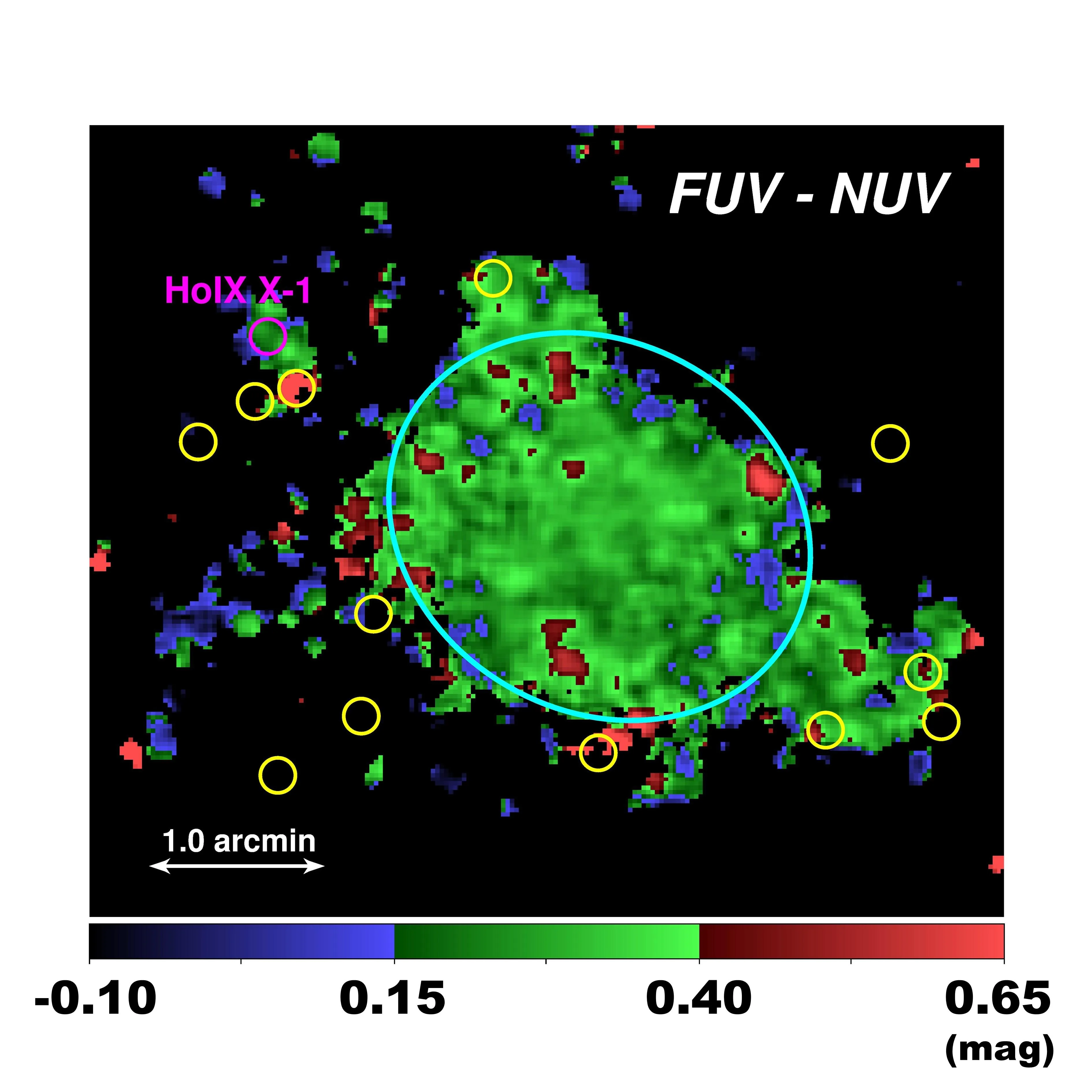
The galaxy Holmberg IX is like a city where construction of new houses suddenly stopped, even though building materials are everywhere. Astronomers peered into it with various telescopes and saw a strange picture: plenty of gas and heavy elements, but almost no dust. Usually, where there's gas, new stars are born, but here it's different.
From the glow in ultraviolet and hydrogen, scientists deduced that nearly all the stars formed about 130 million years ago in a single short burst. After that, star formation abruptly ceased, and in the last 80 million years, hardly any new stars have appeared. Currently, faint pockets of star formation are visible only at the galaxy's edges. It's as if life in the city center has frozen, while the outskirts still show some signs of activity.
What happens next? If star formation doesn't resume, the galaxy could become like a dim globular cluster of stars, or alternatively, gradually dissolve into space. But there's another possibility: if it's only producing very faint stars that are hard to detect, it could remain as is for a long time. Either way, Holmberg IX forces us to rethink our understanding of dwarf galaxy life cycles.
Original abstract
as written by the authors arXiv:2604.02831
In this Letter, we report a novel discovery of unique characteristics for the tidal dwarf galaxy (candidate) Holmberg IX via a multiwavelength investigation. New observations are taken for deeply mapping H{\alpha} emission and combined with archival/published data for comprehensively probing dust, gas, and stellar populations in this galaxy. We find in Holmberg IX a dearth of dust incompatible with its rich gas and metal; globally young stellar populations with prominent far-ultraviolet but deficient and marginal H{\alpha} emissions, distinct from other tidal dwarf galaxies ever known. By assuming a normal initial mass function (IMF), Holmberg IX is suggested to be born ~130 Myr ago from a bursty star formation event, which then rapidly ceased, with very few stars formed in the past ~80 Myr that demarcates a lower age limit for the galactic mainbody; current star formation occurs only in outskirts, bringing a conundrum about the reason for the recent quenching in such a gas-rich environment. Contradicting the general expectation for tidal dwarf galaxies hosting continuous star formation, the present quiescence implies Holmberg IX currently staying in a rarely-seen transient period. Without star formation continuing, Holmberg IX is likely transforming into a dwarf spheroidal galaxy, or oppositely into a(n) (ultra-)diffuse system which will probably dissolve in the end. Instead, if Holmberg IX possesses peculiar IMF and hosts low-mass, weak-H{\alpha} star formation, it is able to maintain long-term survival in its current status. On whichever evolutionary pathway in reality, Holmberg IX appears as a special case updating conventional understandings of tidal dwarf galaxies and hinting potential existence of similar analogs in the Universe.
Holmberg IX lies near the large galaxy M81 and may be stretched by its tidal forces, like dough pulled apart by hand.