A Seyfert galaxy is a type of active galaxy with a very bright, compact nucleus, powered by accretion onto a supermassive black hole. Unlike quasars, Seyfert galaxies are relatively nearby and their host galaxy is clearly visible. They are characterized by strong, broad emission lines in their spectra, originating from gas moving at high speeds near the black hole. They are important laboratories for studying the physics of black hole accretion and jet formation.
History
Carl Seyfert first identified this class of galaxies in 1943, based on their unusual spectra with bright emission lines. The connection to black hole accretion was established in the 1960s and 1970s with the advent of X-ray astronomy.
How it works
The central engine of a Seyfert galaxy is a supermassive black hole surrounded by an accretion disk of gas and dust. As matter spirals inward, it heats up and emits intense radiation across the electromagnetic spectrum. Some Seyferts also launch relativistic jets, collimated beams of plasma moving at near-light speed, which can extend far beyond the host galaxy.
In practice
Seyfert galaxies are used as natural laboratories to study the physics of accretion disks and jets, which is also relevant to understanding black hole systems in our own galaxy. They are also used as probes of the large-scale structure of the universe.
Fun fact
The variability of Seyfert galaxies' emission can be so rapid that it implies the central black hole's event horizon is only a few light-hours across, smaller than our solar system.
A little monster hides in a dwarf galaxy, and its neighbor feeds it. The satellite galaxy is slowly merging with a massive companion, and gas from the outer regions falls toward the center, where a black hole sits. By cosmic standards, it is not large: only 800 to 5000 solar masses, but its appetite is ferocious.
In a quiet back alley of a galaxy, where stars are rare and old, a light suddenly flares up, brighter than an entire galaxy. This is a Type Ia supernova: a thermonuclear explosion of a white dwarf that astronomers use as a standard candle to measure cosmic distances.
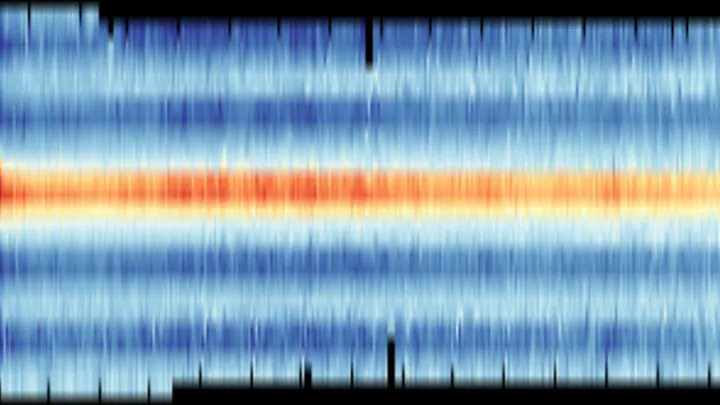
The XMM-Newton X-ray telescope stared at galaxy Mrk 1044 for two straight hours. Inside it, a black hole is surrounded by a swirling disk of superheated gas. This gas glows in X-rays, and its light flickers — brighter, then dimmer.
For the first half hour, the flickering of soft and hard X-rays was in step.
In the far reaches of space, there exists a hypothetical object: an ultracold black hole. It is charged and resides in an expanding universe (de Sitter space). Its temperature hovers just above absolute zero — about one trillionth of a degree above it.
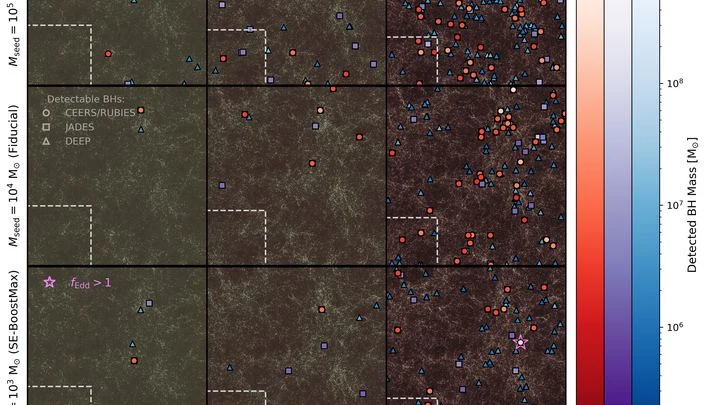
A marathon lasting 13 billion years started with different weights. A hundred solar masses — lighter than some gas clouds. A hundred thousand — gravitational dominance, comparable to an elephant among kittens. That's what black hole seeds looked like, ones that by our time should have turned into supermassive giants.
In the deep field of JWST, among thousands of galaxies, astronomers zoomed in on the source JADES-GS 209777 – and saw a cosmic chick. Its "shell" is a thick cocoon of gas and cosmic dust that long hid the growing black hole at its center. But at a redshift of 3,711 (1,8 billion years after the Big Bang), the shell began to crack.
The fastest wind in the Universe travels at 0,58 times the speed of light. It covers the distance from Earth to the Moon in two seconds. This wind is not a jet stream but a broad flow of gas erupting from the center of a galaxy. Not all black holes work the same: some create such hurricanes, while others produce narrow plasma beams.
The cosmos is full of screams we can't hear. Every time a black hole tears a star apart, a blinding flash is born, and often — a narrow relativistic jet, shooting out thousands of light-years. But if that searchlight is aimed away from Earth, we see only a faint afterglow — a radio echo arriving with a delay.
The James Webb Space Telescope peered into an era when the universe was less than a billion years old and spotted strange objects—'little red dots.' These are black holes with masses of millions of suns, but in very compact, chemically pristine galaxies. Standard scenarios can't grow such heavyweights that early.
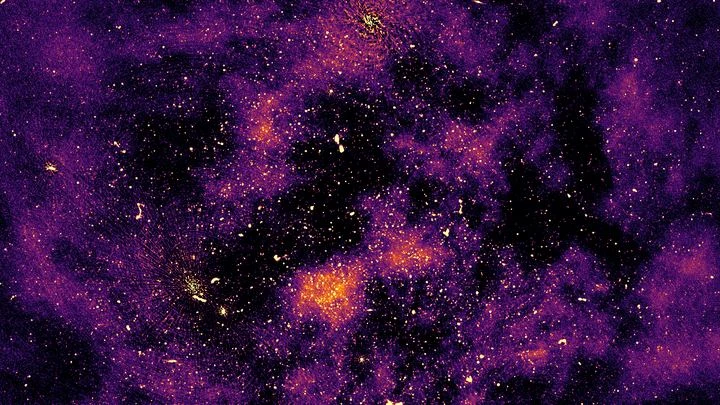
At the center of many galaxies lurks a supermassive black hole, ejecting relativistic plasma jets over hundreds of kiloparsecs. One such is the radio galaxy ESO 137-G007 in the Norma Cluster, known as the “Corkscrew Galaxy” for its twisted jets.
A black hole is not a frozen void, but a living magnetic engine. Its 'heart'—the accretion disk, pulsates: inhale, matter spirals into the funnel, exhale — magnetic reconnection tears the field lines, and plasma shoots away from the horizon.
The heart of many galaxies is a supermassive black hole. It doesn't just sit at the center; it occasionally flares brightly as it swallows surrounding gas.
Imagine a spotlight: if you look at it from the side, it glows dim red, but if you stare straight into it, it blinds you with white-blue light. That, according to new data, is exactly what the mysterious 'little red dots' in the early universe look like. They are giant black holes, objects with gravity so strong that even light cannot escape, turned edge-on to us.
The city has long been asleep: not a single lit window, not a single new house. Only in the very center, in one lone building, someone forgot to turn off a spotlight. That's what a galaxy looks like when stars are no longer born, yet its central black hole still shines.
The black hole GRS 1915+105 usually hides behind a dense gas curtain: its X-ray emission is heavily absorbed on its way to us. But in April 2023, it suddenly flared: the X-ray flux jumped nearly tenfold.
The galaxy MCG+11-11-032 is relatively close to us: its light takes about 150 million years to reach us. At its center, like in most large galaxies, sits a supermassive black hole. But a few years ago, astronomers began to suspect: what if there are two?
The clue came from the X-ray spectrum.
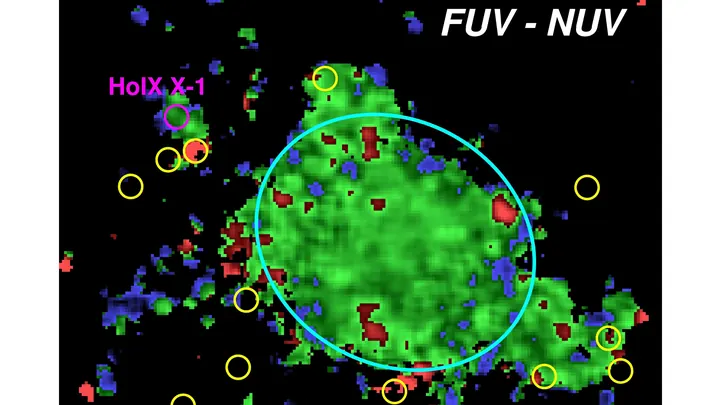
The galaxy Holmberg IX is like a city where construction of new houses suddenly stopped, even though building materials are everywhere. Astronomers peered into it with various telescopes and saw a strange picture: plenty of gas and heavy elements, but almost no dust. Usually, where there's gas, new stars are born, but here it's different.
The Fermi telescope spent 17 years recording gamma rays from the active nuclei of galaxies with giant black holes at their centers. The glow of their jets resembles a chaotic cacophony: it constantly changes.
For half a century, astronomers puzzled over the nature of the powerful X-ray emission from Gamma Cassiopeiae — a bright beacon in its constellation whose X-ray glow didn't fit models of single stars. An invisible companion was suspected, but direct evidence was lacking.
In a gas cloud left after a star exploded (called a supernova remnant), astronomers noticed a giant glowing letter S. It was drawn by two jets of superheated material ejected during the cataclysm. These jets didn't just shoot straight out — they slowly spun like a top, which bent their path into curves.
A stream of water from a hose hitting a wall splashes sideways. Astrophysical jets behave similarly — narrow plasma flows ejected from the vicinity of black holes or young stars. When such a flow encounters resistance from surrounding gas, a shock wave forms inside it, akin to a standing wave in a fast-flowing river.
Deep in the constellation Ophiuchus lies the galaxy NGC 6447. Until recently, it was quiet and unremarkable, like a house with its windows dark. But over the past 14 years, something has ignited at its center, and now it's visible in infrared light.
Black holes are cosmic drains, gravitational funnels that pull in matter from their surroundings. This process, called accretion, doesn't always go smoothly: some of the infalling gas can be ejected back as narrow relativistic jets — jets.
At the center of the galaxy Ton S180 lurks a black hole that occasionally flares in X-rays. These flares are like a flashlight beam shining onto a swirling disk of superheated gas. Part of the light heads straight toward us, while another part first hits the disk, bounces off, and only then reaches the telescope.
Imagine a city where a skyscraper and a huge park are being built at the same time. The skyscraper grows upward, and the park expands outward. Both processes are fast and get in each other's way, but in the end they are meant to become a single whole. That's the situation in galaxy GNz7q: a black hole grows at the center while new stars burst to life around it.
A city at night looks quiet from above, but life bustles in its neighborhoods: streets are blocked off, construction is underway, and equipment hums in basements. That's roughly how astronomers now see the galaxy cluster SPT-CL J2215-3537, located so far away that its light has traveled for more than 8 billion years.
At the center of galaxy VV 340a lies a supermassive black hole — an object with gravity so strong that even light cannot escape it. It emits a relativistic jet: a narrow stream of matter accelerated to near-light speeds.
In the 2010s, astronomers noticed something remarkable: supermassive black holes at the centers of galaxies, despite vast differences in size and brightness, fall onto a single straight line when you plot their millimeter emission against X-ray emission and mass.
The black hole in the binary system V4641 Sagittarii behaves like a giant blender. It sucks in matter from its companion star and flings it back into space in two narrow jets. These jets slam into the surrounding gas like a water jet hitting sand, gradually carving out a huge cavity around the hole.
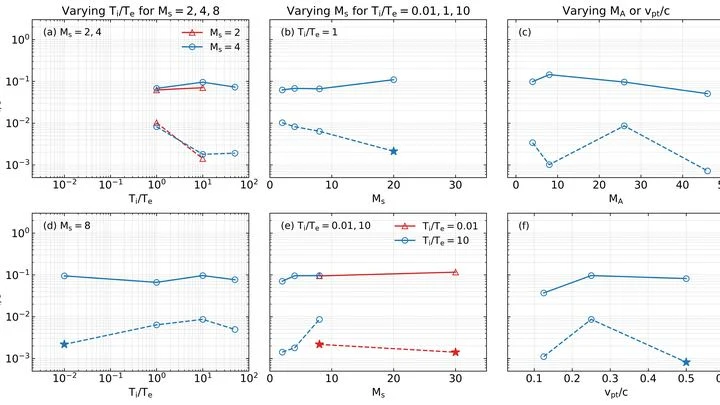
A new study confirms: shock waves in plasma around supermassive black holes at the cores of galaxies act like ocean swells, shoving protons to near-light speeds. Even a weak wave passes on a tenth of its energy, like a gentle surf launching a surfer into space.