Light That Kicks an Atom Sideways express
Light usually pushes an atom straight ahead, like wind pushing a sail. But if the beam is twisted into a corkscrew, the picture changes: the atom can fly off to the side, as if caught by a spinning wheel. In the new work, physicists calculated that such a vortex photon can transfer almost all of its rotation to the atom — up to 100 percent.
To achieve this, the collision must be head-on and very precise: the atom must pass within a few nanometers of the beam's axis. If it misses a bit farther, the fraction of transferred rotation drops, and the atom starts to spin unstably. The scientists found a simple rule: the result depends on how many times the miss distance exceeds the atom's size as a wave.
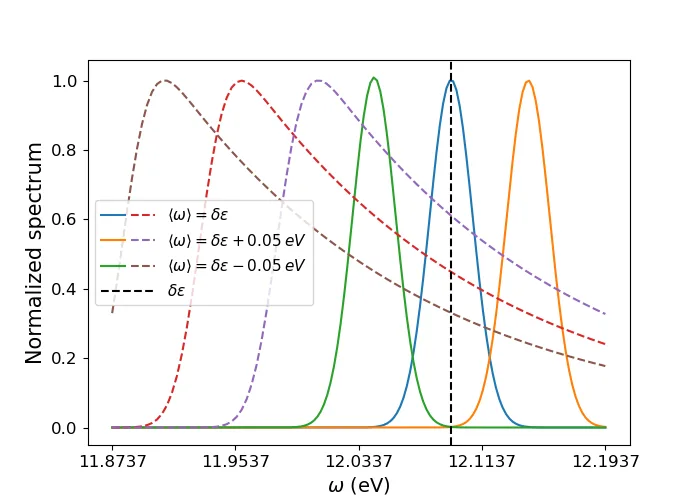
Interestingly, such twisted light allows the atom to undergo transitions that are forbidden with ordinary light. True, the strongest transitions remain ordinary, but the weak "forbidden" ones can also be observed. And if the light comes in a very short pulse, femtosecond, the shape of the atom's absorption line changes noticeably, and this can be measured.
The authors named two effects: "superkick," when the atom flies sideways near a vortex beam, and "self-kick," when the atom itself is initially twisted and gets a push from an ordinary beam. Both effects can be tested experimentally with cold atomic beams or ions in traps.
Thus, light ceases to be just a "pusher" and becomes a tool that can spin and direct an atom along a desired trajectory.
The vortex light in question resembles a beam whose wavefront is twisted like a spiral staircase. Such light carries not only energy but also angular momentum.
In science fiction, beams are often used to capture and move objects. Here, light can indeed spin an atom like a tiny tornado.