Positronium is a fleeting, hydrogen-like atom in which the proton is replaced by a positron — the electron's antimatter counterpart. It is the lightest known atom bound entirely by the electromagnetic force, with no nucleus in the traditional sense. Because the two particles are their own antiparticles, positronium is inherently unstable: it annihilates, converting its entire rest mass into gamma-ray photons, typically within a fraction of a microsecond.
History
Predicted theoretically in 1934 by Stepan Mohorovičić, positronium was first observed experimentally in 1951 by Martin Deutsch at MIT, who detected its annihilation radiation in gases.
How it works
The electron and positron orbit a common center of mass, much like a binary star system. The system can exist in two spin states: para-positronium (spins antiparallel) decays into two photons, while ortho-positronium (spins parallel) decays into three photons and lives about a thousand times longer. The energy levels are exactly half those of hydrogen, a direct consequence of the reduced mass being half the electron mass. Quantum electrodynamics predicts these levels with extraordinary precision, making positronium a pristine testbed for fundamental physics.
In practice
Positronium is used in positron emission tomography (PET) calibration and in studies of antimatterinteractions, as well as in quantum electrodynamics tests and searches for physics beyond the Standard Model.
Fun fact
In its ortho state, positronium lives about 142 nanoseconds — long enough for a photon to travel 42 meters, yet still the shortest-lived stable bound state in nature.
Deep inside a mountain, where cosmic-ray muons are muffled by a thick layer of rock, stands a detector that catches not light but its absence. Positronium is a tiny atom in which an electron and its antiparticle, the positron, circle each other like a pair of dancers. Usually they come together and vanish in a flash of two or three gamma quanta.
The helium atom is like a tightly stretched string: every note it plays is strictly predicted by theory. But in recent years, precise measurements of one such "note"—the energy needed to strip an electron from an excited helium atom — have started to sound slightly higher than they should.
The antiproton is the mirror twin of the proton: same mass, but negative charge. When it hits matter, it usually annihilates instantly — disappearing in a burst of energy upon colliding with an atomic nucleus.
In a tight row of atoms, spaced closer than the wavelength of light, a remarkable state hides. The excitation is distributed among all particles so that their radiation cancels itself out. This quantum 'silence' is an ideal vault for a photon: it can be stored there hundreds of times longer than usual.
In nuclear physics, a puzzle has long been nagging: why among elements lighter than bismuth, only technetium (No. 43) and promethium (No. 61) have no stable isotope at all? All their neighbors in the periodic table can boast at least one long-lived variant, but these two seem to fall out of the general pattern.
Imagine a green beam that, passing through an ingenious optical setup, twists into a three-dimensional funnel of light — an optical vortex. At its heart, like in the eye of a hurricane, the intensity drops to zero. It is there that photons disappear.
In 2021, the LHAASO observatory registered gamma quanta with energies above a petaelectronvolt from sources like the Crab Nebula — a supernova remnant with a pulsating neutron star at its heart.
An electron and its antiparticle — the positron, predicted by Дираком, — upon meeting, momentarily form позитроний: a tiny pair circling each other, like in an atom but without a nucleus. Almost instantly it decays, emitting two photons that turn out to be mysteriously linked.
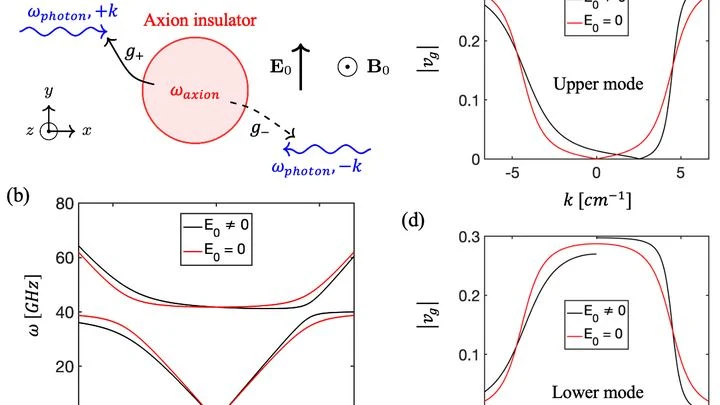
A regular flashlight shines equally forward and backward. But in magnetic crystals, a axion appears — a ghostly excitation, like a wave going around a stadium: atoms pass a magnetic impulse to each other. When light meets an axion, a hybrid forms, whose fate depends on electric and magnetic fields.
A pinch of salt falls into water, and sodium and chlorine ions scatter, surrounded by water molecules. Now, instead of an ion, a positron (an antiparticle, the electron's twin but with a plus instead of a minus) joins the molecular crowd.
A PET scanner catches flashes of light that occur when a radioactive tracer introduced into the body meets electrons in tissues. Usually, the device merely notes where a flash occurred. But between the birth of the tracer and the flash, there is a pause — tiny, in billionths of a second.
Light usually pushes an atom straight ahead, like wind pushing a sail. But if the beam is twisted into a corkscrew, the picture changes: the atom can fly off to the side, as if caught by a spinning wheel. In the new work, physicists calculated that such a vortex photon can transfer almost all of its rotation to the atom — up to 100 percent.
Physicists trapped a cloud of lithium atoms between mirrors. Light bounces inside, like in an echo chamber, forcing the atoms to emit synchronously — resulting in superradiance, akin to a choir where voices merge into a single thunder. Like a stadium chanting in unison: each whisper turns into a deafening rhythm. The secret is density.
The antiproton is the proton's twin, only with a negative charge. When such a twin approaches a nucleus, it doesn't just bounce off: a whole dance of attraction and repulsion unfolds between them.
A multitude of atoms can act like a synchronized orchestra: if each emits light in unison with the rest, the flash becomes many times brighter. This is superradiance — a phenomenon well studied in the lab, but almost never sought in space. Now astrophysicists suspect that such collective 'notes' also play out in interstellar space.
A dense piece of plastic the size of a coin flashes when an invisible particle hits it. That's how scintillators work — materials that turn radiation into faint light. They're usually made from fragile crystals or expensive polymers. But now there's a simpler option: plain polyurethane, the stuff used to mold furniture foam and shoe soles.
In a dark laboratory where superconducting chips are cooled to thousandths of a kelvin, a qubit spins under the influence of a magnetic field. A regular qubit rotates in one direction. An antiqubit, its mirror twin, rotates in the opposite direction. Together they form a pair that senses the field twice as sharply as any ordinary pair.