Retired Galaxies in the Young Universe express
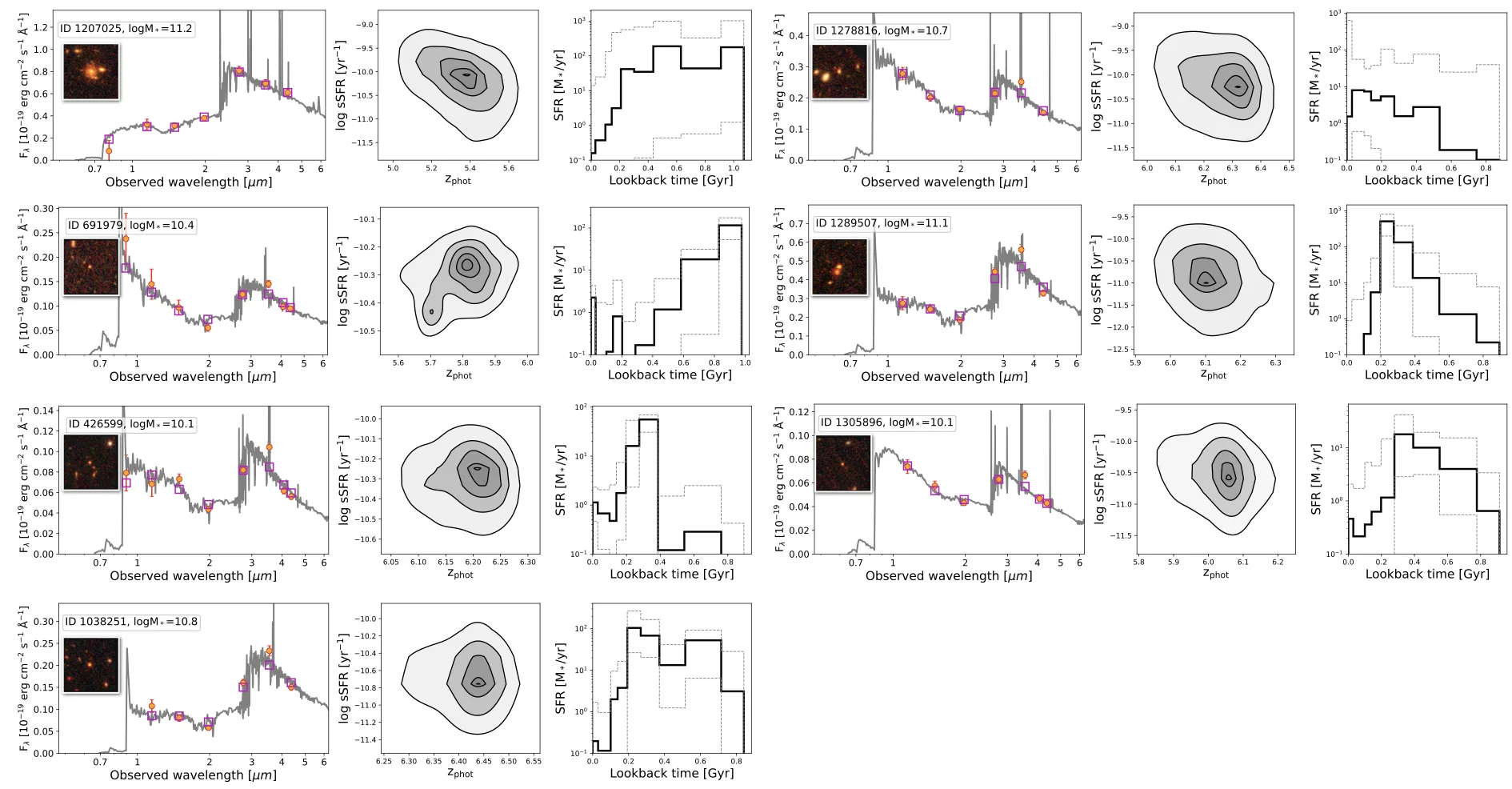
In the first few hundred million years after the Big Bang, the cosmos was like a noisy teen club: galaxies flared up, collided, and churned out stars by the hundreds. But amid this frenzy, the James Webb Space Telescope spotted something odd — entire neighborhoods of quiet 'retirees.' These are massive galaxies that have stopped forming stars, even though by all accounts they should still be bubbling with activity.
Astronomers combed a patch of sky about the size of four full moons and found 101 such galaxies in the 'golden' sample (plus 137 in a less strict one). Their spatial density drops by a factor of 20 by the epoch z~6, but the key point is that at early stages (z~3-4), they were ten times more abundant than the best computer models predicted. It's as if you found a crowd of silver-haired elders in a kindergarten.
What does this mean? Early galaxies not only grew faster: they also clustered into denser 'neighborhoods' than we thought. Perhaps powerful mechanisms were at work, quickly quenching star formation, such as supermassive black holes or supernova explosions blowing out gas. So far, no model reproduces this picture entirely.
If these galaxies really do live in such tight groups, we'll have to redraw our maps of the early universe. And the Webb telescope will need to hunt for even more distant 'retirees' to understand when they managed to age.
The James Webb Space Telescope operates in the infrared, so it sees light stretched by the expansion of the universe, like a distant lantern shining through red glass.