Reflected Light from a Black Hole Reveals Its Secrets express
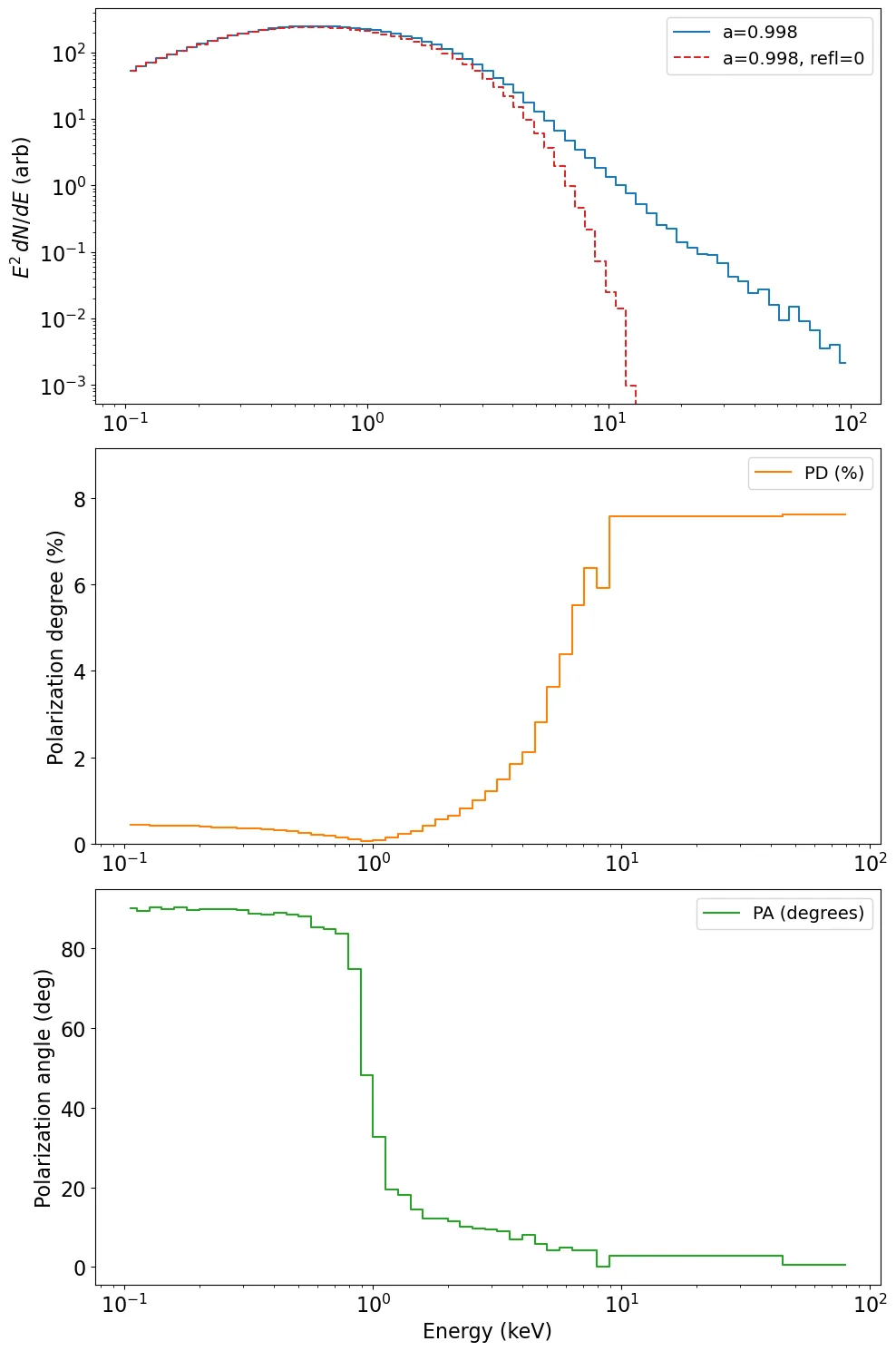
Light reflecting off the scorching disk around a black hole can reveal more about it than we ever thought. When the disk emits heat, some of that light bounces back onto the disk and scatters, acquiring an unusual energy distribution, as if a new component, resembling a power law, is added to the ordinary glow. Previously, such emission was explained only by the presence of a hot corona above the disk, but new work shows it can arise without a corona — simply through reflection near a rapidly spinning black hole.
This new component has distinctive spectral and polarization properties that will allow it to be distinguished from other sources of emission. If it can be detected with current or future X-ray telescopes, scientists will be able to measure black hole spin more precisely and test Einstein's theory of gravity under extreme conditions. It's like finding a new fingerprint that reveals hidden details of a black hole's behavior.
This approach opens a new window for studying the most mysterious objects in the universe. Instead of relying only on rare and hard-to-observe processes, astronomers gain an additional tool that works even for ordinary accretion disks. It's a step toward peering closer to the edge of a black hole, where gravity becomes truly extreme.
Original abstract
as written by the authors arXiv:2604.05085
The Penrose process and the collisional Penrose process involve particles decaying or interacting very close to a spinning black hole, respectively, during which some particles are pushed into negative energy trajectories and fall into the black hole while others gain that energy and escape the system. These two processes are difficult to observe as they occur very rarely by chance. Here we report a new observational signature of similar, but less extreme processes occurring in and near the ergospheres of rapidly spinning black holes. We find that the reflection of the thermal emission from a geometrically thin, optically thick accretion disk can lead to the formation of a power-law component, even in the absence of a corona. Unlike the well-known Penrose processes, the scattering particles lose a good fraction of their energy, but are not pushed into negative energy trajectories. We emphasize that this new component has distinct spectral and polarimetric properties that can be used for its identification as long as it out-competes other power-law emission components. We emphasize that the new component needs to be taken into account when interpreting spectral and spectropolarimetric observations of black holes. The detection and unambiguous identification of the new component with current or future broadband X-ray spectral and spectropolarimetric missions can open a new window into testing Einstein's theory of gravity close to the edges of black holes, and opens up new opportunities to constrain black hole spins and inclinations.
Light reflected from the disk around a black hole can lose up to 90% of its energy due to the strong gravitational field, as if it's being 'sucked' into a whirlpool.
In the movie 'Interstellar,' the visualization of the black hole Gargantua is based on real calculations of how light bends and reflects near the event horizon.