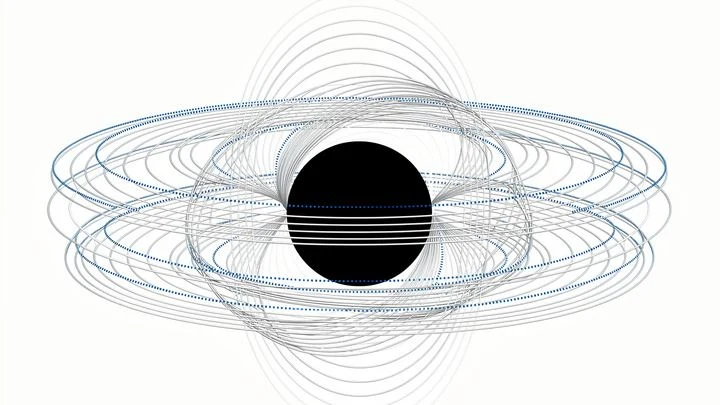
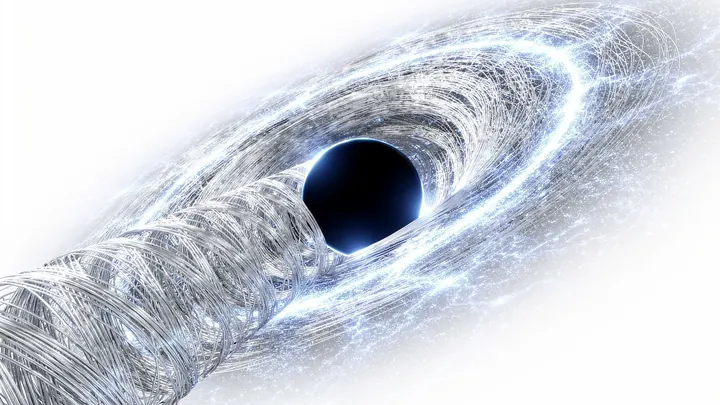
Black hole spin is the angular momentum of a rotating black hole, a fundamental property that affects the geometry of spacetime around it. The spin is characterized by a dimensionless parameter a* (ranging from 0 for non-rotating to 1 for maximally rotating). It influences the size and shape of the event horizon, the innermost stable circular orbit (ISCO), and the energy extraction mechanisms like the Penrose process.
History
The Kerr solution was discovered by Roy Kerr in 1963, and the concept of spin as a measurable parameter was developed in subsequent decades. Observations of X-ray binaries and, more recently, gravitational waves have provided measurements of black hole spins.
How it works
In general relativity, a rotating black hole is described by the Kerr metric. The spin parameter determines the frame-dragging effect, where spacetime itself is dragged around the black hole. This affects the orbits of matter and light, leading to phenomena like the Lense-Thirring precession and the existence of an ergosphere. The spin also sets the maximum efficiency of energy extraction from accretion disks, which can be up to 42% for a maximally spinning black hole.
In practice
Measuring black hole spin is crucial for understanding the formation and evolution of black holes, testing the no-hair theorem, and interpreting observations from X-ray telescopes (like NuSTAR) and gravitational wave detectors.
Fun fact
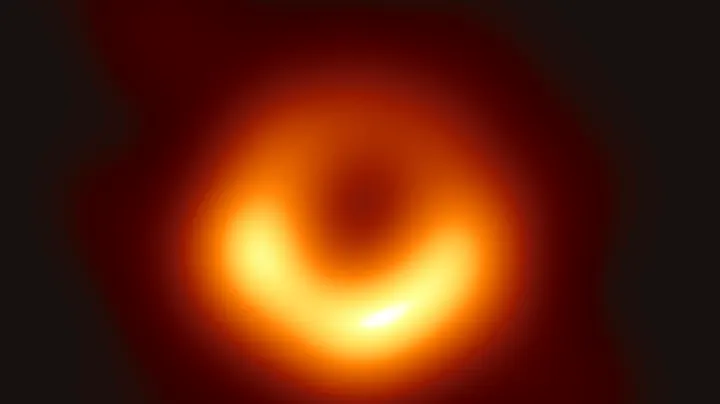
The spin of a black hole can be measured from the shape of its shadow, as seen by the Event Horizon Telescope, because the shadow is slightly asymmetric for rotating black holes.
Speed of light in vacuum, a fundamental constant of nature. — speed of light= 299792458metre per second
G
constant
Newtonian constant of gravitation, determining the strength of gravity. — gravitational constant= 6.67430e-11cubic metre per kilogram per second squared
In 2015, the LIGO detectors caught the first ripple of spacetime from a black hole merger. Since then, hundreds of such events have piled up, each carrying the imprint of its ancestry: whether the holes were born together from a single pair of stars or met by chance in a dense cluster. The difference shows in the direction of their spin axes.
A black hole pulls in anything that gets too close. But if you toss in not one object but a pair, one of them can fly back out, carrying off some of the hole's rotational energy. This trick, devised by Roger Penrose in 1969, works only because a black hole has a horizon — a boundary beyond which nothing returns. Now it turns out the horizon isn't necessary.
At the center of a galaxy sits a supermassive black hole, surrounded by a vast, tenuous cloud of dark matter. It doesn't shine or heat, but its gravity warps space and changes the rules of the game for everything orbiting nearby.
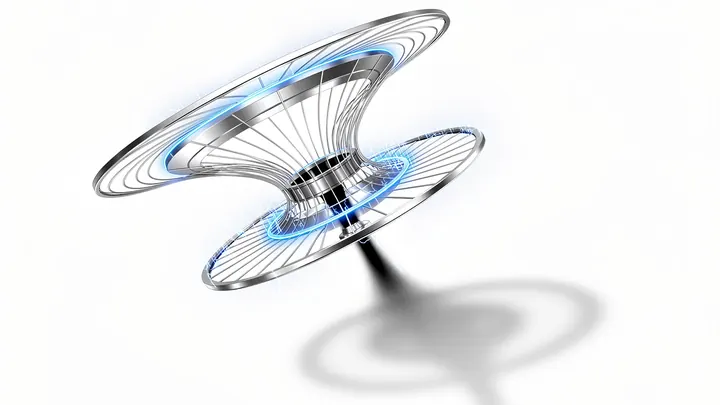
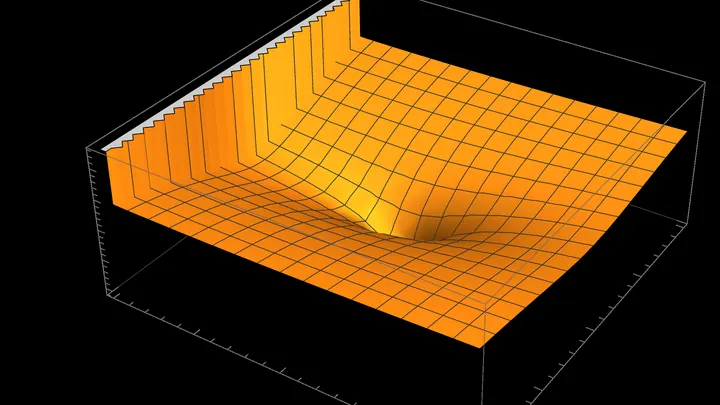
In a two-dimensional universe, a black hole looks like a funnel in spacetime. But the authors of the new work went further: they proposed that the space where particle momenta 'live' is also curved, like a saddle.
At the hearts of many galaxies, cosmic tops of incredible power spin — supermassive black holes. Their nature was first described by Schwarzschild right after Einstein gifted the world with general relativity.
Hot gas spirals inward, falling onto an invisible superdense object. Such a disk resembles a giant whirlpool, but it is often tilted: its axis does not align with the rotation axis of the central body. The gravity of the massive object makes the disk wobble slightly, like a spinning top losing its balance.
For decades astrophysicists painted a neat picture: a galaxy, like a giant carousel, spins in a unified rhythm, and the supermassive black hole at its center inherits that dance.
The mergers of black holes, first predicted by Karl Schwarzschild, are the main source of gravitational waves picked up by LIGO detectors. Over the years, 259 events have accumulated, each one an encrypted birth story of a pair. But is there a hidden system in this data?
A wormhole is a tunnel connecting two distant regions of the universe. If such a wormhole existed and were traversable, a particle inside it would feel not only gravity but also a force from its own electric field. This force depends on how spacetime is curved around it.
A figure skater spins on the ice, gradually spiraling inward. Similarly, a small star or black hole orbiting a massive black hole loses energy. It emits gravitational waves — ripples in spacetime that detectors on Earth pick up.
But the dance of this pair is more intricate than it seems. The small companion isn't just a point.
A black hole is not just a dark spot in the sky. Its shadow falls on the glowing backdrop of infalling matter and carries the imprint of spacetime geometry itself. If gravity works even slightly differently than we think, the shadow will give it away.
In a new study, physicists traced light rays around a rotating black hole in so-called Rastall gravity.
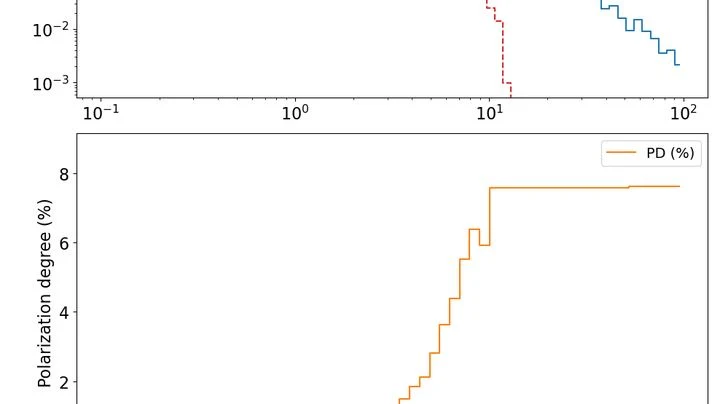
A spinning top whirling so fast that it forces light around it into spirals: that's a fitting image for what happens near a black hole's horizon. Hot plasma falls in and emits radio waves. Their polarization (the plane in which the wave oscillates) becomes an arrow pointing in the direction of energy flow.
A massive top spins so fast that space itself twists into a spiral around it. This is a black hole — only instead of wood and metal, it's made of pure gravity. Add an unusual electromagnetic field that slightly changes the rules of the game, and you get a 'deformed' black hole: its shape and behavior differ a bit from the familiar ones described half a century ago.
Light passing by a black hole falls into a gravitational trap: its trajectory curves and the particle bounces along a nearly closed orbit, like a pinball.
The shadows of supermassive objects at the centers of galaxies, M87 and the Milky Way, have become icons of modern astrophysics. But what if these shadows are not from absorption, but passage? The equations of Einstein allow for traversable wormholes — tunnels in the fabric of spacetime.
A top spun to its limit changes the air flow around it — the air swirls differently than around a barely spinning top. Black holes in some extended theories of gravity behave similarly. When a hole spins fast enough, the curved spacetime near its poles acquires new properties.
Gas falling into a black hole spirals inward like water down a drain. In this flow, magnetic loops constantly form and pop — somewhat like solar flares, but far more powerful. Each loop is a tiny magnet living its own life. When many of them are present, they start to influence each other: their north and south poles attract and repel in turn.
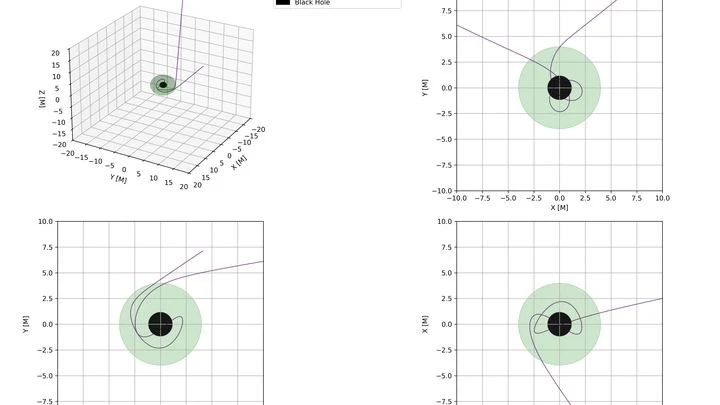
A figure skater glides across the ice, gradually approaching the center of the rink. A slight twist of the torso, and the smooth spiral breaks, the trajectory becomes unpredictable. Something similar happens when a small black hole with its own rotation (spin) falls toward a giant black hole.
Light reflecting off the scorching disk around a black hole can reveal more about it than we ever thought. When the disk emits heat, some of that light bounces back onto the disk and scatters, acquiring an unusual energy distribution, as if a new component, resembling a power law, is added to the ordinary glow.
A spinning top on a table wobbles: its axis is tilted, and the motion becomes unsteady. Black holes surrounded by a disk of gas and dust behave similarly. If the rotation axes of the black hole and the disk do not align, the whole system begins to vibrate, producing ripples in spacetime — gravitational waves.
Black holes are cosmic spinning tops. Their spin warps spacetime (as predicted by Einstein) and is described by a spin parameter from 0 to 1. The limit 1 is unattainable: infalling matter acts like a brake.
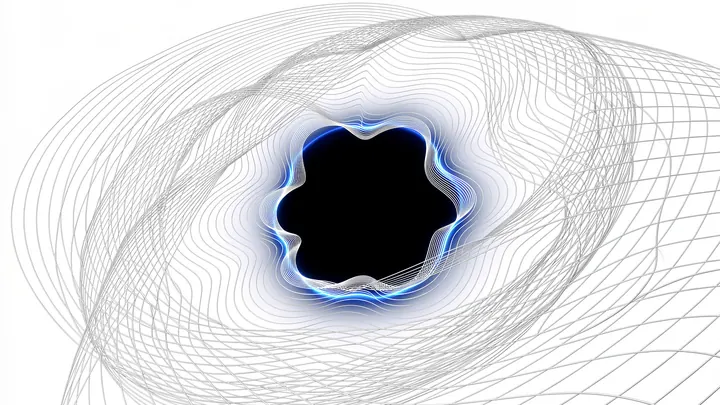
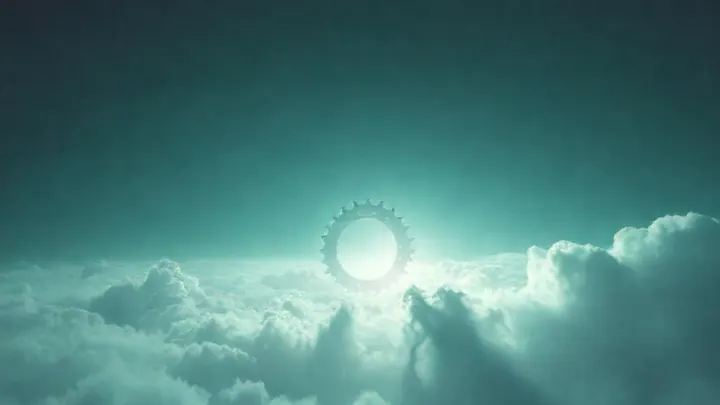
A wormhole is a tunnel through space, connecting distant regions of the Universe. Its shadow against a bright gas background was long thought to be as round as that of a black hole. But for a rotating wormhole (one you could actually traverse), the shape of the shadow might be surprising: the edge becomes jagged, like a gear.
Although invisible, dark matter’s gravity governs the motion of stars and galaxies. It was first proposed by Fritz Zwicky in the 1930s, and later confirmed by Vera Rubin. Scientists have long suspected it accumulates around black holes, but direct proof was lacking.
The black hole in the binary system Swift J1727.8-1613 flickers in X-rays like a campfire in the wind. But if you look closely at the rhythm of this flickering, you can see distinct 'humps'—bursts at specific frequencies, like drumbeats in the noise of a crowd.
In 2019, astronomers unveiled the first-ever image of a black hole's shadow — a dark void encircled by a lopsided orange ring. This is the supermassive black hole at the heart of galaxy M87, 55 million light-years away. The ring isn't just glowing: one side is noticeably brighter than the other, like a campfire burning unevenly, with flames leaping higher on one side.
Vortons are invisible cosmic hoops, closed loops of curved spacetime. Thinner than an atom but heavier than stars, these Big Bang relics spin like giant carousels, churning everything around them. Einstein's equations describe how particles dance near such a hoop: paths twist into spirals or dart chaotically.