Classical gravity refers to the description of gravitational phenomena using general relativity, without incorporating quantum mechanics. It encompasses the curvature of spacetime caused by mass and energy, as described by Einstein's field equations. Classical gravity successfully explains phenomena from planetary orbits to black holes, gravitational lensing, and the expansion of the universe. However, it breaks down in extreme conditions such as the Big Bang singularity or the interior of black holes, where quantum effects become significant.
In classical gravity, spacetime is a dynamical entity that curves in response to the presence of matter and energy. Objects move along geodesics, which are the straightest possible paths in curved spacetime. The Einstein field equations relate the curvature of spacetime to the stress-energy tensor, providing a deterministic evolution of the geometry. This framework is purely classical, meaning it does not account for quantum fluctuations or the discrete nature of particles.
In practice
Classical gravity is used in GPS satellite navigation, where relativistic corrections are essential for accurate positioning. It also underpins astrophysical models of stellar evolution, black hole accretion, and gravitational wave astronomy.
Fun fact
Classical gravity predicts that time runs slower in stronger gravitational fields, an effect that must be corrected for in GPS satellites to maintain accuracy.
Two tiny diamonds float in a vacuum, separated by a distance that light cannot cross during the experiment. Inside each, like a frozen spark, resides an entangled spin — a quantum state linking them into a single whole. Now the diamonds begin to move, but not just any motion: each one seems to split, existing in two places at once.
Drop two stones of different shapes into a pond — the ripples will tell you which one was smooth and which was jagged. Gravitational waves work the same way: when two ultra-dense objects merge, the trembling of spacetime carries details about their inner workings.
A homogeneous, spherical cloud of cosmic dust begins to contract under its own gravity. At some point, by classical laws, it should collapse into a point of infinite density — a singularity.
The quantum world is like a kitchen where particles suddenly appear out of "nothing." But you need a chef — a classical field acting as an external source. Glauber's theorem, long known in optics, has now been generalized: it shows exactly how the field "cooks up" particles, be they photons or gravitons.
A black hole spun up almost to its limit is like an athlete balancing on the edge of a record. The most interesting action isn't inside the hole itself, but in the thinnest film of spacetime at its horizon. It's there that tiny corrections to Einstein's gravity can suddenly swell to gigantic proportions.
A black hole is like a perfectly smooth sphere. It has no features — only mass, charge, and spin. This rule is called "no-hair." But nature loves to complicate things: sometimes a cloud of a scalar field (a special field described by a single number at each point) spontaneously appears around a black hole.
Two houses with identical facades. Windows, doors, wall color — everything matches. But inside, one is empty, while the other buzzes with life. How can you tell without stepping inside? In space, there's a similar puzzle: a black hole and a gravastar look the same from the outside, but they are built differently.
A pendulum in a noisy room is constantly jostled by people passing by. Its motion is a mix of regular swings and random jerks. Something similar happens with weak gravitational waves against the backdrop of an expanding universe. In Einstein's general relativity, these waves are tiny ripples in spacetime.
A star circles a rotating black hole like a figure skater at the center of a rink. While it is far away and can be treated as a point, the dance remains predictable: the orbit follows clear laws, like music that is easy to glide to. But as it approaches, gravity begins to act unevenly.
A cloud of waves collapses under its own gravity. While it's loose, everything goes by the book: the field oscillates gently in nearly flat space, and approximate formulas work perfectly. But add just a bit more energy, and the picture changes.
Physicists used a numerical model to catch the moment when simple calculations stop describing reality.
Clocks in the Universe are tricky things. Usually, in calculations of the birth of the world, a special scalar field plays the role of a clock — something like an invisible fluid filling all of space. It ticks, and physicists watch how the world changes relative to that ticking. But these clocks are man-made, introduced for convenience.
The authors of the new work took a different path.
At the center of nearly every galaxy lurks a supermassive black hole. Its gravity is so strong that it warps space itself. But few stop to wonder: what does it do to the very fabric of reality — the fields that permeate the cosmos?
One such field is the Higgs field.
At the center of attention is a monopole, a special clump of a non-Abelian field (a field where the order of operations changes the result), resembling a magnetic charge without a pair. In this work, it is placed in curved spacetime described by Einstein's equations with a Gauss-Bonnet addition (a correction important at small distances).
In a two-dimensional universe, a black hole looks like a funnel in spacetime. But the authors of the new work went further: they proposed that the space where particle momenta 'live' is also curved, like a saddle.
Usually, a black hole is described as a frozen frame: there's mass, there's charge, and it's all static. But real objects live in time. They radiate, lose energy, and change.
An eardrum at the very edge of a waterfall. Sound behaves strangely here: echoes don't multiply: they fade. That's exactly what gravitational waves look like at the horizon of a black hole — the boundary beyond which even light disappears.
The spiral of water draining into a sink spins faster and faster toward the center. In an ordinary black hole, that funnel ends in an infinitely sharp point — a singularity where the laws of physics break down. But this new work considers a different picture: the funnel doesn't taper to a needle but ends in a smooth, swelling bubble.
A campfire burns steadily and long. But when the wind blows, the flame flickers out, leaving only embers. A similar story plays out with the gravastar — a hypothetical object that was supposed to replace the black hole.
An ordinary black hole hides a singularity — a point where the laws of physics break down.
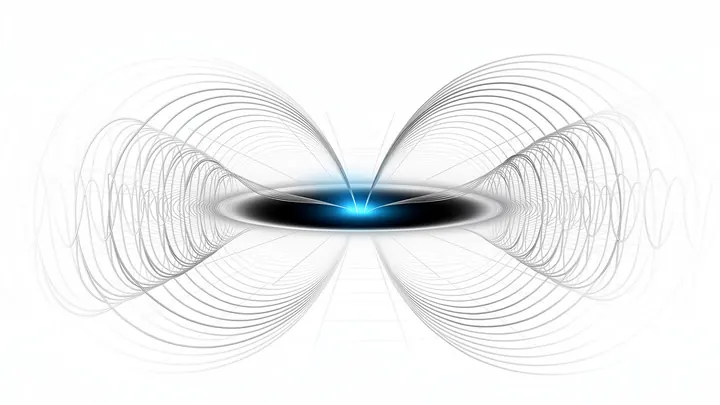
A pair of black holes circles in a dance, gradually drawing closer. They lose energy and spin — a process known as angular momentum radiation. In standard Einstein theory, only gravitational waves carry away angular momentum.
Gravity is the invisible glue that holds stars and planets together. But what if this glue has a tiny mass? In massive gravity, the carrier particles (called gravitons) weigh a minuscule but nonzero amount. This changes the rules near black holes.
The authors of the new study built on a mathematical tool — eigenvalue decomposition.
A tiny magnetized sphere floats in a vacuum, held by invisible fields. It starts to spin around the axis of the magnetic field, just like a top that's been given a gentle nudge. That's precession. But when the sphere becomes really small, quantum laws come into play.
Gravity isn't just the force that keeps us on the floor. On cosmic scales, it conducts galaxies, bends light rays, and decides the fate of everything. A century ago, Einstein described it as the curvature of space and time.
10⁻¹²⁰. That's not just a small number: it's a chasm. That's the ratio of dark energy density to the Planck density, the natural scale of quantum gravity. The colossal difference of 120 orders of magnitude has long seemed an unsolvable puzzle. But the answer might lie in a drama played out at the dawn of time.
It is commonly believed that a black hole is a merciless cosmic vacuum cleaner, sucking in everything indiscriminately. But new research flips the picture: right at the horizon, curvature transforms from a trap into a trampoline.
A black hole usually hides its singularity behind an event horizon — an invisible boundary from which not even light can escape. But sometimes this 'cloak' is absent, and the singularity, a point where familiar physics breaks down, is exposed to an outside observer.
Picture the early Universe as an unimaginably large bell. Inflation — the era of rapid expansion, dreamed up by Alan Guth, strikes it, sending a wave rippling across the fabric of spacetime.
Gravitational-wave detectors are like sensitive microphones, listening for the whispers of distant cataclysms. But every now and then, a sharp crack bursts in — a brief noise spike known as a glitch.
At the center of a classical black hole lurks a singularity — a point where the density and curvature of spacetime become infinite. Physics goes silent there.
In classical theory, a black hole is where matter collapses to a point of infinite density. Such a 'singularity' looks like an error in the equations: nature hardly tolerates infinities. Many physicists seek ways to 'smooth out' this flaw, and one idea is to modify the theory of gravity itself at small distances.
At the center of an ordinary black hole, according to classical ideas, lurks a singularity — a point of infinite density where the laws of physics break down. But some theories, inspired by the duality idea from string theory, propose replacing the point with a tiny 'smudged' region.
In cricket, there's a special delivery — the googly. The ball spins in a way that deceives the batsman. Physics had its own googly: for nearly half a century, mathematicians couldn't make twistor theory work with real gravity. It described 'nice' fields perfectly, where everything twists in one direction. But as soon as an 'awkward' component appeared, the machinery broke down.
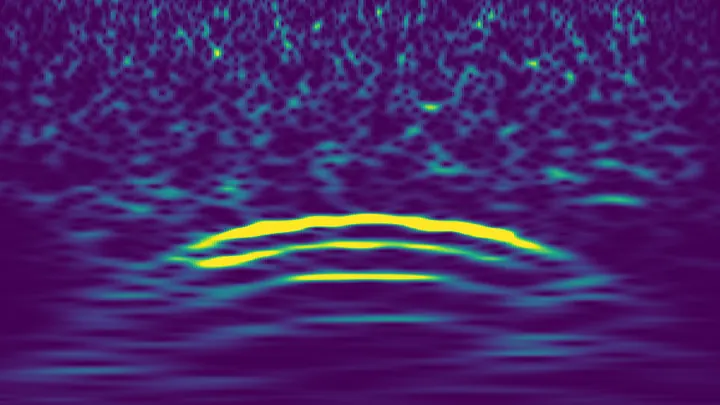
The merger of two black holes is not just a silent dance, but a grand act after which spacetime itself vibrates for a long time. These damped oscillations — quasi-normal modes — are like the ringing of a gigantic bell. But there is another echo: barely perceptible, almost ghostly.
A quantum wave is like a long-exposure photograph: everything’s blurred, but the blur itself reveals motion. Usually these frozen waves are treated as convenient abstractions. Yet if at each point in the image you estimate, by brightness, the moment on the particle’s internal clock it landed there, flat space suddenly acquires curves.
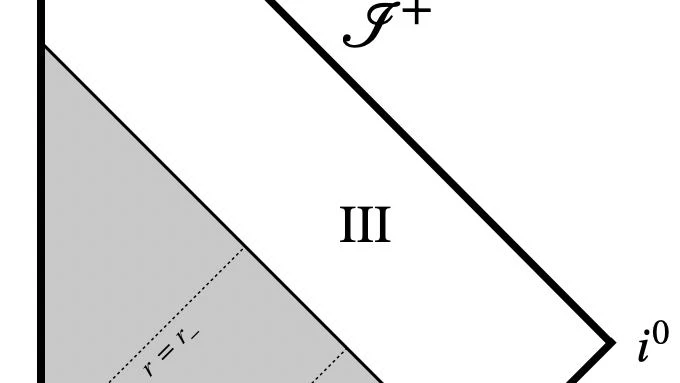
When a giant star runs out of fuel, it collapses into a black hole. Such a hole has an outer boundary — the event horizon, beyond which even light cannot escape. But many black holes also have an inner boundary — a second horizon that separates the outer layers from the singularity core.
At the center of a black hole, classical theory paints a point where density and spacetime curvature shoot to infinity — like an infinitely sharp needle. But quantum corrections, tracing back to the work of Karl Schwarzschild, add a tiny “pillow”: space cannot collapse to zero.
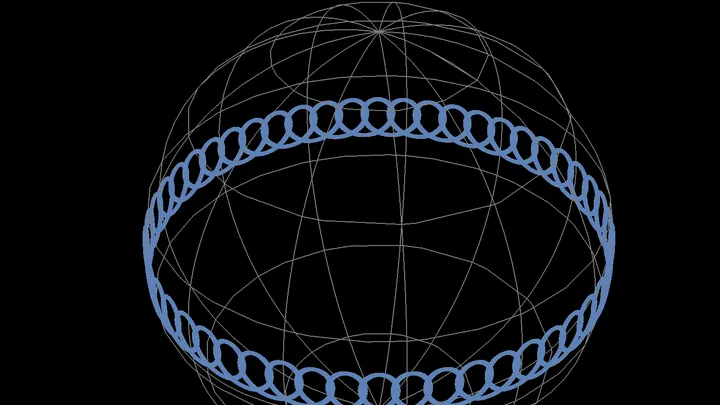
In the ocean, a whirlpool pulls everything into a closed loop, just as a gravitational wave in empty space twists time into a loop. Gravitational wave — a ripple in the fabric of spacetime, and its special shape can turn the usual flow of events into a closed cycle. In such a zone, an object can return to its own past without violating the laws of physics.
The explosion of a distant supernova told us something hard to believe: the universe is expanding faster and faster. The engine of this acceleration is dark energy — nearly 70% of everything that exists.
An ordinary black hole is surrounded by a thin photon sphere — a place where light can loop around before falling in or escaping. In the new work, this region has puffed up into a whole layer packed with massless particles that zip around at nearly the speed of light and don't press against the walls.
A textbook black hole resembles a perfectly smooth sphere: everything outside it calmly flies off to infinity. However, quantum gravity paints a different picture. Recently, within loop quantum gravity, a solution was found — a 'Kruskal' black hole where spacetime beyond the horizon behaves differently.
The early universe resembled an overcrowded hall where heavy particles collided and decayed at a deafening pace. Among them could have been scalar leptoquarks — particles that simultaneously latch onto a quark (a building block of matter) and a lepton (such as an electron).