A Distant Planet's Magnetic Pulse express
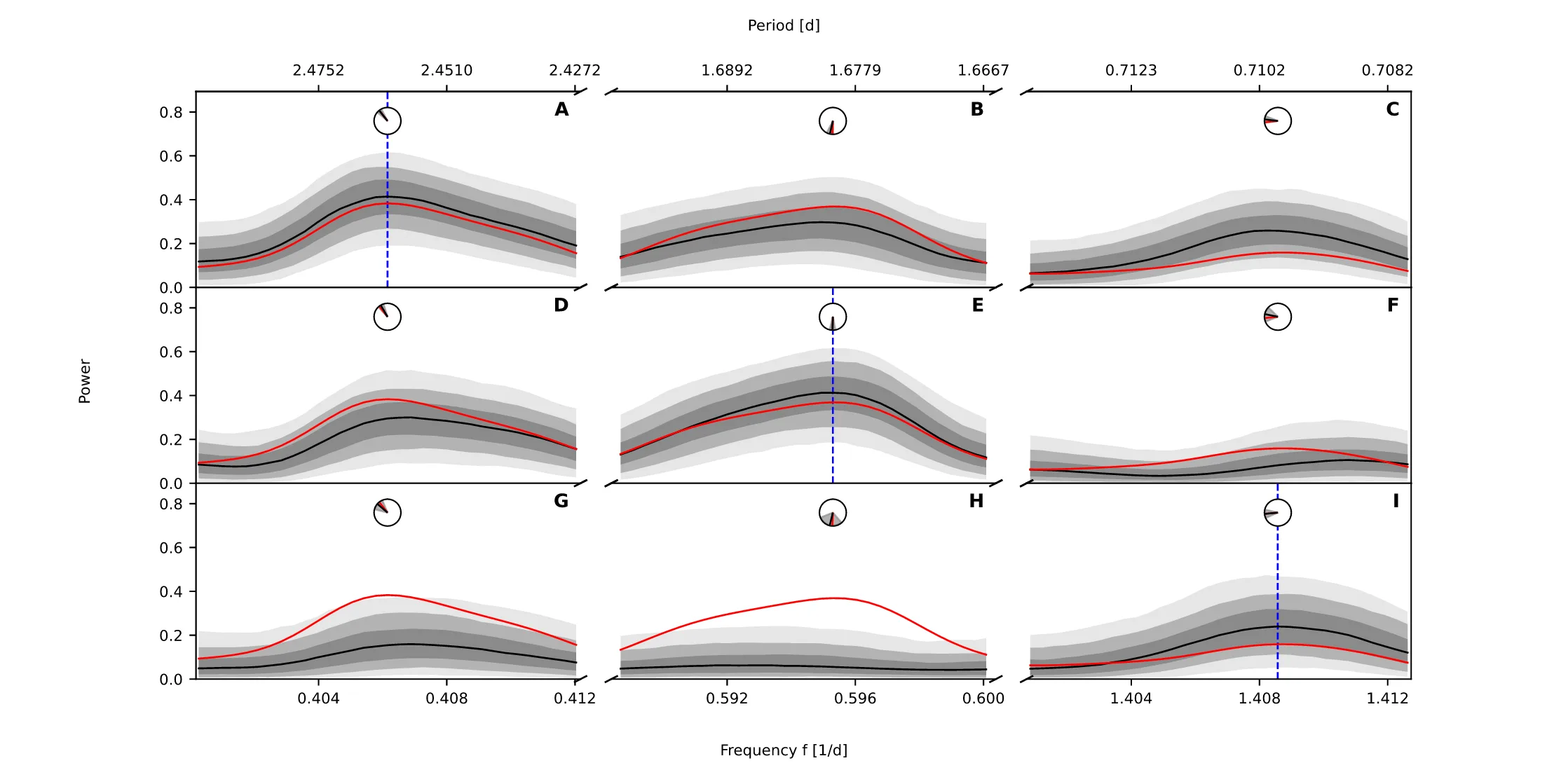
The star GJ 436 is a dim red dwarf, and orbiting it is a Neptune-sized planet on a nearly vertical, tilted orbit. Astronomers spent 18 years taking spectra of this star to track its spots and flares. Suddenly, a rhythm emerged in the data that matched neither the star's rotation nor its 8-year activity cycle. This rhythm exactly followed the planet's orbit.
That's what happens when a planet's magnetic field reaches out and grabs the star. The planet plows through the stellar wind — a stream of charged particles from the star. If the planet has its own magnetic field, it acts as a shield, but it also gives the star's field a slight tug. This creates extra spots and ejections, visible as a boost in activity with the orbital period. The researchers built a simple geometric model and pinned down the field strength: from 6 to 110 gauss. For comparison, Earth's surface magnetic field is about 0.5 gauss, and a fridge magnet is roughly 50 gauss.
This is the first time a magnetic interaction between a star and a planet has been suspected from long-term optical observations. Previously, such signals were sought in the radio range but rarely caught. Now astronomers have a new way to estimate the magnetic fields of distant planets without getting close to them.
Original abstract
as written by the authors arXiv:2604.06969
Theory predicts that a planet with a sufficiently strong magnetic field orbiting close to its host star could induce star-planet magnetic interactions. This is potentially observable as an optical or radio signal synchronised with the orbital period. We analyze 18 years of high-resolution optical spectroscopy of GJ 436, a low mass star orbited by a Neptune-sized exoplanet in a polar eccentric orbit. Stellar activity indicators show enhancements at a period corresponding to the exoplanet orbit, modulated by stellar rotation, and the star's 8-year magnetic cycle. We interpret this as a signal of star-planet magnetic interaction. Using a geometric model, we reproduce these periods if GJ 436 b has a magnetic field strength of 6 to 110 Gauss.
Earth's magnetic field is 100–200 times weaker than a fridge magnet's, while GJ 436 b's might be as strong as that magnet.
In Stanislaw Lem's novel 'Solaris,' an ocean planet influences its star — here, for the first time, a real exoplanet shows a similar but magnetic effect.