Exoplanet characterization is the process of determining the physical and chemical properties of planets orbiting other stars — their temperatures, atmospheric compositions, masses, radii, and orbital dynamics. Unlike mere detection, which establishes a planet's existence, characterization aims to build a detailed picture of what a world is like: whether it is rocky or gaseous, hot or cold, and whether its atmosphere contains water vapor, carbon dioxide, or even potential biosignatures. This field has transformed planetary science from a study of our solar system to a comparative science across the galaxy.
History
The first exoplanet around a Sun-like star was discovered in 1995, but characterization began in earnest with the first transit detection in 1999 and the first atmospheric detection in 2002 using the Hubble Space Telescope. The field exploded with the Kepler mission (2009–2018), which found thousands of planets and enabled statistical characterization of planetary populations.
How it works
Characterization relies on several complementary techniques. Transit spectroscopy analyzes starlight filtered through a planet's atmosphere during a transit, revealing absorption lines of atmospheric gases. Radial velocity measurements provide the planet's mass, while transit photometry gives its radius — together yielding density and clues about composition. Direct imaging, though challenging, allows spectroscopy of young, massive planets. More recently, phase curves (measuring the planet's brightness as it orbits) reveal temperature maps and atmospheric circulation patterns.
In practice
Used to identify potentially habitable worlds, study atmospheric chemistry, and understand planetary formation and evolution. It also guides the design of future missions like the James Webb Space Telescope, which is optimized for characterizing the atmospheres of transitingexoplanets.
Fun fact
The first exoplanet atmosphere ever detected was that of HD 209458b, a 'hot Jupiter' where sodium was found in 2002 — and later, the planet was observed to have an evaporating hydrogen atmosphere, earning it the nickname 'Osiris'.
A telescope stares at a star for many nights in a row. Somewhere in the stream of light hides a tiny dip in brightness — an Earth-sized planet briefly blocking part of the star. Such a dip lasts a few hours and repeats once a year or less. Catching it is like hearing a single quiet click in a noisy hall.
A planet in the habitable zone is no guarantee of life. Like a conductor leading an orchestra, a star dictates the tempo and character of planetary atmosphere evolution over billions of years.
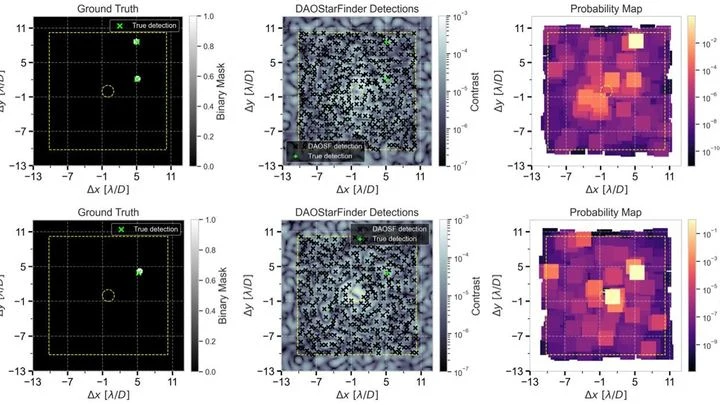
A pebble on a streambed lies still as sunlight sparkles dance on the water's surface. In astronomy, the contrast is similar: a real exoplanet is the stone, while myriad speckles (patches of scattered starlight) are the ripples trembling in instruments.
In 1960, the Tatel radio telescope spent weeks listening to emptiness around Tau Ceti and Epsilon Eridani. Project Ozma was searching for technosignatures — traces of another mind at work.
Every star is a living archive, and its spectrum a multilayered manuscript. Over billions of years, the history of the galaxy is written into it: the galactic chemical evolution of the Milky Way leaves a smooth trace in elemental abundances.
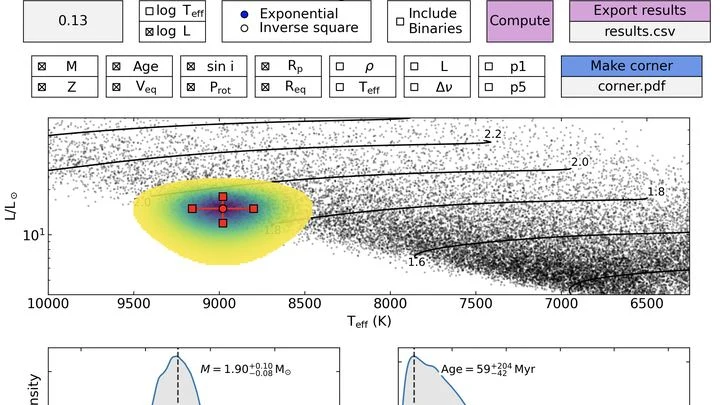
Imagine a person in an old photograph standing in a crowd while spinning — guessing their age would be nearly impossible. That's roughly how astronomers determine the ages and masses of distant stars, and they often get it wrong. For stars slightly heavier than the Sun (from 1.4 to 2.5 solar masses), standard methods like chemical-composition 'clocks' work poorly.
When astronomers peer at distant worlds, they often don't see crisp lines of water vapor or methane, but a blurry silhouette, as if the planet has thrown on a thick veil. This veil, a haze of organic particles, behaves like a temperamental photographic plate: it darkens under harsh ultraviolet light, revealing hidden chemical patterns.
In the orchestra of interstellar life search, every note counts. And the score here is dictated not by man, but by a distant star. For the planet TRAPPIST-1 e, one of seven in the system of an ultracool red dwarf, the conductor's baton is harsh ultraviolet light.
A star's light curve is not chaotic noise, but a text written by pulsations, spots, and the steady glow of a thermonuclear furnace. Any planet slipping across the disk leaves a typo in this text: a tiny dip in brightness lasting hours.
The search for extraterrestrial life is like a detective investigation: from tiny clues, you must distinguish traces of life from random imprints of non-living nature. On Saturn's moon Enceladus, the investigators are lucky — geysers burst from cracks in the icy crust, ejecting water from the subsurface ocean straight into space.
When the light of a distant planet is split into colors, it suddenly jumps at the boundary between red and invisible infrared, as if someone flipped a switch. This is how the vegetation red edge manifests itself: chlorophyll is transparent to near-infrared radiation, and the leaf, to avoid overheating, reflects it away.
A giant planet hangs in space in complete solitude, separated from its star by a distance 160 times greater than the path from the Sun to Pluto. The light from its parent star arrives so faintly that the surface temperature barely exceeds 200 degrees Celsius — about as warm as a well-heated sauna.
At the edge of the solar system, far beyond Neptune's orbit, something is knocking icy chunks off their paths. Their orbits are stretched and tilted in the same way, as if an invisible hand arranged them in a pattern.
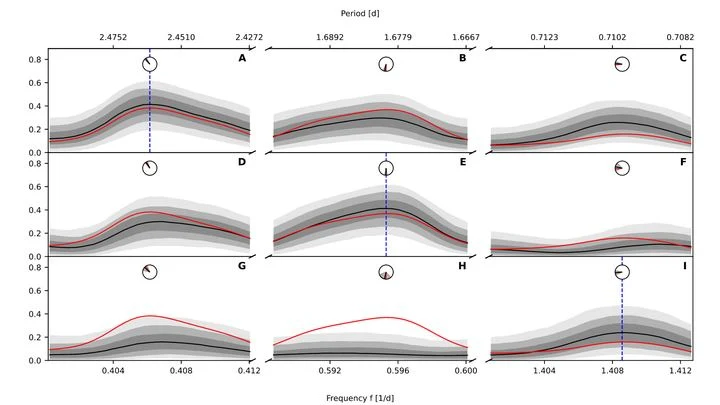
The star GJ 436 is a dim red dwarf, and orbiting it is a Neptune-sized planet on a nearly vertical, tilted orbit. Astronomers spent 18 years taking spectra of this star to track its spots and flares. Suddenly, a rhythm emerged in the data that matched neither the star's rotation nor its 8-year activity cycle. This rhythm exactly followed the planet's orbit.
At night, a distant streetlamp seems motionless, but if you walk closer and look carefully, you might notice it swaying slightly in the wind. That's roughly how astronomers hunt for planets around other stars: they measure how a star shifts ever so slightly under the gravitational tug of its invisible companions.
The Gaia space telescope measures star positions with an accuracy of a microarcsecond, like spotting a coin on the Moon from Earth. In 2022, it noticed that the bright star HD 12800 was wobbling slightly, as if tugged by an invisible companion. Astronomers hypothesized that a planet orbits the star.
But a wobble can be deceiving.
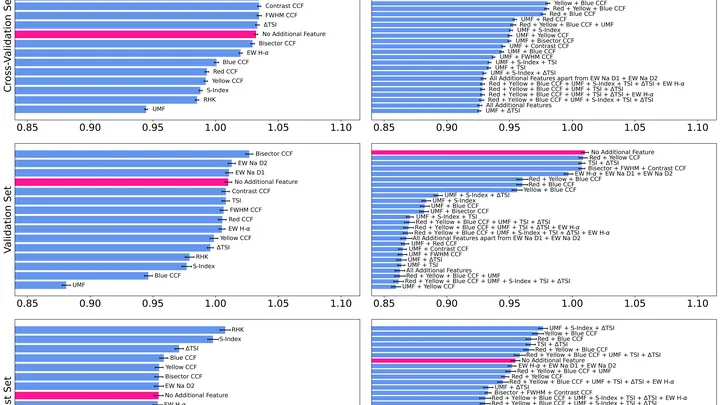
For six straight years, the HARPS-N telescope on La Palma island stared at the Sun as if it were a distant star — taking spectra, tracking brightness, and recording every quiver of spectral lines. All this was to understand how to distinguish a star's subtle sway from a genuine planetary signal.
A star doesn't sit still: its surface boils like a pot of soup.
Three distant giant planets circle their stars so closely that a year on them lasts just a few Earth days. These worlds are called hot Jupiters, and their orbits are a real puzzle: how did they end up right next to the star if they were born far away, in the cold outskirts of the system? One key clue is the angle at which a planet orbits relative to the star's rotation.
The night sky is dotted with stars, and many of them have planets. But how do you spot a tiny dark disk against the glare of a distant sun? The Kepler telescope spent nine years watching hundreds of thousands of stars, waiting for a planet to pass in front of its star and briefly dim it. That 'wink' is the only way to find worlds like ours.
The galaxy is like a city at night: most windows shine steadily, but sometimes a skyscraper lights up all its lights and then goes dark. Just like that, according to a new hypothesis about planets around alien stars (exoplanet), we might first notice another civilization — by a short but blinding flash that could mark its demise.
The chemical composition of a sample is like a soundscape. A living forest sounds polyphonic: chirping, rustles, the hum of insects. A barren desert is just the whistle of the wind.