Water in Nanopores: Layer by Layer or All at Once express
In a narrow gap between two plates, water from humid air collects on its own: this is capillary condensation. If the gap is only a few nanometers wide, water no longer behaves like a continuous liquid: every molecule counts. But how exactly such a gap fills, layer by layer or all at once, has remained unclear.
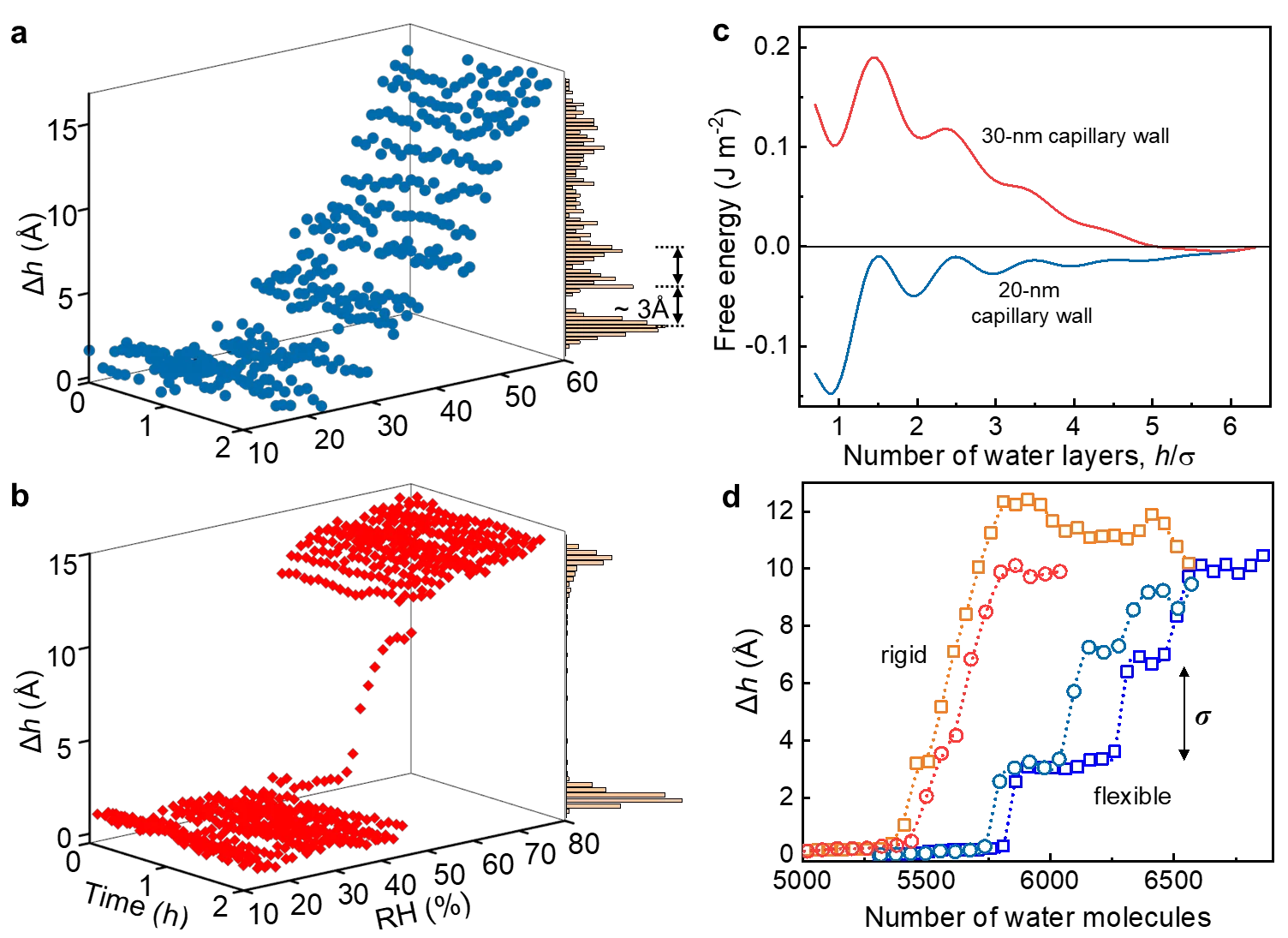
Researchers fabricated capillaries from layers of material just one atom thick and used an atomic force microscope to watch how the walls bent as water entered. Flexible walls let water in gradually: each new layer of molecules added about 0.3 nanometers to the thickness of the water film. Rigid walls, in contrast, filled abruptly, in a single jump.
The difference is explained by a tug-of-war between two forces: the energy needed to bend the wall and the interaction of water with the wall, which changes depending on distance. When a wall bends easily, it is better off letting water in one layer at a time, following the undulating landscape of interaction. A rigid wall cannot bend, so water rushes in all at once, as soon as the gain from filling exceeds the resistance.
This discovery shows that the molecular nature of water can radically alter familiar capillary phenomena — from soil wetting to the operation of microfluidic devices. And the choice between smooth and abrupt filling depends simply on how compliant the walls are.
Original abstract
as written by the authors arXiv:2604.07946
Under ambient humidity, water spontaneously condenses in pores only a few nanometers in size, making nanoscale capillarity central to numerous natural phenomena and technological applications. At these dimensions, water may no longer be treated as a continuous fluid, yet the consequences of molecular discreteness for capillary condensation and filling remain poorly understood. Here we study nanocapillaries fabricated by van der Waals assembly and, using atomic force microscopy, monitor their wall deformations during humidity-driven water uptake. We observe two distinct regimes: layer-by-layer filling of flexible capillaries and abrupt filling of rigid ones. Flexible walls deform in steps of ~3 {\AA}, corresponding to the sequential entry of individual water molecular layers. The different filling regimes are explained by the competition between deformation energy and oscillatory wall-water interactions. Our findings show that the molecular discreteness of water can profoundly affect ubiquitous capillary phenomena, with wall compliance selecting between discrete and abrupt filling.
The thickness of a single layer of water molecules is about 0.3 nanometers. That's ten thousand times thinner than a human hair.