Proteins Frozen in Flight express
Imagine trying to examine a snowflake without letting it melt or get damaged. That's roughly the challenge facing scientists who want to study individual proteins — the tiny molecular machines of life. In solution, a protein constantly jiggles and clumps with its neighbors, and in an electron microscope, the beam destroys it. The authors of a new study have built a device that solves this problem: it plucks proteins from liquid, cools them to liquid helium temperatures, and launches them into a vacuum chamber at bullet speed.
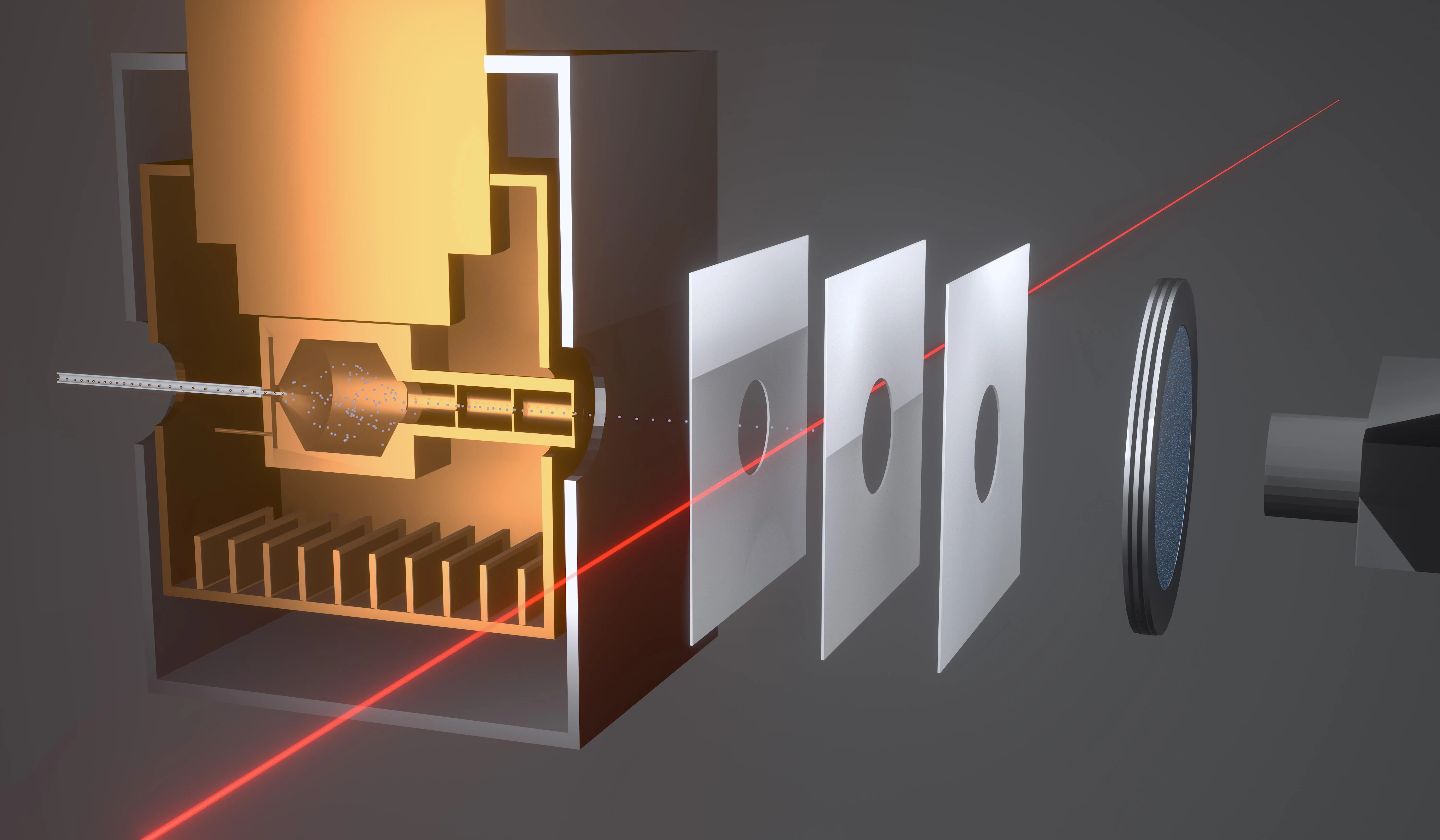
The heart of the setup is a combination of two techniques. First, a gas stream carrying proteins passes through a narrow nozzle: the gas expands rapidly and cools, like a can of air freshener whose nozzle freezes. The proteins are 'frozen' in random but fixed poses, like statues caught mid-jump. Then the particles enter an aerodynamic lens — a system of rings that squeezes the stream into a thin beam, discarding everything else. The result is a dense beam of individual proteins flying in a single direction.
To verify that the beam truly consists of single proteins rather than clumps, the scientists used a powerful laser. A short pulse knocks electrons off the particles, and by analyzing how these electrons scatter, one can reconstruct the size and shape of each particle. It turned out that the proteins retain their structure and do not break apart in flight. The beam density reached one hundred million particles per cubic centimeter: that's like packing the population of a large city into a thimble.
Such an instrument opens the door to taking 'portraits' of individual biomolecules with atomic resolution. An X-ray laser can illuminate a flying protein and capture its shadow before the molecule is destroyed. And cooling to ultra-low temperatures allows studying quantum properties of large particles — for example, testing whether an entire protein can behave like a wave. Proteins frozen in flight are like paused moments of life that can now be examined at leisure.
Proteins in the beam travel at about 200 meters per second — faster than sound. In one second, such a protein covers a distance equal to two football fields.