The Rain That Counts Its Drops express
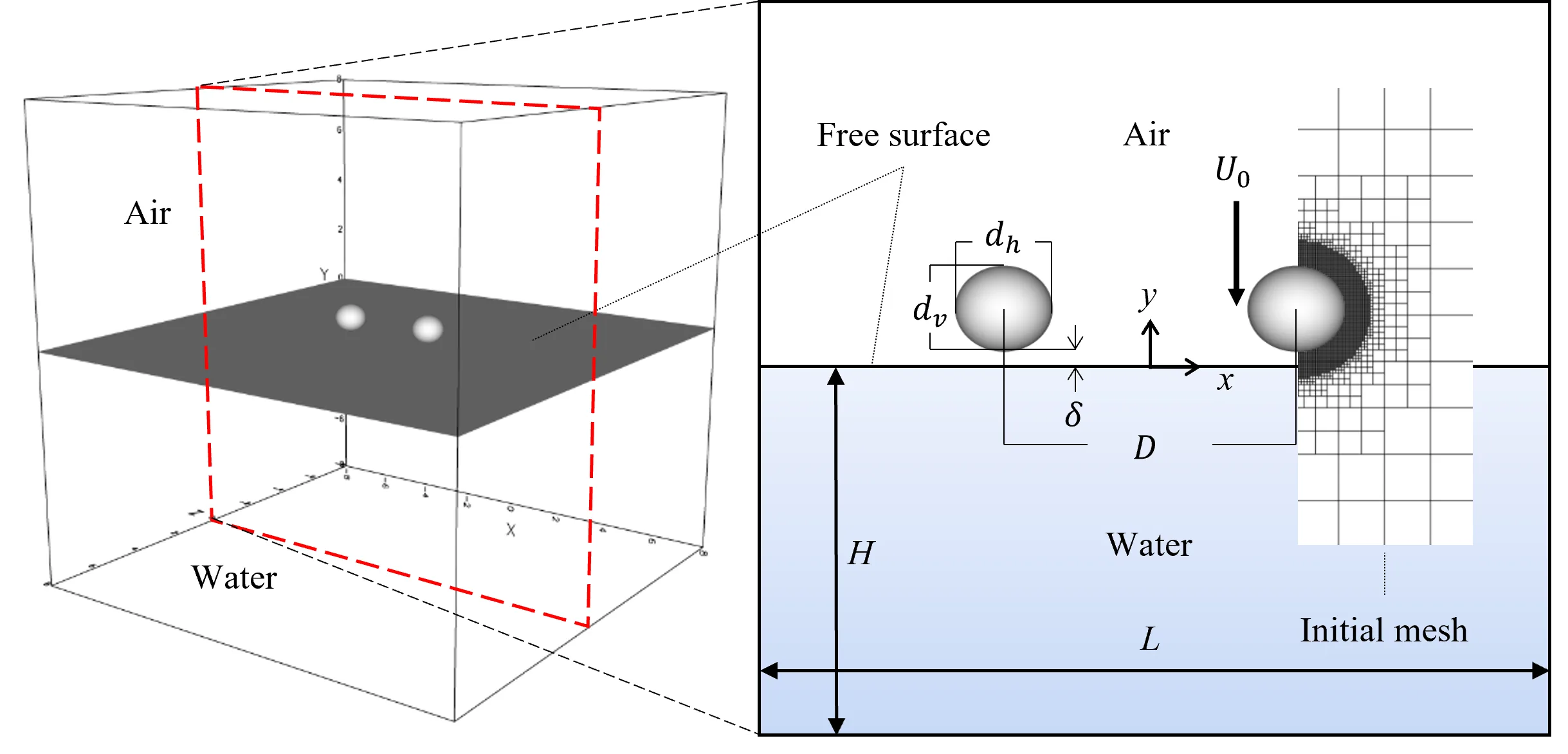
A raindrop falls into a puddle, and the impact sends up a little fountain of fine spray. Each of those droplets is a new, secondary drop. How many there are, how big they are, and how long they live depend on a host of factors: the fall speed, the drop size, the properties of the water. Scientists set out to make sense of this chaos using computer simulations.
They recreated the fall of one and two raindrops into water. The speed was that of real rain—7 meters per second, and the drop sizes ranged from 1 to 4 millimeters. They also varied the surface tension (the force that pulls the liquid's surface tight, like a film). It turned out that the number of secondary droplets drops sharply with their size: there are far more tiny splashes than large ones. If you plot it, you get a power law with an exponent of minus five-halves. That means a droplet with half the radius is about 6 times more common.
When two drops fall close together, the picture gets more complicated. The second drop can land in the crater left by the first, and then the splashes fly off differently. The researchers noticed that the lifetime of the splashes and their number depend on the distance between the falling drops. If the drops fall close together, the crater from the first hasn't collapsed yet, so the second drop plunges deeper and kicks up fewer splashes. If they fall far apart, each drop behaves almost independently.
But the most surprising thing: when they replotted all the data using the new formula, every point from the different simulations fell onto a single curve. That means the law of splash formation is universal: it doesn't depend on drop size, speed, or surface tension. Rain, it turns out, obeys simple mathematics, just like falling icicles or snowflakes.
Original abstract
as written by the authors arXiv:2604.10491
Secondary droplets produced by interactions between falling fluid drops and a liquid pool play a significant role in engineering applications and geophysical processes in nature. This study uses direct numerical simulations to investigate the dynamics of secondary droplets generated by raindrop-liquid pool interactions. The raindrop parameters feature a realistic speed of 7 m/s, effective diameters of 1-4 mm, and surface tension values ranging from $$25\%$$ to twice the typical air-water interface value. The numerical configurations include both a single raindrop and two raindrops separated by distances between two and four times the raindrop diameter. The secondary droplet size distribution, $$N_d$$, is found to scale with the droplet radius, $$r_s$$, as $$N_d(r_s)\propto r_s^{-5/2}$$, with additional dependencies on surface tension and raindrop diameter. When normalized according to this new scaling law, the droplet size distribution obtained from simulations with different parameter values collapses onto a single curve. Analysis of the impact morphology reveals distinct stages of raindrop interactions and identifies the formation and breakup of a central liquid film. Spatial and temporal analyses of the secondary droplets show that raindrop interaction can influence both the percentage of droplets captured by the cavity and the duration over which they re-merge with the pool. These behaviors arise from the combined effects of differences in the birth times of secondary droplets of various sizes and aerodynamic forcing associated with the cavity airflow.
When a raindrop hits a puddle, it doesn't just send up a fountain: it also creates a thin film of liquid that stretches rapidly and breaks into droplets, like a soap bubble popping at a touch.