A particle shower is a cascade of secondary particles produced when a high-energy particle, such as a cosmic ray, collides with matter. The primary particle interacts with atomic nuclei, creating new particles, which in turn interact further, multiplying the number of particles exponentially until the energy is dissipated. This phenomenon is fundamental to understanding cosmic rays and high-energy astrophysical processes.
History
The concept was developed in the 1930s by physicists such as Pierre Auger, who observed coincident cosmic ray detections at separated detectors, confirming the existence of extensive air showers.
How it works
When a high-energy particle strikes a nucleus, it produces pions and other mesons. These decay or interact, generating electrons, photons, and muons. Each new particle carries a fraction of the original energy, and the process repeats, creating a shower that can spread over large areas. The shower develops until the average particle energy drops below the threshold for further particle production.
In practice
Particle showers are used in ground-based cosmic ray observatories like the Pierre Auger Observatory, which detects the secondary particles to infer the properties of the primary cosmic ray.
Fun fact
A single ultra-high-energy cosmic ray can produce a shower containing billions of secondary particles covering an area of several square kilometers.
A storm in the upper atmosphere lasts a few millionths of a second. A cosmic ray, a proton or a helium nucleus, strikes air molecules, sending a swarm of particles downward. Most of them stay together, but occasionally one particle gains so much energy that it surges ahead.
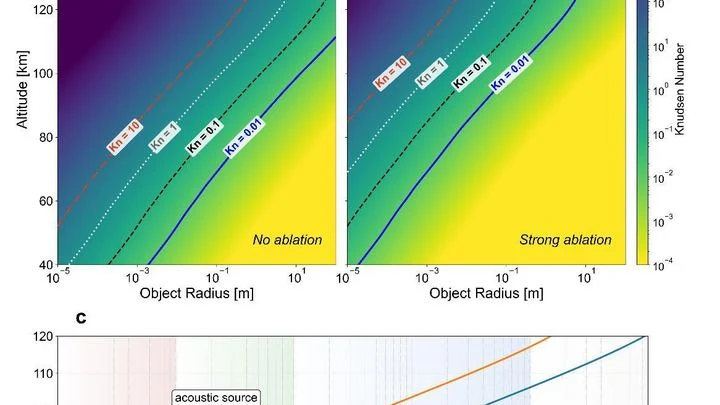
A pebble the size of a grape enters the atmosphere almost tangentially and skims across the sky without falling. That's exactly what happened to a meteoroid weighing about 45 grams. It came in at such a shallow angle that it traveled 164 kilometers at an altitude of 92 kilometers — where the air is a million times thinner than at the surface.
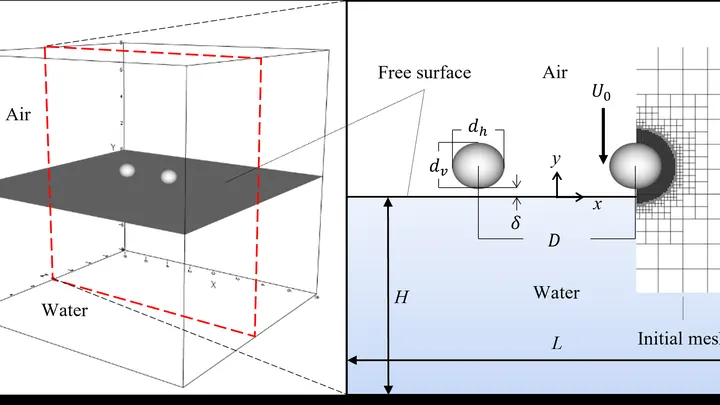
A raindrop falls into a puddle, and the impact sends up a little fountain of fine spray. Each of those droplets is a new, secondary drop. How many there are, how big they are, and how long they live depend on a host of factors: the fall speed, the drop size, the properties of the water. Scientists set out to make sense of this chaos using computer simulations.
The Mpemba effect is surprising: hot water sometimes freezes faster than cold. Scientists built a simple model: a bead in a thick, honey-like medium, on a landscape with two dips and a wall at the edge. The bead moves viscously, unable to hop over the central bump.
A semiconductor diode normally conducts current in only one direction, like a spring-loaded door: it opens easily one way but pushes back the other. But if you dope the crystal heavily, the door starts behaving strangely: under reverse bias, the current doesn't just flow: it shoots up.
Somewhere above our heads, every second, a proton accelerated to energies millions of times greater than those at the Large Hadron Collider slams into the atmosphere. It strikes an air molecule, and a cascade is born — a wide atmospheric shower of thousands of particles.
Light from an ordinary lamp is chaos: photons scatter in all directions with no order. But if you make many atoms emit light simultaneously and in sync, you get a short, powerful flash, like applause that turns individual claps into a single burst. Such coordinated emission is called superradiance.
Neutrinos are ghost particles: predicted by the Standard Model, they barely interact with matter. Catching them is like trying to hear a whisper in the roar of a waterfall.
Two particles cling to each other like climbers on the same rope and fly toward a wall. When they hit, will they bounce off together, or will the rope snap? What does it depend on? Physicists considered the simplest case: everything happens on a single line, the particles attract only when they occupy the same point, and the wall is perfectly rigid.
Fresh after the Big Bang, the Universe fizzed like a freshly poured soda. All of space was filled with bubbles — regions of new vacuum, the kind governed by the Standard Model, pushing out the old unstable state. The walls of these bubbles accelerated to near light speed, and in head-on collisions they crumpled and burst, unleashing monstrous energy.
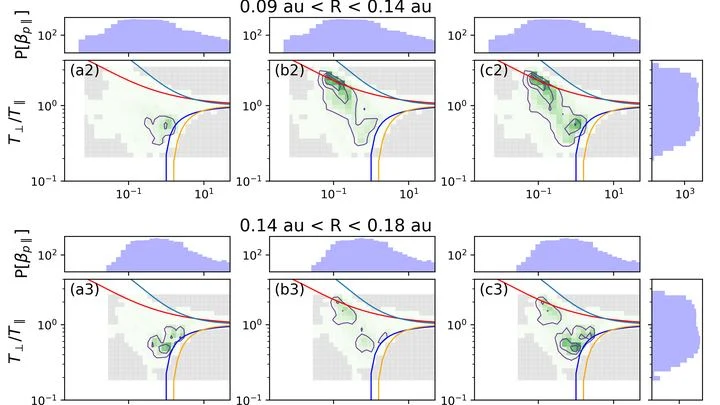
The solar wind isn't a calm stream but a bubbling soup of charged particles. Diving close to the Sun, the Parker probe picked up two types of stirring waves. Left-handed ones, like a whisk in a chef's hand, whip up the material when the temperature differs along and across the flow.