When a high-energy cosmic ray — a proton or atomic nucleus from deep space — slams into a molecule in Earth's upper atmosphere, it doesn't just stop. The collision creates a spray of secondary particles, each of which can collide again, producing more particles, and so on. This cascading process, called an extensive air shower, spreads millions of particles over many square kilometers by the time it reaches the ground. The shower is like a footprint of the original cosmic ray, and by studying it, physicists can infer the energy and direction of the particle that started it all.
History
The concept was established in the 1930s, notably by Pierre Auger, who observed coincident particle detections at separated Geiger counters and correctly interpreted them as a single widespread shower.
How it works
The primary cosmic ray hits an air nucleus, producing pions and other short-lived particles. These decay or collide, generating muons, electrons, photons, and neutrinos. The shower develops as a disk of particles moving at nearly the speed of light, with the most energetic particles near the center. Ground-based detectors, such as water Cherenkov tanks or scintillators, sample the particles that arrive, and the timing and density of hits across an array of detectors reveal the shower's direction and energy.
In practice
Extensive air showers are the primary tool for studying ultra-high-energy cosmic rays, including the search for their sources and tests of particle physics at energies beyond any accelerator.
Fun fact
A single ultra-high-energy cosmic ray can carry as much kinetic energy as a well-hit tennis ball, concentrated in a single subatomic particle.
A storm in the upper atmosphere lasts a few millionths of a second. A cosmic ray, a proton or a helium nucleus, strikes air molecules, sending a swarm of particles downward. Most of them stay together, but occasionally one particle gains so much energy that it surges ahead.
In a pot on the stove, water starts to churn from the bottom long before the whole thing boils. Bubbles of steam rise from the base even though the burner itself hasn't heated up yet.
Deep beneath the ice of the South Pole, nearly two and a half kilometers down, an unusual telescope is at work. It is not pointed at the sky but through the Earth. Its quarry: neutrinos, nearly elusive particles that pass through planets and stars without interacting with anything.
A pot of porridge boiling over a high flame: bubbles carry grains from the bottom to the surface. A similar mechanism works on a neutron star. As it accumulates hydrogen and helium from a companion star, it occasionally triggers a powerful nuclear explosion — an X-ray burst.
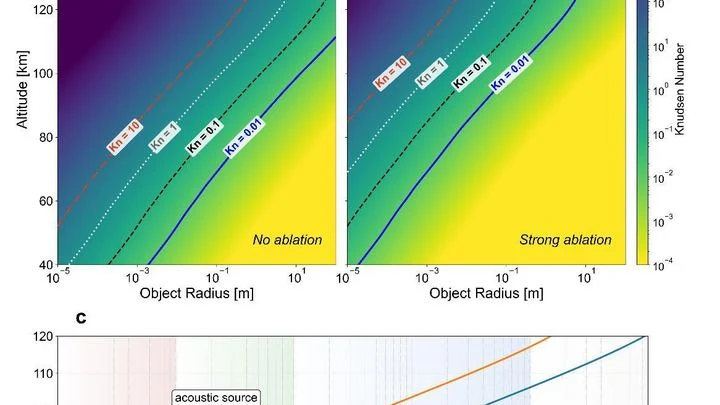
A pebble the size of a grape enters the atmosphere almost tangentially and skims across the sky without falling. That's exactly what happened to a meteoroid weighing about 45 grams. It came in at such a shallow angle that it traveled 164 kilometers at an altitude of 92 kilometers — where the air is a million times thinner than at the surface.
A clap of the hands compresses the air, and it flies outward — the simplest shock. In space, exploding stars play the role of hands: their shock waves sharply compress gas and trigger chaotic mixing — turbulence.
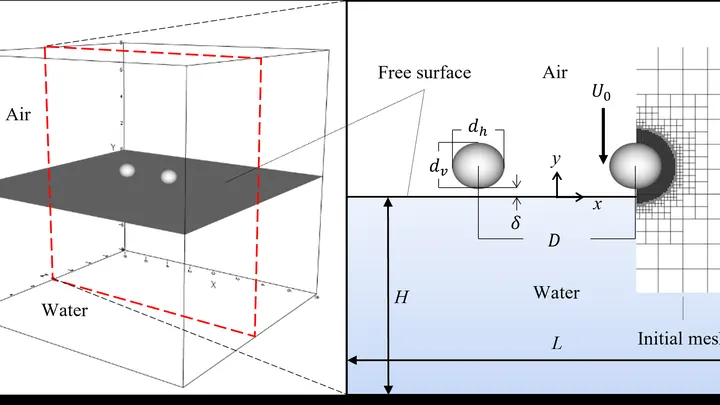
A raindrop falls into a puddle, and the impact sends up a little fountain of fine spray. Each of those droplets is a new, secondary drop. How many there are, how big they are, and how long they live depend on a host of factors: the fall speed, the drop size, the properties of the water. Scientists set out to make sense of this chaos using computer simulations.
When a heavy nucleus slams into interstellar gas at enormous speed, it shatters into pieces. Those pieces (lithium, beryllium, boron) then fly onward, and their abundance in the cosmic-ray flux depends on how the breakup unfolded. Conventionally, one expected the proportions to shift smoothly with energy, like the taste of soup when you keep adding water.
Cosmic rays are not light but charged particles bombarding Earth from all directions. Most of them are protons (hydrogen nuclei), but heavier nuclei also show up: helium, nitrogen, iron.
Somewhere above our heads, every second, a proton accelerated to energies millions of times greater than those at the Large Hadron Collider slams into the atmosphere. It strikes an air molecule, and a cascade is born — a wide atmospheric shower of thousands of particles.
The Einstein Probe space telescope detected a celestial storm: after a short (0.4-second) gamma-ray burst — a cosmic lightning bolt — came a long roll of X-ray thunder. It lasted nearly 10 minutes. This is the first direct proof that such explosions leave a lingering X-ray afterglow.
Neutrinos are ghost particles: predicted by the Standard Model, they barely interact with matter. Catching them is like trying to hear a whisper in the roar of a waterfall.