The second derivative measures how the rate of change of a quantity is itself changing. If the first derivative of a function tells you its slope or velocity, the second derivative tells you the slope's slope — the acceleration of the quantity. In physics, it appears everywhere: Newton's second law relates force to the second derivative of position (acceleration), and the wave equation ties spatial and temporal second derivatives together.
History
The concept emerged with the development of calculus in the late 17th century, primarily through the work of Isaac Newton and Gottfried Wilhelm Leibniz, who formalized derivatives of any order.
How it works
For a function f(x), the first derivative f'(x) gives the instantaneous rate of change. The second derivative f''(x) is the derivative of f'(x), computed by applying the same limiting process again. Geometrically, it indicates concavity: positive means the function curves upward, negative downward, zero marks an inflection point. In motion, if x(t) is position, then x''(t) is acceleration — how quickly velocity changes.
In practice
Used in engineering for vibration analysis (second derivative of displacement gives acceleration), in economics for marginal returns, and in physics for deriving equations of motion and wave propagation.
Fun fact
The second derivative of a straight line is always zero, which is why constant-velocity motion feels smooth — no acceleration.
In 2017, detectors picked up a gravitational wave from the collision of two neutron stars. Just 1.7 seconds later, telescopes saw a flash of gamma-ray burst from the same spot. That tiny delay became a treasure for physicists.
The early Universe was like a tightly coiled spring. In the first moments, it expanded at an unimaginable rate — a phase called inflation. Usually, this is attributed to a special field, but there's another idea: spacetime itself twists like a spring, and this twisting (in physics, torsion) becomes the engine of expansion.
When two neutron stars circle each other, they don't remain rigid spheres. The partner's gravity stretches each star, creating tidal bulges — much like the Moon raises ocean tides on Earth. But unlike water, here it's superdense matter that deforms: a teaspoon of this stuff weighs billions of tons.
A black hole is like a perfect vacuum cleaner: anything that crosses its horizon vanishes without a trace. But this vacuum cleaner has a strange feature: its "dust bag" grows, and by the size of the bag you can tell how much has been sucked in. In black hole physics, this size is linked to entropy entropy — a measure of hidden information about what fell inside.
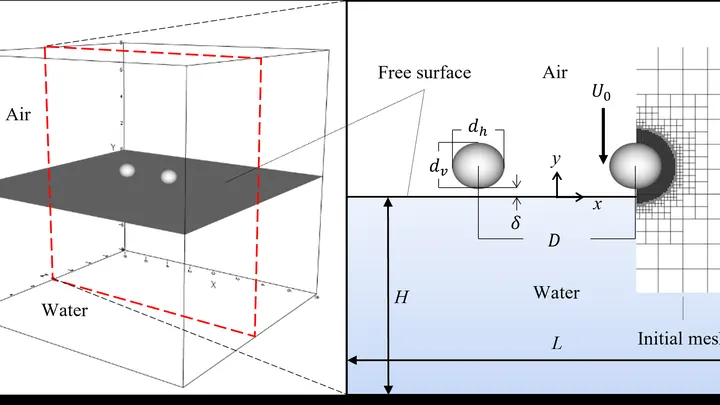
A raindrop falls into a puddle, and the impact sends up a little fountain of fine spray. Each of those droplets is a new, secondary drop. How many there are, how big they are, and how long they live depend on a host of factors: the fall speed, the drop size, the properties of the water. Scientists set out to make sense of this chaos using computer simulations.
In most magnetic materials, a domain wall, the boundary between regions with different magnetization, moves in one direction under current, set by the current's direction. But in ferrimagnets near a special point where the angular momenta of two sublattices cancel each other, the behavior changes.
An atom excited by light gives its energy back in an instant — it emits a photon. This process is like a tired runner dropping a heavy load. But if the runner is on a mountain slope, it's harder to pick up speed. Gravity acts on the atom similarly: near a massive body, time flows slower, and the atom emits differently.
When water churns behind a boat, the energy of motion is converted into heat through a cascade of vortices. Measuring how quickly this happens directly is difficult: you'd need to track all the vortices at once. So scientists use a simplification: they look at only one velocity component at a single point.
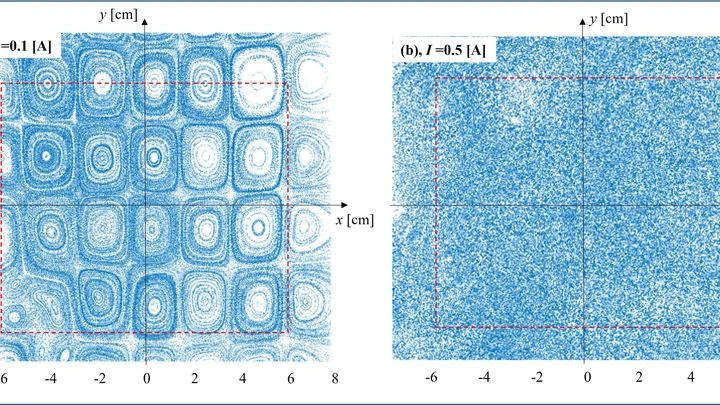
Water in a puddle after rain swirls differently than in a deep lake. A thin layer of fluid feels the bottom, and that changes the nature of its vortices. Scientists created such a layer in the lab: they poured in an electrolyte, ran a current and a magnetic field, and the fluid began to move.
In the quantum world, an object can be in several places at once. Yet in everyday life we see things strictly in their places. The reason is gravity. A massive star under its own weight inevitably collapses into a black hole or a neutron star, but it can't be both at the same time.