Quantum Whispers in Scale-Free Silence express
A stone drops into a pond. Ripples spread, fade, and soon the surface is smooth again. But what if the pond has no shores, no bottom, and no characteristic ripple size? That is the world, a scale-free world, where quantum systems live when surrounded by an environment that picks out no particular length or energy. In such a pond, the water always 'remembers' the stone's shape, and the ripples never fully settle.
Every environment of this kind acts on a quantum particle in the same way: as a 'non-particle bath.' This is not a substance made of familiar atoms but a continuous spectrum of states, like an infinitely dense fog with no individual droplets. All the fog's behavior is set by a single number — the scaling dimension dU. It tells you how strongly the environment 'smears out' quantum effects. The authors proved that this is not a convenient model but a rigorous consequence of nature's fundamental symmetries: locality (influence spreads gradually, point by point), Lorentz invariance (the laws of physics are the same for all observers), and continuous scale invariance (the picture does not change when you zoom in or out).
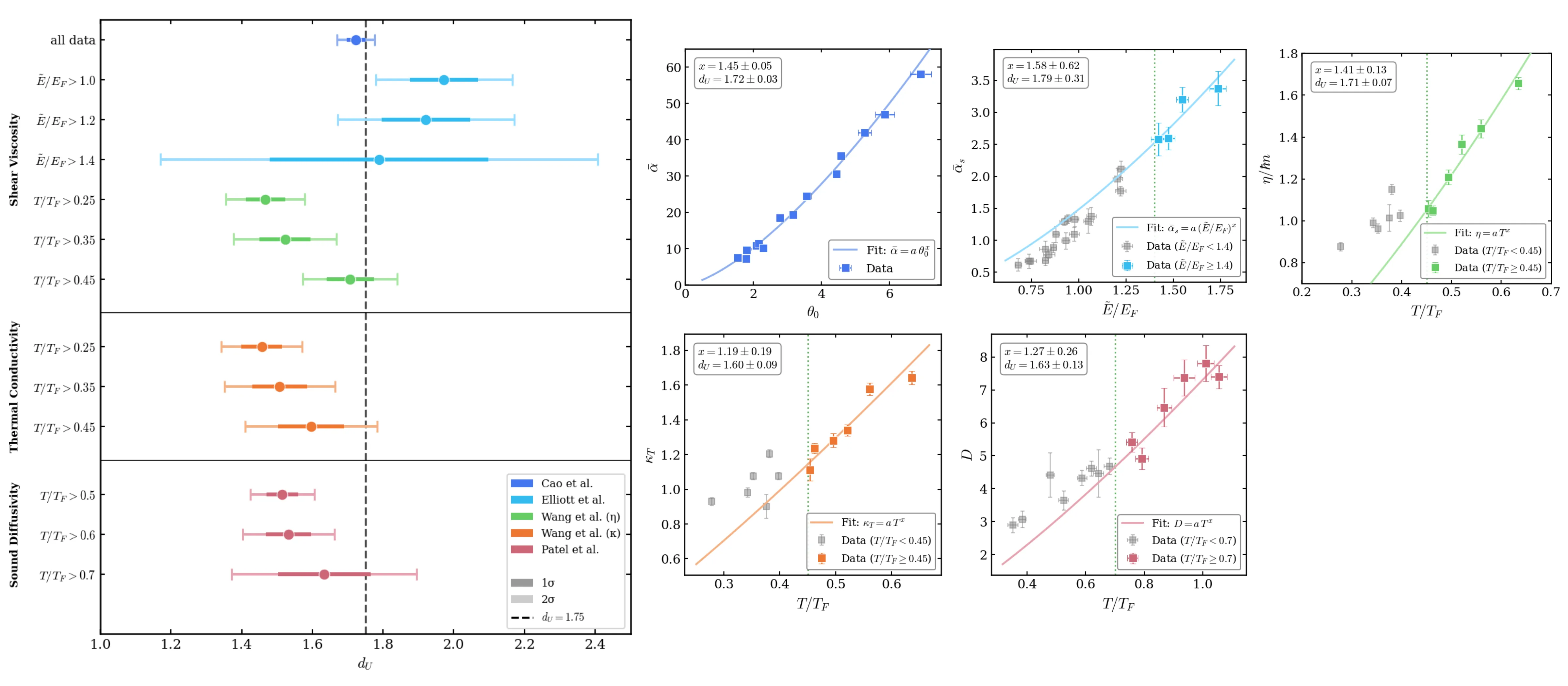
The chain of consequences is rigid: knowing dU lets you compute how fast quantum correlations decay: that 'whisper' between particles that makes them unlike classical objects. Conversely, measuring the decay rate in an experiment gives you dU. That is exactly what they did with an ultracold Fermi gas — a cloud of atoms cooled to near absolute zero, behaving as a single quantum liquid. Two completely different measurements (transport properties — how the gas conducts heat and momentum) gave the same value dU = 7/4. It is as if you measured Everest's height with a barometer and a tape measure and got the same result, so the theory is right.
But that is not all. The authors showed that three very different areas of physics (the critical point of the quantum Ising model (a simplified description of a magnet near a phase transition), inflationary cosmology (the era of superfast expansion in the early universe), and ultra-high-energy astrophysical neutrinos) are described by the same mathematical structure. The energies of these phenomena differ by a factor of $10^{25}$—like comparing a ripple from a tossed grain of sand to a tsunami, yet the decoherence equation is the same.
This is like a film on the water's surface: if it is elastic enough, the ripples from the stone do not vanish but freeze, storing information about the moment of impact. In a scale-free world, the geometry of quantum correlations itself becomes such a 'film,' and the transition at dU = 5/2 is the moment when it either bursts or, on the contrary, tightens. And then the pond stops forgetting.
Scale invariance means the system has no characteristic size. If you photograph such an environment and enlarge the image, you cannot tell by how much — the picture looks the same. In everyday life, clouds or coastlines behave this way: their ruggedness looks similar at all scales.
In Carl Sagan's novel 'Contact,' aliens encode a message in the very structure of spacetime, using its scale-invariant properties. Protected coherence at dU > 5/2 is almost the same trick: information is not erased but sealed within quantum correlations.