A quantum liquid is a state of matter where quantum mechanical effects dominate its macroscopic properties, often leading to phenomena like superfluidity, superconductivity, or quantum spin liquids. Unlike classical liquids, these systems exhibit long-range quantum coherence, meaning particles behave collectively as a single quantum entity. Examples include superfluid helium-4, where atoms flow without viscosity, and the electron liquid in a superconductor, which conducts electricity without resistance.
History
The concept dates back to the 1930s with the discovery of superfluidity in helium-4 by Pyotr Kapitsa and others, and was later extended to superconductivity by Bardeen, Cooper, and Schrieffer in 1957.
How it works
In a quantum liquid, particles are described by a single macroscopic wavefunction. For bosons like helium-4 atoms, cooling below a critical temperature causes them to condense into the same quantum state, forming a superfluid. For fermions like electrons, pairing into Cooper pairs allows them to behave as bosons and condense, leading to superconductivity. The quantum liquid's properties arise from the interplay of particle statistics, interactions, and quantum fluctuations.
In practice
Quantum liquids are used in technologies like superconducting magnets for MRI machines and particle accelerators, and in quantum computing as a basis for qubits.
Fun fact
In a quantum spin liquid, magnetic moments remain disordered even at absolute zero, never freezing into a solid pattern—a state that has been sought for decades and may enable topological quantum computing.
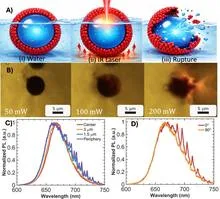
A tiny capsule, like a soap bubble but with a shell of glowing crystals, behaves like a laser. While its wall is intact, light circulates, amplifies, and escapes as a narrow, bright beam. Once the wall bursts, the beam turns into a dim spot. Such a capsule is a colloidosome, and it can change its glow on command.
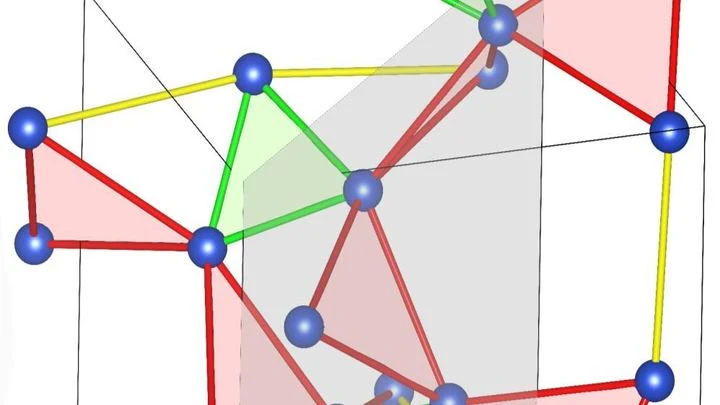
The PbCuTe₂O₆ crystal resembles a three-dimensional web of copper, tellurium, and oxygen. Inside, the magnetic moments, tiny arrows tied to electron spins, are so entangled that they can't settle into an orderly arrangement even near absolute zero.
A superfluid flows without friction, like water that never stops. But when you spin it, it doesn't just rotate: each tiny vortex remembers exactly how it was spun. This 'trace' is not a metaphor but a real geometric imprint, which physicists call the Berry phase (the phase acquired by a wave as it travels along a closed path).
In the conventional Heisenberg picture, spins at low temperatures are supposed to line up in a strict pattern. But there are crystals — like pyrochlore — where geometry has its own way. Each ion sits at a vertex of a tetrahedron, and the main interaction enforces a rule: two spins point inward, two outward.
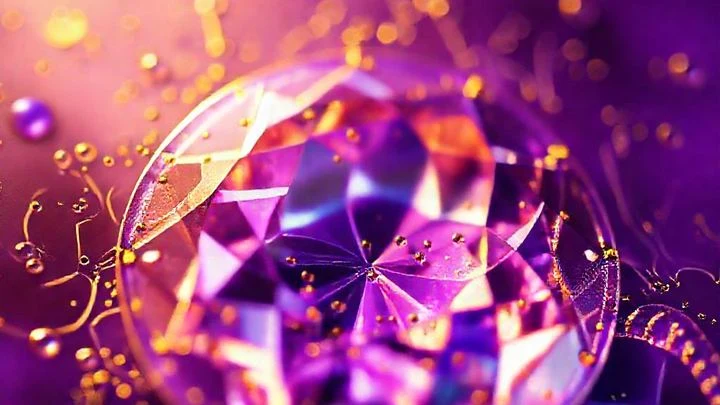
Magnetic particles are attached to the surface of the diamond by DNA strands, like puppets on strings. They constantly dance under the thermal motion of the liquid molecules. The liquid's viscosity sets the pace: in honey, the particles barely tremble; in alcohol, they dance quickly.
A stone falls into a pond, and ripples spread across the water. Long waves and short ones travel at the same speed: that's how ordinary sound behaves in almost any medium. But in quantum liquids, things can be different.
Physicists considered a superfluid where particles move along a "flat" energy band.
Sound travels through a medium at a certain speed. If the medium moves faster, the sound gets swept along by the flow — like a wood chip pulled into a whirlpool. In superfluid helium — a frictionless liquid — rapid rotation spawns vortex funnels. Inside them, an acoustic black hole forms: a region from which sound cannot return.
In superfluid helium, friction disappears — the liquid flows like a mountain stream, but without a single eddy. A short laser pulse rippled this smooth surface, and scientists using spectroscopy captured the spreading ripples — quantum waves with many speeds.