How to Measure the Electric Wind Behind the Moon express
The Moon isn't just hanging in the sky: it leaves behind a long tail of disturbed solar wind. The stream of charged particles from the Sun flows around the rocky sphere, and behind it forms a zone where particles are almost absent. But this emptiness is not simple: electric fields arise in it that push apart the remaining electrons and ions. Measuring these fields directly is difficult, so scientists took a roundabout path.
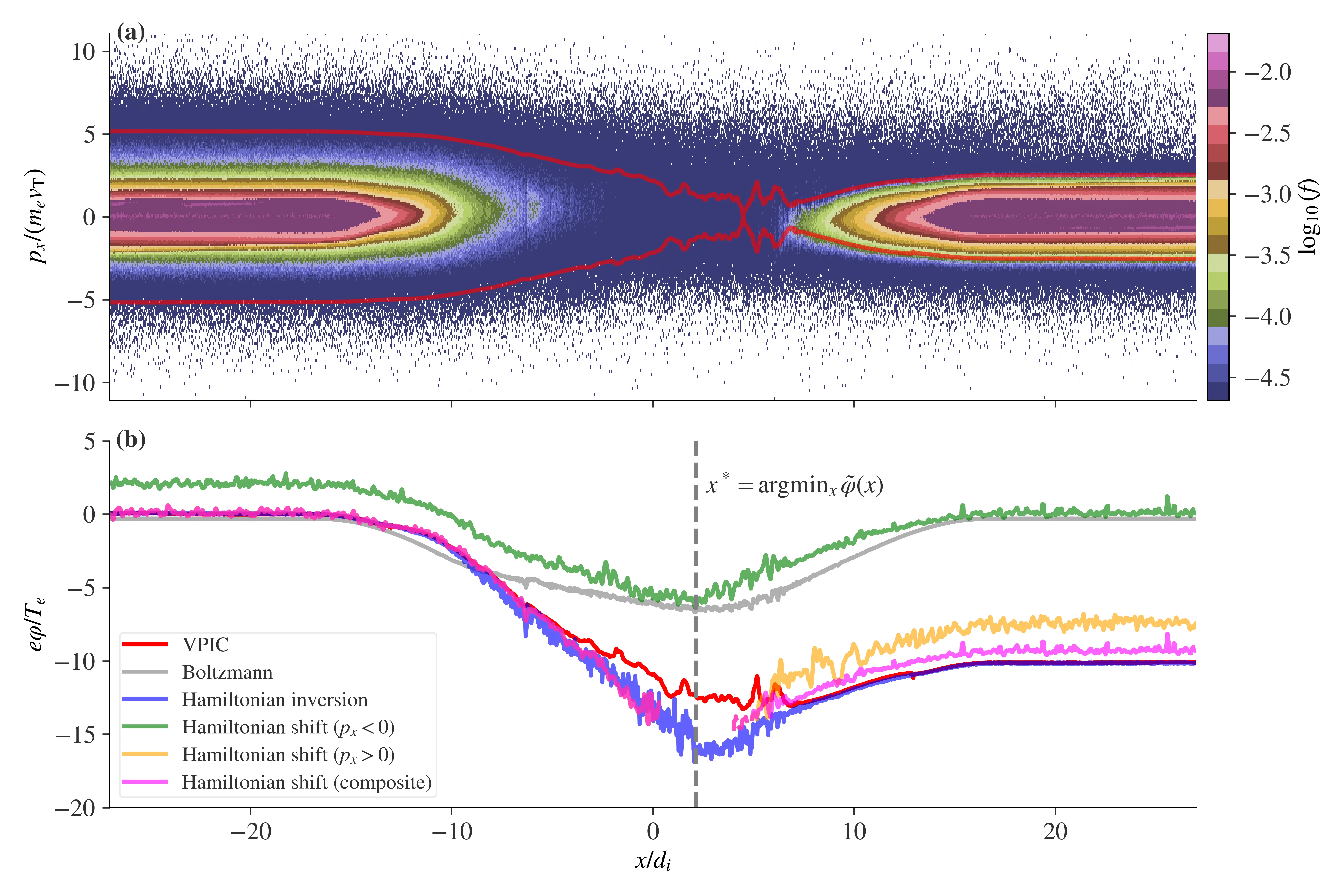
Usually, particles in a plasma are distributed smoothly by speed, like a crowd on an escalator. But in the lunar shadow, the picture breaks down: on the sunward side, electrons fly faster; on the shadow side, slower; and in the very center, groups of particles with the same energy appear, as if stuck on a step. The new method, called Hamiltonian inversion, uses this stepped structure. It reconstructs the shape of the electric field from how exactly the electrons have grouped by energy.
The method was tested on a computer simulation of the lunar shadow at two moments in time: right after formation, when asymmetry is strong but shock waves haven't yet appeared, and later, when ion-acoustic waves are already raging in the center. Then it was applied to real data from the ARTEMIS spacecraft, which flew through the Moon's shadow. It turned out that the electric potential drop in the shadow reaches fifteen units of electron thermal energy: that's like a voltage change of tens of volts over a path of several kilometers. In the regular solar wind, such drops are many times smaller.
The Moon's shadow turned out to be not just an empty bag, but a living electric structure. Where streams of particles collide, sharp potential jumps are born, like waves running along a taut string. The method devised for the Moon will also work for other bodies without atmospheres: asteroids, planetary moons, even artificial probes. Wherever electrons are trapped by an electric field, its shape can be reconstructed from their motion.
Original abstract
as written by the authors arXiv:2604.17825
Inferring electric potentials from electron phase space density measurements in the lunar wake is complicated by two challenges: the asymmetry between the sunward and anti-sunward sides of the wake driven by the solar wind strahl, and the presence of ion acoustic shocks in the central wake. We develop the Hamiltonian inversion method, which infers the full spatial electric potential profile by exploiting the quasi-static Vlasov equilibrium condition $$f = f(H)$$, where $$H$$ is the electron Hamiltonian. The method addresses both challenges through a domain-decomposition strategy: on the two sides of the wake the potential is inferred independently by minimizing the misfit between the observed phase space density and a self-consistently reconstructed $$f_\mathrm{interp}(\tilde{H})$$, while in the central wake where flat-top trapped electron distributions are present the potential is inferred directly from the flat-top width. We validate the method against particle-in-cell simulation data at two evolutionary stages of the lunar wake: an early stage where strahl asymmetry is strong but no shocks have formed, and a later stage where ion acoustic shocks and flat-top distributions are present. We then apply the method to two ARTEMIS lunar wake crossings at the same evolutionary stages, inferring normalized potential drops of $$e\Delta\varphi/T_e \sim 15$$ and $$\sim 5$$ respectively and capturing shock-associated potential enhancements in the central wake. The method is broadly applicable to plasma environments where electrons are in quasi-static equilibrium with a field-aligned electric potential.
The lunar shadow stretches for hundreds of thousands of kilometers, farther than the distance from Earth to the Moon, and in it constantly blows an 'electric wind' of escaping electrons.
In Arthur C. Clarke's novel 'A Fall of Moondust,' tourists are trapped beneath the Moon's surface; the real lunar shadow is also a trap, but for charged particles, and scientists are learning to read its electric writings.