The Universe in a Test Tube: How Tiny Slices of the Cosmos Replace Massive Simulations express
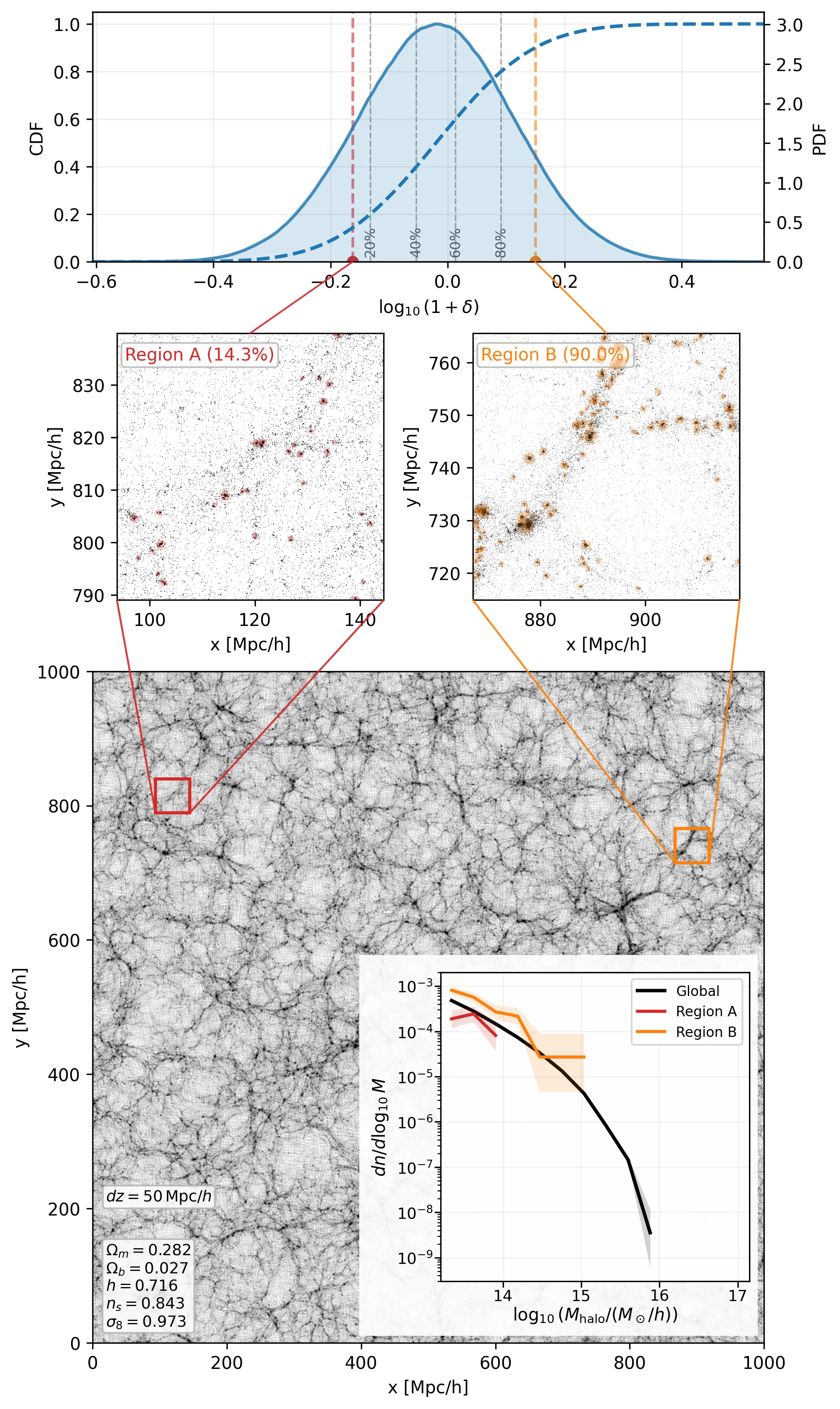
The Universe is vast, and figuring out how galaxies and dark matter are distributed within it is no easy task. Usually, scientists run computer simulations that "play out" the evolution of entire regions of space billions of light-years across. But such calculations demand colossal resources and time. Dark matter is invisible, yet it acts as an invisible scaffold, determining where galaxies will gather.
This new method is like a restorer who rebuilds a huge mosaic from a few surviving fragments. Instead of modeling the entire gigantic volume, researchers take small cubes of space — only about 50 megaparsecs across (that's the distance light travels in 163 million years). There are many such cubes, each with its own density: some have a bit more matter, others a bit less. After training a model on these pieces, you can then "glue" them together into a complete picture of mass distribution.
The secret is that the model accounts for how the density of each piece affects the number of galaxies within it. Then, knowing how often regions of different densities occur, you can sum all the contributions to get a global picture. It's like wanting to know the average height of people in a city, but instead of surveying everyone, you measure heights in a few neighborhoods (poor and rich, old and new) and average them properly.
This approach opens the door to studying the smallest galaxies, which were previously hard to "catch" in large simulations. And ahead lie new telescopes like Euclid and Roman, which will collect data on billions of galaxies. To make sense of it all, we'll need exactly such fast and clever methods.
The volume of one small cube in the new method is roughly a cube with a side of 50 megaparsecs. If you were to fly through it at the speed of light, the journey would take 163 million years.