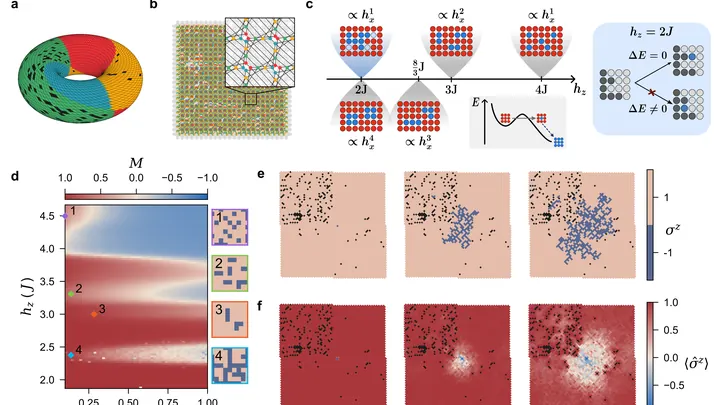
Quantum simulationcosmology is a research strategy that uses controllable quantum systems—such as ultracold atomic gases, trapped ions, or superconducting qubits—as miniature stand-ins for the early universe. The idea is that the same quantum field theories believed to govern the cosmos shortly after the Big Bang can be reproduced in the lab, at vastly smaller scales and slower timescales, allowing physicists to study phenomena that are otherwise inaccessible to direct observation. This includes vacuum decay, the process by which a 'false vacuum' state collapses into a lower-energy 'true vacuum,' potentially producing bubbles that expand and create matter—a mechanism some theories propose for the birth of our universe.
History
The concept of using analog systems to study cosmological phenomena gained traction in the early 2000s, notably with proposals by William Unruh and others to simulate Hawking radiation using sonic horizons in fluids. The specific application to vacuum decay and early-universe dynamics has been explored theoretically since the 2010s, with experimental realizations in atomic gases emerging around the same period.
How it works
The approach relies on the mathematical equivalence between certain condensed-matter systems and cosmological models. For example, a Bose-Einstein condensate of ultracold atoms can be engineered to mimic a scalar field in curved spacetime, complete with an effective 'speed of light' and 'gravitational' potential. By tuning interactions and external traps, researchers can create analog horizons, simulate inflationary expansion, or trigger vacuum decay events in a controlled way. The resulting dynamics—such as the growth of bubble-like domains—are then measured and compared with theoretical predictions, providing empirical tests of ideas that would otherwise remain purely speculative.
In practice
Beyond fundamental physics, quantum simulators of cosmology help develop computational tools for quantum many-body problems and inform technologies like quantum sensors and quantum computing, which rely on precise control of quantum states.
Fun fact
In some experiments, the 'bubbles' of vacuum decay in a quantum gas expand at speeds that can be directly filmed with high-speed cameras, making an event from the first fractions of a second after the Big Bang visible in real time.
The universe rang piercingly in its first moments. During the inflation epoch, when space expanded faster than light, energies were monstrous — trillions of times higher than in the Large Hadron Collider.
A false vacuum is not just a supercooled liquid, but a quantum hologram, ready to spring to life under the right projection. Its decay is described by the tunneling of a quantum field from a metastable minimum, and the classic calculation via Euclidean instantons is as elegant as a still life under spotlights.
In 1981, Alan Guth proposed a scenario of cosmological inflation — a lightning-fast expansion of space that stretched quantum fluctuations to the scale of entire galaxies. Since then, cosmologists, like archaeologists, have been excavating this event from the structures of the Universe.
The quantum vacuum is not a dead void but a boiling cauldron of probabilities. In some theories, our Universe is frozen in a metastable state: like superheated water, it's ready to explode into steam at the slightest nudge.
After the Big Bang, the universe may have been stuck in a false vacuum — a temporary state like a soap bubble ready to pop. A rare true vacuum bubble could then erupt, stretching space in the blink of an eye.
A translator hears not just words, but intonation, pauses, the tremor in a voice. Ordinary entropy analysis of cosmic perturbations is like meeting minutes: it records facts but loses the nuances. Pseudoentropy entropy is a new tool that captures the hidden "music" of the early universe.
A compressed spring can sit for years without moving. It seems frozen forever, but inside the metal, atoms slowly rearrange, and one day the spring clicks, settling into a new, more relaxed position.
The birth of the universe resembles not an explosion, but a traffic jam. At first, a tiny fraction of a second after the Big Bang, space expanded sluggishly, like cars stuck in gridlock. Then came a sharp surge — accelerated expansion, which cosmologists call inflation.
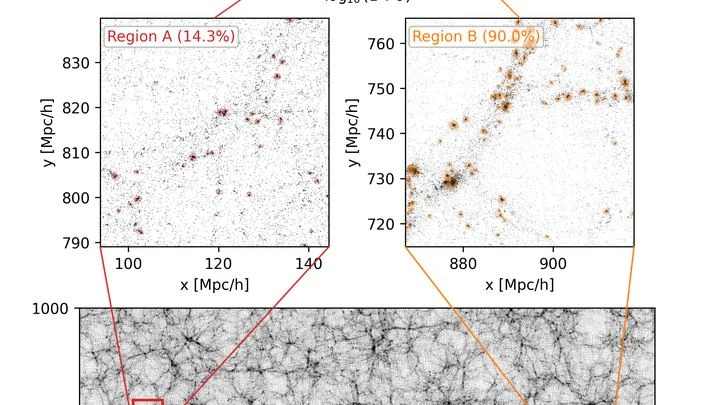
The Universe is vast, and figuring out how galaxies and dark matter are distributed within it is no easy task. Usually, scientists run computer simulations that "play out" the evolution of entire regions of space billions of light-years across. But such calculations demand colossal resources and time.
Dark matter is invisible, but its gravity holds galaxies together. For a long time, it was thought that dark matter particles pass right through each other without noticing. However, in small galaxies, the density of dark matter in the center turns out to be lower than calculations predict.
Our Universe may have arisen from a highly unstable state that physicists call the false vacuum. Imagine a glass of water cooled below its freezing point: the liquid remains liquid only until the first jolt, which instantly triggers crystallization into ice.
In the first moments after the Big Bang, the Universe underwent rapid expansion: inflation. But perhaps it was contracting before that, and then bounced. Both scenarios leave nearly identical imprints on the cosmic microwave background, and cosmologists have debated for decades which one is correct.