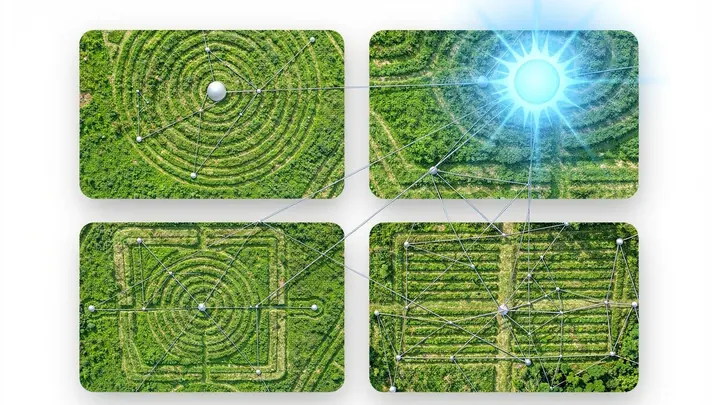
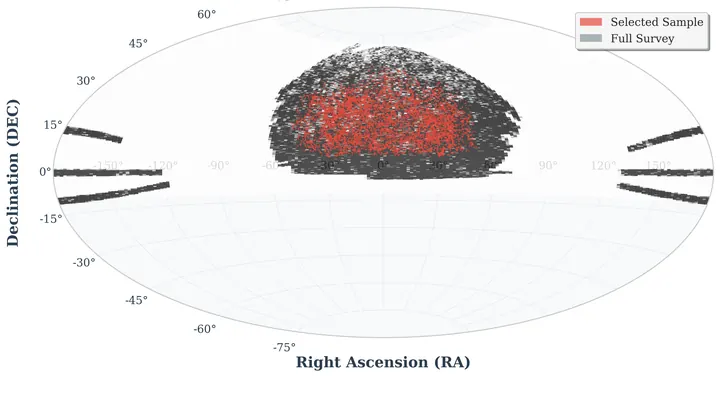
A mosaic, in the context of cosmic structure, is a composite image or map built from many smaller patches, each observed separately, then stitched together to reveal a larger whole. This technique is essential in astronomy because telescopes have limited fields of view, and the largest structures in the universe — such as galaxy clusters, cosmic filaments, and the cosmic web — span far more sky than a single exposure can capture. By combining hundreds or thousands of individual observations, astronomers can reconstruct the large-scale distribution of matter across billions of light-years.
History
The technique of photographic mosaicking dates back to the early 20th century, when astronomers like George Ellery Hale stitched together plates from the Mount Wilson Observatory to map the Milky Way. Digital mosaicking became standard in the 1990s with the advent of large-format CCD cameras and powerful image-processing software.
How it works
The process begins with a series of overlapping observations, each covering a small patch of sky. Software identifies common stars or galaxies in the overlapping regions to align the images precisely, correcting for telescope pointing errors and distortions. The patches are then blended together, adjusting brightness and color to produce a seamless final image. In radio astronomy, mosaicking also involves combining data from different antenna positions, using interferometric techniques to synthesize a larger effective aperture.
In practice
Mosaicking is used in all major sky surveys, such as the Sloan Digital Sky Survey and the upcoming Vera C. Rubin Observatory, to create deep, wide-field maps of the universe that reveal the cosmic web.
Fun fact
The largest astronomical mosaic ever created is the 1.7-billion-pixel image of the Andromeda Galaxy, assembled from over 7,000 individual exposures taken by the Hubble Space Telescope.
A census by body shape: that's one way to describe what astronomers did with 6348 massive galaxies. Instead of height and weight, they measured how concentrated the light is toward the center, how flattened the galaxy is, and how asymmetric its shape is. Then they ran the same measurements on galaxies from three computer models of the universe and compared the results.
A river drawn on a map is always a single line. But stand on the bank, and you will see that within the channel there are faster currents, eddies, and branches that merge and split. The cosmic web is like that river, but made of dark matter, and until recently astronomers drew it as a single line.
The night sky looks like a random scattering of stars. But zoom out to enormous distances, and the chaos disappears. Galaxies gather into long filaments and flat walls, with colossal voids gaping between them — cosmic voids. This structure is called the cosmic web.
In 2019, the world saw the first image of a black hole's shadow — an orange doughnut on a black background, becoming a symbol of scientific progress. But this image wasn't captured by a camera: it was born from mathematical alchemy, where data from eight radio telescopes, which gathered only crumbs of signal, merged into a single picture.
Deep in the Amazon rainforest, beneath a multi-layered canopy of leaves, lie vast earthen figures — squares, rectangles, the occasional rhombus. For decades they teased archaeologists with their silent geometry, until a researcher armed with orbital optics saw them as an astronomical instrument.
In the silent ocean of the Galaxy, mature civilizations have likely long chosen an unexpected strategy: instead of loud beacons, they scatter quiet fireflies — autonomous interstellar laser beacons, drifting in the void and dropping microsecond flashes. These 'seeds of contact' are not tied to their home stars and do not drown in their glow.
From childhood, we're used to thinking of space as infinite and isotropic. But Einstein and Lemaître were already asking: could the Universe be closed in on itself, like a Möbius strip or a 3-torus?
A drop of water in your palm holds roughly $$10^{21}$$ molecules, each made of three atoms surrounded by a swarm of electrons. To understand how matter behaves, physicists solve equations for these electrons. The trouble is that the number of equations grows like an avalanche: for N electrons, you need to store $$N^2$$ numbers.
Tile a floor with identical triangles, and you get a boring repeating pattern. But what if you want the pattern to never repeat, yet use just one tile? For a long time, mathematicians were sure it couldn't be done: you'd need at least two different shapes. The famous Penrose mosaic is a case in point: rhombi with acute and obtuse angles arrange into an infinitely varied but strictly ordered pattern.
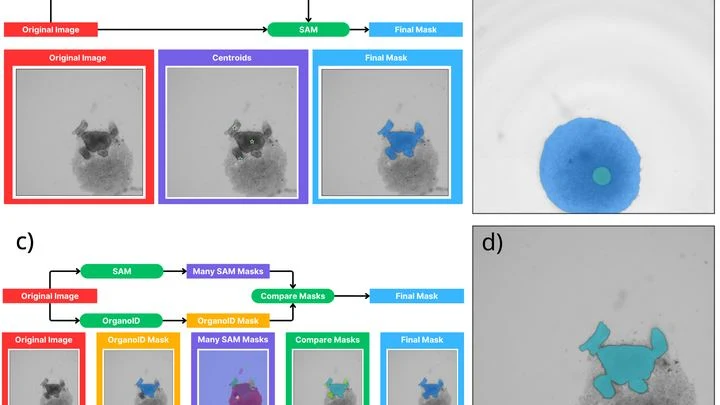
A biologist looks through a microscope at dozens of tiny cell spheres — spheroids. From these, miniature organ-like structures will later grow. The task is similar to a baker's job of checking whether the dough has risen evenly in each mold. Only here, instead of molds, there's a nutrient medium, and instead of dough, there are living cells.
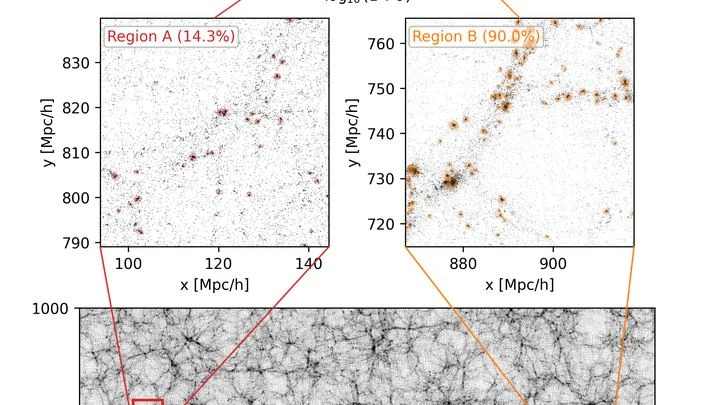
The Universe is vast, and figuring out how galaxies and dark matter are distributed within it is no easy task. Usually, scientists run computer simulations that "play out" the evolution of entire regions of space billions of light-years across. But such calculations demand colossal resources and time.
Toss a handful of glitter into a river, and some flakes will drift straight while others spin in tiny eddies. Galaxies in the universe do something similar: they don't just recede due to cosmic expansion: they also swirl in giant currents, like wood chips caught in invisible whirlpools.
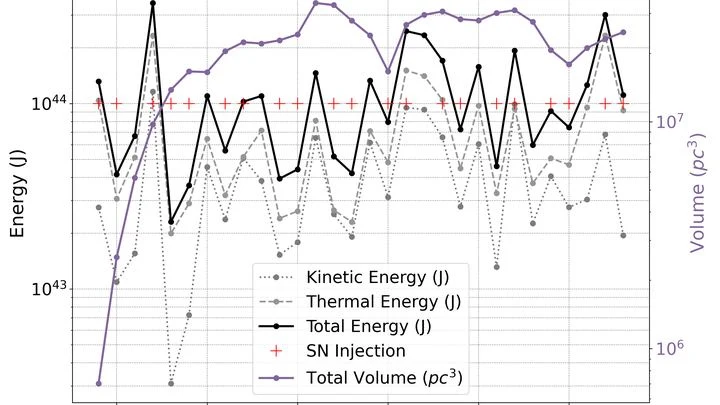
Superbubbles are cosmic giants, akin to soap bubbles, but instead of soap film, they contain rarefied interstellar gas, and they're inflated not by a breath but by a series of supernova explosions. In computer simulations, they behave like living things: they grow, cool, and move. But until now, we couldn't precisely trace their boundaries.
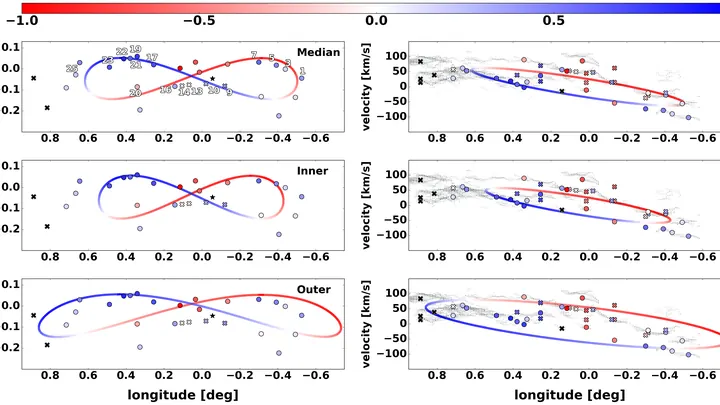
In the very center of the Milky Way, hidden behind a thick veil of dust, lies a giant accumulation of gas — the Central Molecular Zone. You can't see it with the naked eye: dust absorbs visible light, much like dense fog hides the lights of a city.
Images of distant galaxies are riddled with curved arcs and smears — light warped on its way to us. This effect, predicted by Albert Einstein, acts like a giant funhouse mirror: a massive galaxy cluster distorts the images of background sources.
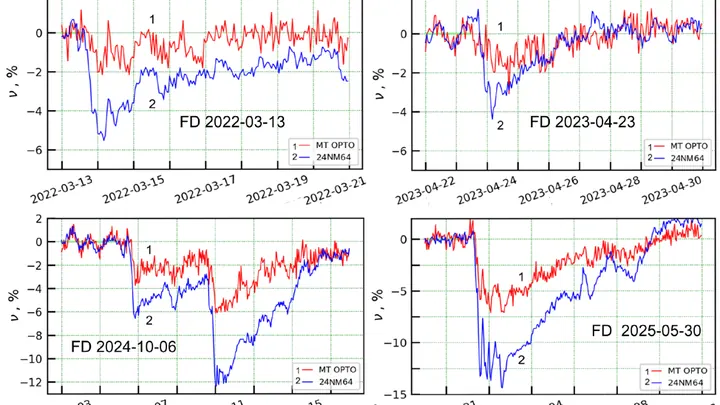
A storm is brewing somewhere far away, and the Geiger counter is already clicking more often. That's how cosmic rays, a stream of charged particles from deep space, make themselves known. When they slam into the atmosphere, they create showers of secondary particles, including muons: heavy cousins of electrons that can reach the ground.
Light from a distant galaxy travels toward us for billions of years, but along the way it can run into a massive galaxy cluster. Its gravity acts like curved glass: it bends the path of rays, so instead of one image, we see several — sometimes arcs, sometimes points.