Cosmic Remelting of the First Rocks express
An old chest of family heirlooms opens, and inside lie jewels that were thought to be as old as great-grandmother. But suddenly it turns out: the gold was remelted, the stones were recut, and this happened much later than thought. A similar story happened to the oldest particles in meteorites — calcium-aluminum inclusions, or CAIs. Their age is about 4.567 billion years, and they are considered the first solid bodies to condense in the protoplanetary cloud.
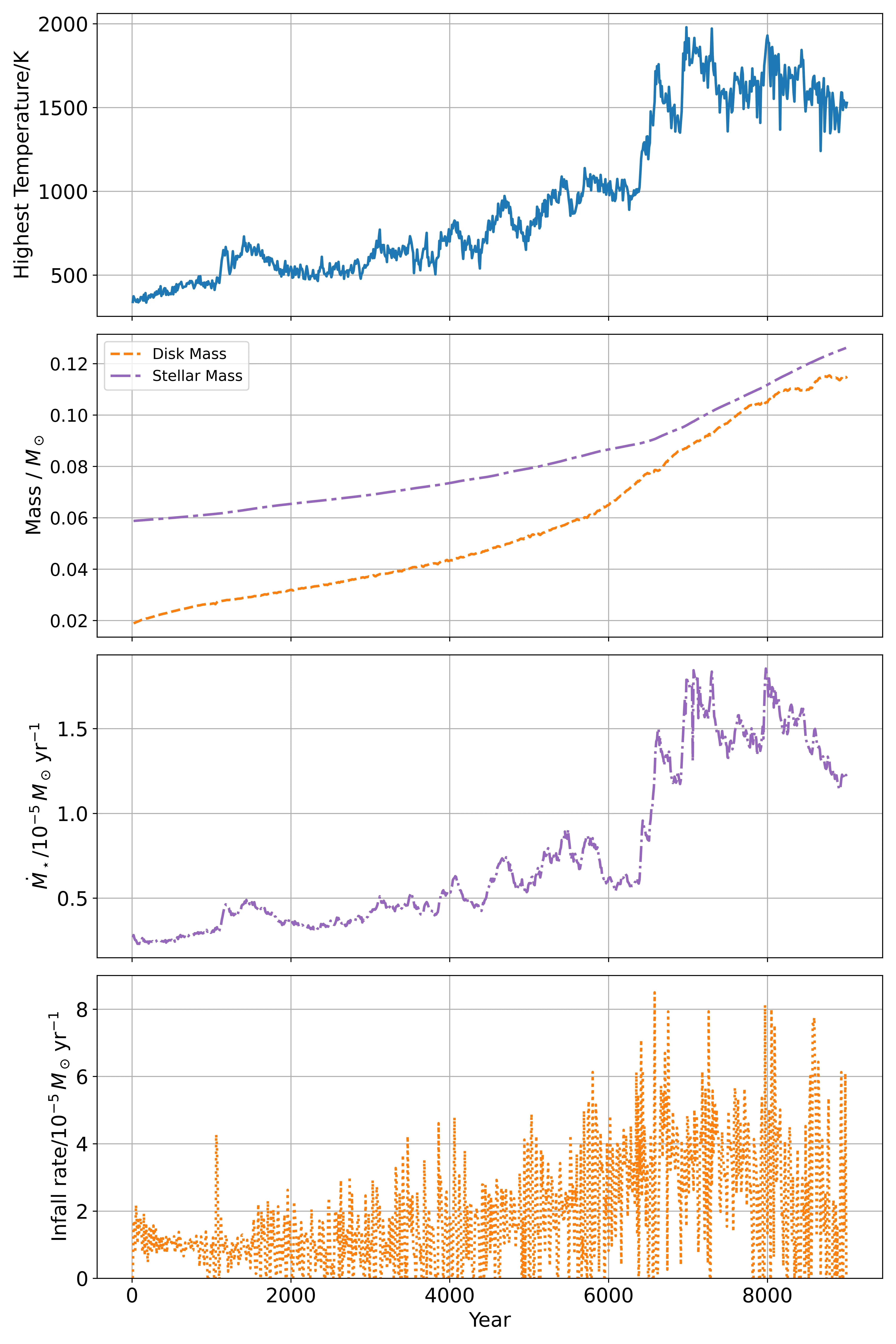
For a long time, it was believed that these particles are untouched witnesses of the very beginning. But a new study, based on computer simulations, paints a different picture. When a giant molecular cloud collapsed and gave birth to a star cluster, streams of gas and dust flowed toward the forming protostars. These streams, like celestial rivers, crashed into the stellar embryos. In high-resolution simulations, you can see the disk around a young star begin to warp and ripple with spiral waves — much like water in a cup when you give it a sharp nudge.
Then, as it cooled, new solid particles were born from this gas. It turns out that the CAIs found in meteorites today are not pristine at all. They are "remelted" relics that preserved the memory only of the last major episode of matter falling onto the disk. The most interesting part is that this entire cycle (vaporization, mixing, new condensation) fit into just 100,000 years. By cosmic standards, that's an instant. So meteorites tell us not about a calm dawn of the Solar System, but about its turbulent, fiery youth.
The vaporization temperature of CAIs is roughly twice that of a blast furnace — about 1700°C. For comparison, lava from a volcano is already "liquid" at 1200°C.