Quasi-Stars: Black Holes Inside Giant Stars express
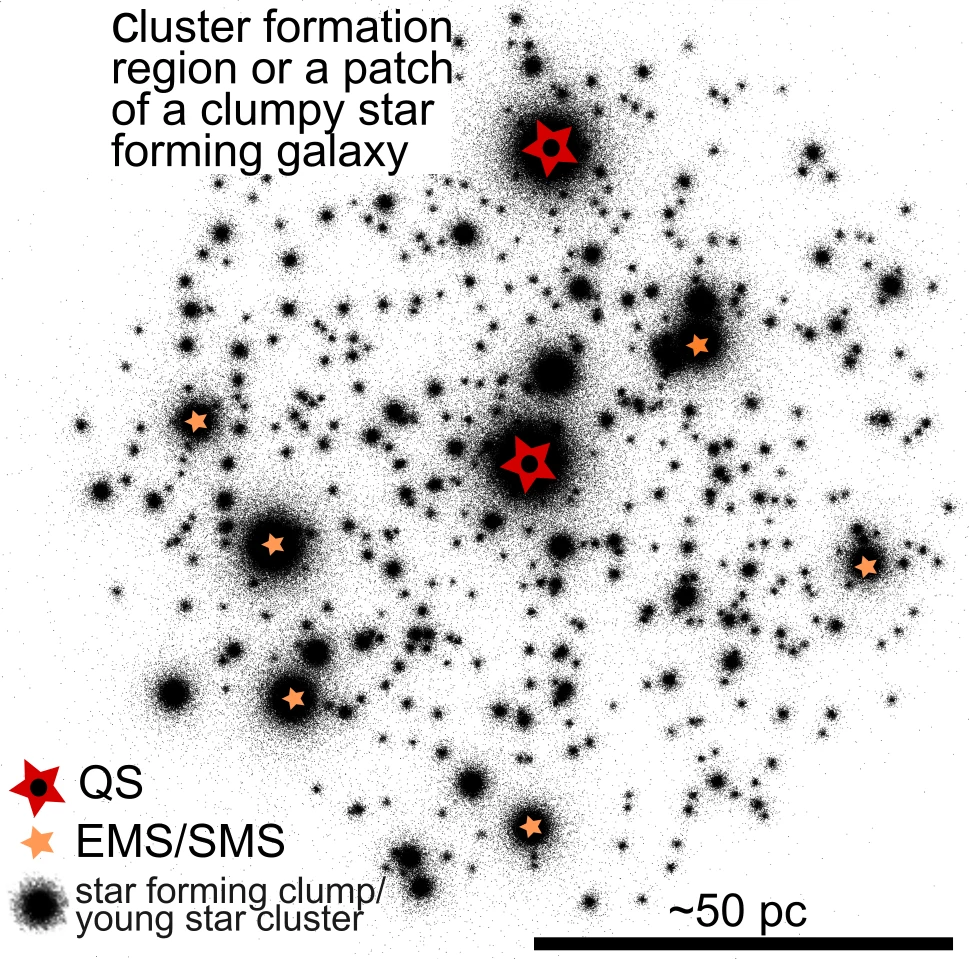
In the early Universe, star clusters were so dense that they gave birth to giants the size of the Solar System. If such a giant had taken the place of the Sun, its edge would have reached as far as Jupiter. These stars sometimes swallowed small black holes. The black hole would sink into the core and begin to grow, turning the star into a ghostly glow — a quasi-star. Here's a surprising paradox: a quasi-star weighs as much as ten thousand Suns, yet its outer layers are so thin that it's almost transparent.
Such a cosmic ghost can live for hundreds of thousands of years, until the black hole inside gains colossal mass. These rare objects explain the mysterious red dots that the James Webb Space Telescope has found in distant galaxies. And if several black holes fall into the same star, their merger creates gravitational waves — ripples in spacetime, detected by instruments on Earth. Thus, the ancient light of ghost stars reveals the secrets of the birth of supermassive black holes.
Original abstract
as written by the authors arXiv:2604.22924
Numerical simulations have established that star clusters with densities comparable to the high redshift ($$z>6$$-$$10$$) James Webb Space Telescope (JWST) proto globular clusters may build up extremely massive (EMSs; $$m_\mathrm{\star}>1000 M_\odot$$) or even supermassive stars (SMSs; $$m_\mathrm{\star}>10000 M_\odot$$) and potentially intermediate mass black holes (IMBHs) through runaway stellar collisions. Using direct simulations of assembling star clusters including post-Newtonian black hole dynamics and stellar evolution, we demonstrate that in such dense environments ($$\Sigma_\mathrm{h} \gtrsim 10^6 M_\odot$$pc$$^\mathrm{-2}$$) stellar BHs ($$m_\bullet \lesssim 60 M_\odot$$), driven by rapid mass segregation and relaxation effects within the sphere of influence of the EMSs/SMSs, may strongly interact with the extremely massive stars and become embedded within their gaseous layers. We suggest that this quasi-star (QS) like embedded BH phase is a natural outcome of the runaway formation of EMSs/SMSs in the densest star clusters. The QS phase is orders of magnitude longer in duration than the lifetime of the SMS, enabling an extended growth period by stellar collisions, and allows the formation of embedded gravitational wave sources if the QS captures more than a single stellar BH. The star cluster assembly region sizes ($$\sim100$$ pc), QS masses ($$\gtrsim 10^4 M_\odot$$) and their proximity to young, massive blue star forming clumps are consistent with the faint population of multiple little red dots (LRDs) recently discovered by the JWST.
A quasi-star weighs as much as 10,000 Suns, but its outer layers are so thin that it's almost transparent — a true cosmic ghost.